
Teams replace Google reCAPTCHA for different reasons: visible challenges interrupt signup, privacy reviews question third-party data flows, or a simple widget does not match the risk in a login or checkout journey. The best option depends on your traffic, users, architecture, and response model. This shortlist compares eight alternatives by control layer, user experience, privacy, deployment, and operating fit. It is a use-case guide, not a universal vendor ranking. For a product-focused starting point, see this reCAPTCHA alternative overview, then validate the shortlist against your own flows.
How We Evaluated the Best reCAPTCHA Alternatives
1. The criteria behind each best-for label
Each option is assessed across seven questions:
- What is the security model? Does it use browser signals, a human challenge, proof-of-work, a WAF rule, adaptive risk, or a broader challenge service?
- How much friction reaches legitimate users? Review invisible coverage, fallback frequency, mobile behavior, localization, and accessible alternatives.
- What data and governance work is required? Check cookies, tracking, processing purposes, hosting regions, retention, DPA terms, and internal privacy review.
- How will it be deployed? Confirm JavaScript, API, SDK, server-side verification, framework, CDN, WAF, and mobile support.
- Who operates the control? A managed service can reduce maintenance; a self-hosted option gives control but shifts monitoring, abuse tuning, and incident response to your team.
- What does it cost at your volume? Free tiers, quotas, paid plans, infrastructure, and support terms change. Verify current documentation rather than relying on a static comparison.
- What problem is in scope? Form spam, automated registration, credential attacks, scraping, promotion abuse, and payment fraud are different problems.
These criteria follow the principle that a CAPTCHA is one possible response in a risk policy. It should not be treated as the entire bot-management or fraud program. The W3C accessibility guidance is a useful reference when testing visual, audio, cognitive, and motor barriers.
2. CAPTCHA versus broader bot and fraud controls
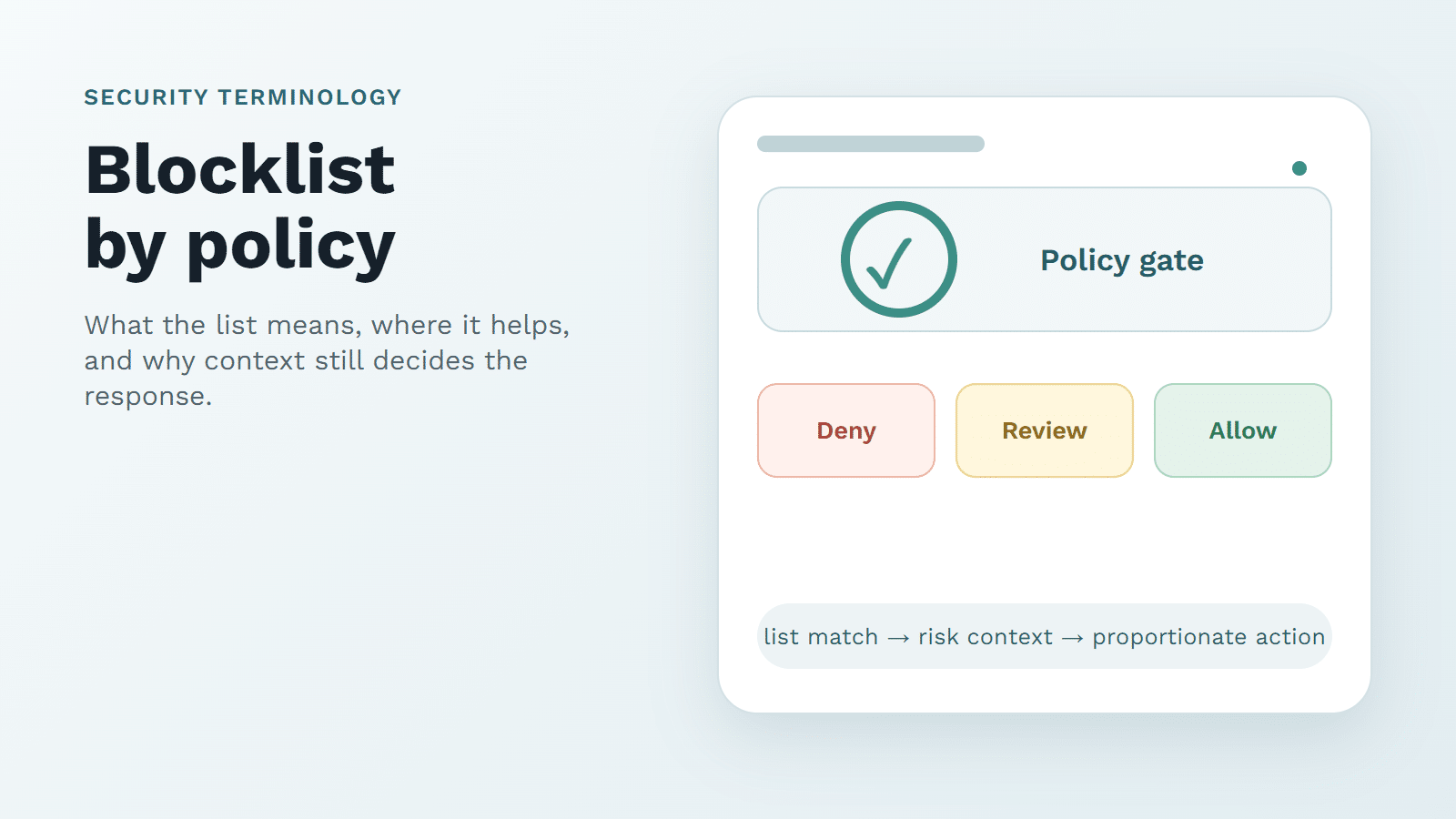
A verification widget answers a narrow question: should this interaction receive a human-verification step? A WAF can make an edge decision, device intelligence can add context, and a business rules layer can combine signals with account, IP, region, velocity, or transaction data. In practice, teams often combine controls: observe low-risk traffic, add a signal or step-up check as risk rises, and reserve a challenge or block for traffic that crosses a defined threshold.
Best reCAPTCHA Alternatives at a Glance
The table is a starting shortlist. Product names, quotas, prices, regional availability, and privacy terms are time-sensitive and should be checked on official documentation before procurement.
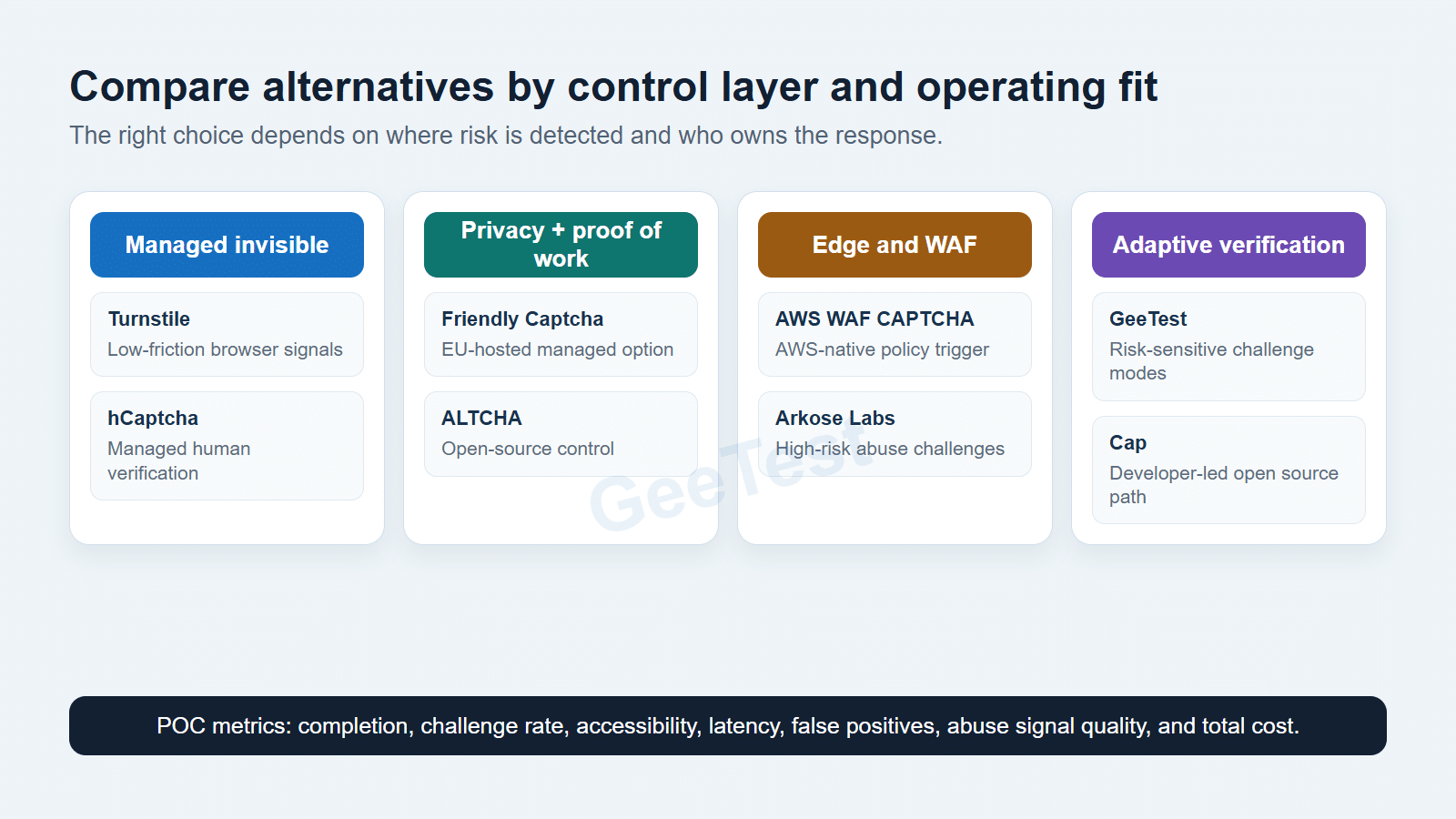
| Tool | Best for | Security/control model | Deployment and ownership | Main caveat |
|---|---|---|---|---|
| Cloudflare Turnstile | Free, low-friction web verification | Browser signals with managed fallback | Managed JavaScript and server verification | Cloudflare dependency and changing terms |
| hCaptcha | Privacy-oriented managed CAPTCHA | Human-verification challenges | Managed widget/API | Some users still receive puzzles; plan limits apply |
| Friendly Captcha | EU privacy and proof-of-work goals | Proof-of-work | Managed service | Subscription and client-resource tradeoffs |
| ALTCHA | Open-source or self-hosted control | Proof-of-work | Team-operated deployment | Scaling, abuse tuning, and support are yours |
| GeeTest Adaptive CAPTCHA | Adaptive enterprise web journeys | Risk fusion and adaptive challenge modes | Managed SDK/API with POC | Not a WAF, AML/KYC, or payment-fraud suite |
| AWS WAF CAPTCHA | AWS-native edge controls | WAF-triggered challenge | AWS-managed and architecture-bound | AWS coupling and UX must be tested |
| Cap | Developer-led open-source path | Open-source CAPTCHA service/widget | Self-hosted or selected service | Maturity and production support require diligence |
| Arkose Labs Funcaptcha | High-risk abuse challenges | Challenge and risk orchestration | Enterprise integration | Complexity and commercial cost may be high |
Managed and Privacy-Focused Alternatives
1. Cloudflare Turnstile: Best Free, Frictionless Starting Point

Turnstile is a sensible first test for teams that want a managed web widget with minimal visible interaction. Its positioning centers on assessing browser and interaction signals in the background and presenting a challenge only when the service determines that additional verification is needed. That makes it a natural candidate for contact forms, newsletter signup, account registration, and other journeys where abandonment matters.
The buyer questions are architectural rather than purely visual. Confirm how tokens are verified on the server, how the service fits your CDN and origin model, how fallback challenges behave on mobile and assistive technology, and what data-processing terms apply to your regions. “Free” should be treated as a plan attribute, not a permanent procurement assumption. Turnstile is less compelling when your team needs vendor-neutral orchestration across several signals or wants to operate the entire control plane outside a single edge provider.
2. hCaptcha: Best Privacy-Oriented Managed CAPTCHA

hCaptcha fits teams that prefer a dedicated human-verification provider and want to compare privacy positioning, challenge design, and pricing against Google’s model. It can be appropriate for forms, registration, and abuse-heavy endpoints where a visible or audio challenge is an acceptable step-up action. Review its server-side verification flow, accessibility options, regional processing terms, and expected challenge rate with real users.
Its main tradeoff is familiar to CAPTCHA buyers: a managed challenge can still interrupt legitimate users, especially on high-risk traffic or constrained devices. Free or entry plans may have volume and feature boundaries, so confirm current terms. If the problem is account takeover or automated promotion abuse rather than simple form spam, pair the challenge with rate controls, account signals, and a review path.
3. Friendly Captcha: Best EU-Hosted Proof-of-Work Service

Friendly Captcha is aimed at organizations that want a managed, privacy-oriented alternative built around proof-of-work rather than a traditional image puzzle. The model can reduce the need for users to identify distorted objects, which is attractive for accessibility and conversion reviews. It is worth testing when EU hosting, data minimization, and a managed operating model are important requirements.
Proof-of-work moves some computation to the client. That creates a different set of questions: how does it behave on low-powered phones, older browsers, battery-constrained devices, and high-volume pages? Confirm the service plan, regional availability, accessibility behavior, and documentation for server verification. Do not equate a privacy-oriented design with automatic legal compliance; your data flows and contractual controls still need review.
Open-Source and Self-Hosted Options
4. ALTCHA: Best Open-Source or Self-Hosted Option
ALTCHA is a strong candidate for teams that want source-level control and a proof-of-work approach without depending on a large advertising or identity ecosystem. Self-hosting can simplify certain data-boundary conversations and lets an engineering team decide how the challenge is integrated into forms and APIs.
The ownership tradeoff is significant. Your team must manage scaling, key and endpoint protection, challenge difficulty, abuse monitoring, accessibility testing, upgrades, incident response, and support. Open source is a governance and deployment choice, not a security guarantee. Before production, test replay resistance, workload cost, browser compatibility, and what happens when an attacker changes volume or automation tactics.
5. Cap: Best for a Developer-Led Open-Source Path
Cap belongs on a technical evaluation list when developers want to explore an open-source CAPTCHA path with control over hosting and integration. It may suit a product team that can own the service lifecycle and wants to avoid a tightly coupled enterprise provider during early experimentation.
Treat maturity and operations as first-class criteria. Confirm release cadence, maintainer responsiveness, deployment guidance, abuse reporting, accessibility behavior, observability, and production support before using it on a revenue-critical journey. A self-managed widget can be a useful component, but it will not by itself provide account intelligence, WAF coverage, fraud analytics, or a policy team.
Adaptive and Enterprise-Focused Alternatives
6. GeeTest Adaptive CAPTCHA: Best Adaptive Enterprise Verification Option

GeeTest Adaptive CAPTCHA is designed for teams that need verification to respond to changing risk rather than show the same puzzle to every visitor. Its supported operating concepts include intelligent verification, where suitable challenge types can be selected from risk signals; risk fusion, where the customer’s own logic can influence the challenge decision; and an invisible probe mode for scenarios where background assessment is appropriate. The right mode depends on the journey and policy, so a proof of concept should test registration, login, recovery, SMS, promotion, and other high-risk actions separately.
The product supports multiple verification forms, voice verification, and interface customization for different languages and user contexts. These features can help a security team balance protection with completion, but they should be evaluated with real accessibility feedback and false-positive measurement. Learn more about GeeTest Adaptive CAPTCHA as a capability reference.
GeeTest is not a complete WAF, AML/KYC, payment-fraud, or case-management platform. It is a verification layer that can work alongside device and business-risk signals. Confirm data deployment, API behavior, service coverage, support model, and measurable outcomes in a POC rather than assuming that adaptive means zero friction or universal detection.
7. AWS WAF CAPTCHA: Best for AWS-Native Web Controls
AWS WAF CAPTCHA is a practical option when your security team already manages edge rules, protected resources, and monitoring in AWS. A WAF rule can trigger a challenge for traffic that matches a defined condition, keeping the control close to the edge and reducing the need to introduce another standalone widget.
The tradeoff is architectural fit. AWS WAF CAPTCHA does not automatically define your identity, account, or transaction-risk policy. Review how tokens, logs, exceptions, localization, and accessible alternatives work across your applications. It may be a strong edge control for a known rule, but a less complete answer for coordinated abuse across accounts, devices, promotions, and APIs.
8. Arkose Labs Funcaptcha: Best for High-Risk Abuse Challenges
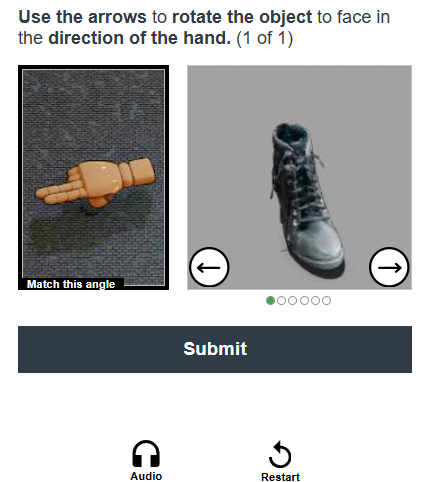
Arkose Labs is relevant to organizations that face high-value automated abuse and are prepared to operate an enterprise challenge and risk program. It belongs in a shortlist when promotion abuse, account attacks, or other adversarial traffic justifies a more specialized service and a dedicated integration project.
This is a heavier category than a drop-in form widget. Assess challenge accessibility, user impact, implementation effort, support coverage, pricing, regional behavior, and how decisions connect to your existing identity and fraud stack. It can be disproportionate for a low-risk contact form, while a simple invisible widget may be insufficient for a coordinated, high-impact attack.
How to Choose the Right reCAPTCHA Alternative
1. Map the journey before choosing the widget
List every place where automation creates measurable harm: contact forms, registration, login, password recovery, SMS delivery, downloads, checkout, promotions, APIs, and scraping-sensitive pages. Assign each journey an abuse impact, an acceptable friction budget, an accessibility requirement, and an owner for the response. This prevents a low-risk form decision from being copied into a high-risk account flow.
2. Choose the least-friction proportionate action
Use a graduated policy. Observe or allow low-risk traffic. Add device, browser, behavior, account, or velocity signals when uncertainty rises. Use a step-up check or challenge when the expected abuse cost justifies it. Block or send to review only when the evidence and business policy support that action. The NIST Digital Identity Guidelines provide useful context for proportionate assurance and risk decisions. A challenge is one response, not the entire decision system.
3. Run a measured proof of concept
Set a baseline before switching providers. Measure completion rate, challenge rate, accessibility feedback, latency, false positives, abuse-signal quality, support response, and total cost by journey and device type. Define rollback criteria and a review cadence. Ask each vendor to show how you can export decisions, tune policies, investigate spikes, and preserve a safe path for legitimate users.
Final Takeaway: Pick the Control Layer That Matches Your Risk
Cloudflare Turnstile is a practical low-friction starting point; hCaptcha and Friendly Captcha are useful privacy-oriented comparisons; ALTCHA and Cap provide more operating control; AWS WAF fits an AWS edge model; and Arkose Labs targets high-risk abuse.
GeeTest Adaptive CAPTCHA belongs in the enterprise evaluation when risk-sensitive verification, multiple challenge forms, and customer-side policy context matter. The strongest choice is the one that meets your security, privacy, accessibility, deployment, and operating requirements in a measured POC.
Frequently Asked Questions
1. What is the best reCAPTCHA alternative?
There is no universal winner. Turnstile is often evaluated for low-friction managed verification, hCaptcha for a privacy-oriented managed challenge, proof-of-work tools for privacy and control, AWS WAF for AWS-native rules, and adaptive services for risk-sensitive enterprise journeys. Compare them against your users, traffic, architecture, and response ownership.
2. What is the best free reCAPTCHA alternative?
Cloudflare Turnstile is a common starting point for teams seeking a free, managed web option, while other providers may offer free or trial tiers. Limits, eligibility, quotas, and terms change. Confirm current pricing and processing conditions in the provider’s official documentation before treating a free tier as a long-term plan.
3. Which is better, hCaptcha or reCAPTCHA?
The better choice depends on privacy requirements, challenge experience, accessibility, data handling, integration, and operating fit. hCaptcha may suit a team prioritizing a dedicated privacy-oriented provider, while reCAPTCHA may already fit an existing Google stack. Test both on representative journeys and compare challenge rates, completion, support, and governance requirements.
4. Can AI defeat reCAPTCHA or its alternatives?
Automated systems, solver services, and protocol abuse can pressure challenge mechanisms, and no single CAPTCHA should be treated as permanently unbreakable. Reduce exposure by combining verification with device, behavior, account, and velocity signals, then applying proportionate policy actions. This article intentionally does not provide evasion instructions.
5. Is bypassing CAPTCHA illegal?
Legality depends on jurisdiction, authorization, contract terms, system ownership, and purpose. Testing a system you do not own or have permission to assess can create legal and contractual risk. Obtain appropriate authorization and professional legal advice for a specific situation; this answer is general information, not legal advice.