
The best Cloudflare Turnstile alternative depends on the reason for switching: challenge control, privacy or hosting, support for high-risk journeys, or security signals beyond one verification event.
Six practical paths belong on the 2026 shortlist: Google reCAPTCHA, GeeTest Adaptive CAPTCHA, hCaptcha, Friendly Captcha, a self-hosted proof-of-work option such as ALTCHA or Cap, and a layered device-intelligence plus risk-based verification stack. They are not interchangeable. The right choice must fit your abuse pattern, legitimate users, data-governance rules, engineering capacity, and support needs.
This guide focuses on defensive human verification. For a wider market view, see our guide to CAPTCHA alternatives for bot protection.
Why Teams Look Beyond Cloudflare Turnstile
Cloudflare Turnstile is a managed verification service designed to reduce visible puzzles. It can be embedded on a website even when that site does not use Cloudflare’s CDN. That distinction matters: replacing Turnstile solely because you believe the entire site must run through Cloudflare starts from the wrong premise.

The more useful question is whether Cloudflare Turnstile’s operating model fits the application. Teams usually look beyond it for one or more clearly defined reasons:
- Security coverage: A team may need stronger interactive step-up options, richer decision signals, or defenses that connect activity across sessions, devices, accounts, and transactions. The replacement must address the actual abuse pattern rather than merely return another pass/fail token.
- Privacy and data governance: Security and legal teams may require a different data-processing model, clearer control over where verification data travels, or a self-hosted component they can inspect and operate. A privacy label is not enough; the deployed data flow, retention, contracts, and subprocessors still need review.
- Flexibility and challenge policy: Different journeys need different responses. A newsletter form may tolerate passive assessment, while login recovery, promotion redemption, or suspicious checkout may need configurable step-up challenges, multiple verification forms, and journey-specific thresholds.
- Enterprise service and operations: Procurement and security teams may need contracted support, regional service coverage, implementation guidance, incident escalation, reporting, and post-launch policy tuning. These requirements are separate from the widget’s user interface.
- User experience, accessibility, and regional resilience: Teams may need a better fit for their device mix, accessibility paths, browsers, networks, or geographic traffic. They should measure challenge exposure and legitimate completion by segment, not only as a global average.
No CAPTCHA or verification widget should be treated as a complete bot-management program. A token can show that a browser completed a check, but the application still has to validate that token on the server, bind it to the intended action where supported, enforce rate and account controls, and watch for distributed or low-and-slow abuse. The evolution of anti-bot solutions explains why modern defenses combine signals and responses instead of relying on one test.
How to Evaluate a Turnstile Alternative
Start with the protected journey, not a feature checklist. Login, account creation, password reset, checkout, promotions, comments, and API registration have different threat levels and different costs when a legitimate user is delayed.
Use five evaluation lenses:
- Security fit: Define the abuse you need to interrupt. Ask whether the service supports passive assessment, interactive step-up verification, configurable policies, and signals that help distinguish ordinary automation from higher-risk behavior.
- User experience and accessibility: Measure how often legitimate users see a task, how long they take, and whether keyboard, screen-reader, audio, or other accessible paths work. The W3C’s Inaccessibility of CAPTCHA note documents why visual and cognitive tests can create barriers. Challenge design matters; our CAPTCHA challenge guide covers the trade-offs.
- Privacy and data governance: Identify what data is processed, for which purpose, where it travels, how long it is retained, and which contracts apply. Article 5 of the EU General Data Protection Regulation provides principles such as purpose limitation and data minimization, but a product label alone does not establish compliance for your deployment.
- Deployment and operations: Review client and server integration, key rotation, token expiry and replay controls, observability, fail-open or fail-closed behavior, incident response, and rollback options. A self-hosted package transfers more responsibility to your team; a managed service transfers more availability and change risk to a vendor.
- Enterprise fit: Compare support coverage, regional performance, policy ownership, reporting, procurement requirements, and the effort needed to tune the control after launch.
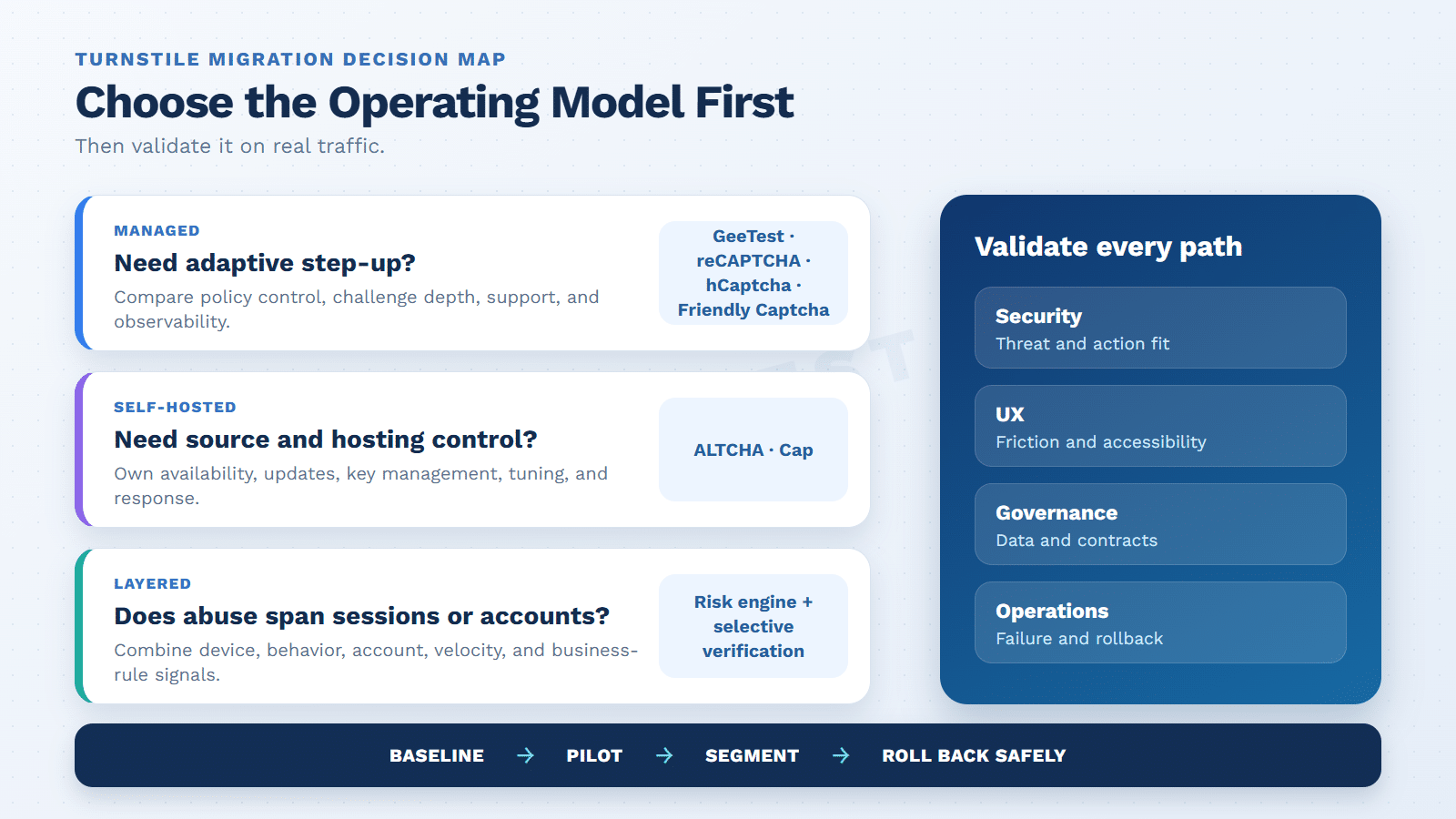
Choose the operating model first, then validate security, UX, governance, deployment, and support on real traffic.
6 Alternative Products and Architecture Paths Compared
| Option | Best-fit starting point | Interaction model | Operating model | Main question to validate |
|---|---|---|---|---|
| Google reCAPTCHA | Teams already aligned with Google’s ecosystem | Score-based and/or interactive challenge | Managed | Can your team govern thresholds, data flows, fallback, and false positives? |
| GeeTest Adaptive CAPTCHA | Enterprises needing configurable, adaptive verification | Background assessment through interactive step-up | Managed | Can policies reduce abuse without adding unnecessary friction to valuable journeys? |
| hCaptcha | Teams comparing a familiar challenge-led alternative | Passive or interactive, depending on product/configuration | Managed | Are challenge frequency, accessibility, privacy terms, and controls acceptable? |
| Friendly Captcha | Privacy-conscious, low-interaction use cases | Proof-of-work-oriented verification | Managed | Does it perform reliably across your actual devices, browsers, and regions? |
| ALTCHA or Cap | Teams prioritizing open-source and self-hosted control | Proof of work and related client signals | Self-hosted or self-operated | Can you own availability, updates, tuning, monitoring, and abuse response? |
| Device intelligence + risk verification | Cross-session, account, and transaction abuse | Background signals plus selective CAPTCHA or step-up | Composed stack | Can you combine signals and rules without turning fingerprinting into a binary identity claim? |
1. Google reCAPTCHA
Google reCAPTCHA is a familiar managed alternative with score-led and interactive challenge models, depending on version and tier. Treat any score as an input to documented thresholds, step-up actions, monitoring, and legitimate-user recovery. Review current service terms and deployment-specific data flows rather than relying on generic privacy claims.
Core advantage over Cloudflare Turnstile: reCAPTCHA offers a familiar choice between score-led decisions and interactive challenge models, which can fit teams already operating Google-aligned tooling and threshold workflows. Best fit: teams comfortable operating score or challenge policies within a Google-aligned environment. Validate: current pricing and limits, threshold stability, regional behavior, data governance, accessibility, and outage handling.

For a broader comparison around this product family, see our review of reCAPTCHA alternatives.
2. GeeTest Adaptive CAPTCHA
GeeTest Adaptive CAPTCHA combines behavioral analysis, environment detection, and interactive challenges. Intelligent Verification selects a response from risk signals, Risk Fusion lets enterprise logic influence the challenge path, and Invisible Probe supports background assessment for appropriate flows. These capabilities support different step-up responses across journeys without requiring the article to make a numerical cross-vendor performance claim.
Core advantage over Cloudflare Turnstile: GeeTest packages adaptive step-up logic, multiple interactive challenge formats, configurable verification strategies, and enterprise implementation and support options in one managed verification layer. Best fit: enterprises that want configurable human verification, varied step-up challenges, policy control, and vendor support across multiple risk journeys, subject to the contracted support scope. Validate: policy design, accessible alternatives, regional performance, reporting, support scope, and the effect on conversion. Boundary: Adaptive CAPTCHA verifies human interaction; it does not replace every device, account, rate-limit, or transaction-risk control.

3. hCaptcha
hCaptcha supports passive and interactive patterns, depending on configuration and service. Its visible challenges create a clear step-up moment, but frequency matters: an occasional administrator challenge may be unacceptable on consumer checkout. Segment completion by browser, region, network, and accessibility path because aggregate rates can hide concentrated failures.
Core advantage over Cloudflare Turnstile: hCaptcha provides a more explicit, challenge-led step-up path and an independent managed-vendor choice for teams that do not want to standardize on Cloudflare or Google. Best fit: teams that want a managed, challenge-capable alternative and are willing to evaluate challenge frequency carefully. Validate: accessible paths, puzzle burden, data terms, false-positive escalation, support, and segmented abandonment.

4. Friendly Captcha
Friendly Captcha uses a proof-of-work-oriented approach intended to minimize traditional image puzzles while remaining managed. Proof of work is not a guarantee of security or usability: test CPU and battery cost, older devices, privacy tools, unstable networks, client failure, and attackers distributing computation across many machines.
Core advantage over Cloudflare Turnstile: Friendly Captcha centers its operating model on low-interaction proof of work and privacy-focused deployment considerations, offering a distinct path for teams that want to minimize conventional visual challenges. Best fit: low-interaction use cases where privacy review and managed operations are important. Validate: device cost, browser coverage, regional latency, failure behavior, accessibility, and threat-model fit.
5. ALTCHA or Cap for Self-Hosted Proof of Work
ALTCHA and Cap are open-source, proof-of-work-based components that can support self-hosted deployments. That choice transfers capacity, monitoring, upgrades, key management, difficulty tuning, abuse research, and incident response to your team. Proof of work can raise automation cost, but does not automatically reveal coordinated account abuse or distributed compute.
Core advantage over Cloudflare Turnstile: ALTCHA and Cap give engineering teams direct control over source code, hosting, update timing, telemetry, and operational dependencies rather than relying entirely on a managed third-party gate. Best fit: engineering teams with a clear self-hosting requirement and the capacity to own a security-sensitive service. Validate: maintenance ownership, high-availability design, client resource use, replay resistance, telemetry, and emergency rollback.
6. Device Intelligence Plus Risk-Based Verification
Some teams need to detect credential stuffing, promotion abuse, account farming, or distributed automation that looks normal at one page view. A broader architecture combines device and browser signals, behavior, account history, velocity, and business rules, then invokes human verification only when risk justifies it.
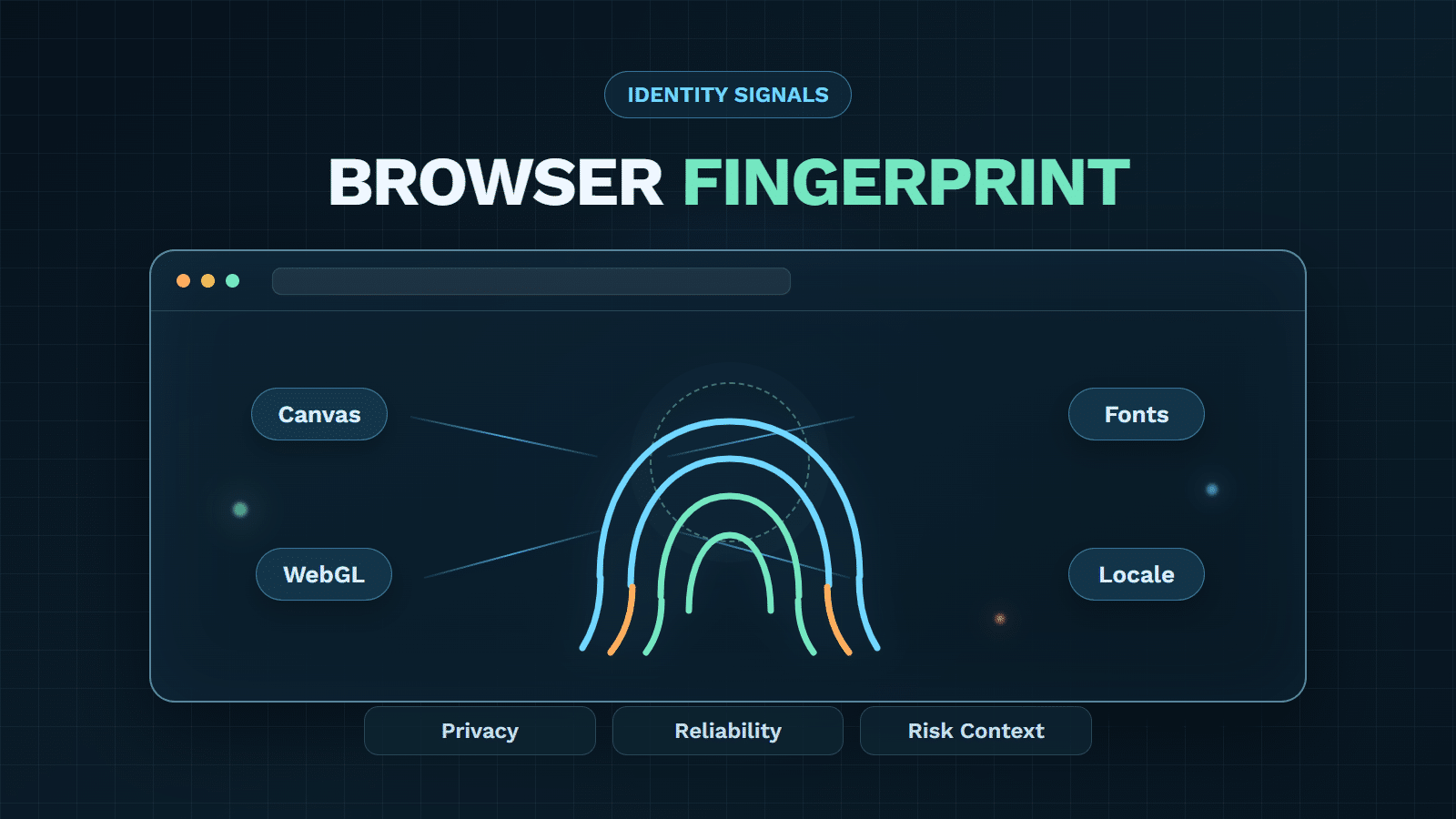
Browser fingerprinting can contribute a device signal, but it is neither certain identity nor a one-for-one replacement for human verification. Combine imperfect signals and apply proportionate responses.
Core advantage over Cloudflare Turnstile: a layered risk stack can correlate requests, sessions, devices, accounts, and transaction behavior, then orchestrate multiple responses—coverage that is intentionally broader than a single verification event. Best fit: enterprises facing abuse that spans requests, sessions, devices, accounts, or transactions. Validate: signal quality, privacy governance, explainability, false-positive review, rule ownership, and which events should trigger human verification.
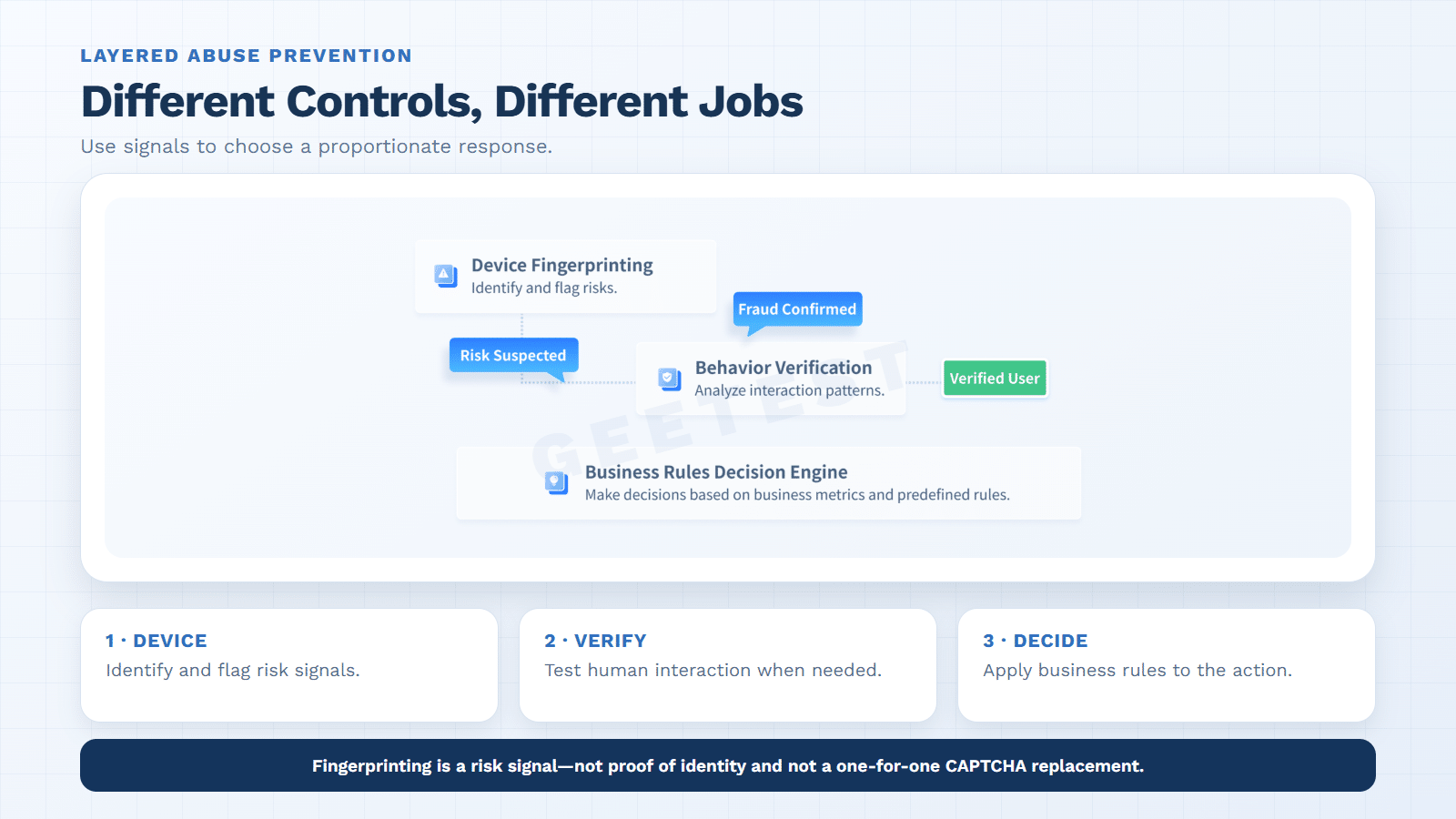
Device intelligence, behavior verification, and business rules have different jobs; combine them instead of asking one control to solve every risk.
Which Option Fits Each Enterprise Scenario?
Start with the capability the current deployment cannot provide, then define the evidence a replacement must produce. The scenario determines which layer changes and what the pilot must prove.
| Decision dimension | What to change | What to verify before migration |
|---|---|---|
| Security coverage | Move from a single verification event to stronger step-up challenges or a layered risk decision when abuse spans accounts, devices, sessions, or transactions. | Attack interruption, replay resistance, server-side validation, false positives, and whether high-risk actions receive a proportionate response. |
| Privacy and governance | Change the data-processing or hosting model when current flows, contracts, retention, or subprocessors do not fit internal policy. | A documented data-flow map, purpose and retention controls, regional handling, contract terms, and the operational cost of any self-hosted component. |
| Challenge flexibility | Replace one uniform response with journey-specific passive assessment, configurable thresholds, or interactive step-up forms. | Challenge rate and completion by journey, risk band, browser, device, accessibility path, and region—not only an aggregate pass rate. |
| Enterprise service | Add a provider and service model that can support implementation, policy tuning, incident escalation, reporting, and regional operations. | Contracted support scope, escalation time, change management, observability, reporting access, and ownership after launch. |
| User experience and accessibility | Reduce unnecessary challenge exposure while preserving a usable recovery path for users who cannot complete the default flow. | Legitimate-user completion, abandonment, latency, keyboard/screen-reader or alternative paths, and failure behavior on constrained devices and networks. |
| Deployment ownership | Choose deliberately between a managed dependency, self-hosted component, or composed risk stack. | Engineering workload, availability design, updates, key rotation, monitoring, rollback, fail-open/fail-closed policy, and total operating cost. |
Use passive assessment for low-risk forms, adaptive step-up for account recovery, and device or transaction signals for promotion abuse. Standardize measurement and server-side enforcement, not the response.
For teams evaluating adaptive step-up, multiple challenge forms, configurable policy, and enterprise support in one managed layer, GeeTest Adaptive CAPTCHA is a candidate for a controlled pilot. Confirm that fit against your traffic, accessibility needs, governance rules, and support contract; this is not a universal performance ranking.
Migration Checklist: Test Before You Switch
- Baseline the current deployment. Record challenge exposure, validation failures, legitimate completion, abandonment, abuse outcomes, latency, and key device or regional segments.
- Map the verification flow. Document client rendering, server validation, action binding, token lifetime, replay controls, errors, and monitoring. Never trust client-side success alone.
- Define success and guardrails. Set targets for abuse, accessibility, privacy, reliability, user impact, support, and operating workload—not only solve rate.
- Pilot bounded traffic. Start with one journey or traffic slice. Assign each request to one verifier; do not accept interchangeable provider tokens. Bind validation to hostname, action, and session where supported.
- Test attacks and failures. Exercise expired or reused tokens, automation, blocked scripts, privacy browsers, slow networks, timeouts, clock skew, and key rotation.
- Segment results. Review browser, device, geography, network, accessibility path, user history, and risk band; averages can conceal local failures.
- Prepare fallback and rollback. Define behavior during slowdown or outage without creating a high-risk fail-open or permanent legitimate-user lockout.
- Complete governance review. Confirm data flows, retention, subprocessors, incident contacts, accessibility evidence, contracts, and escalation paths.
Run the pilot long enough to include ordinary traffic cycles and likely attack variation. A clean test on developer traffic is integration evidence, not production security evidence.
Final Decision: Choosing the Right Enterprise Fit
Prioritize GeeTest Adaptive CAPTCHA when switching requires configurable step-up, challenge variety, policy control, and enterprise support. reCAPTCHA fits Google-aligned teams; hCaptcha offers managed challenges; Friendly Captcha emphasizes low-interaction proof of work; ALTCHA and Cap prioritize self-hosting; and a risk stack covers abuse beyond one CAPTCHA.
Choose through a controlled comparison on your traffic. Match verification to the journey, validate server-side controls, measure legitimate-user impact, and keep layered defenses around the CAPTCHA. For adaptive human verification and configurable enterprise deployment, request a GeeTest Adaptive CAPTCHA pilot.
FAQs
1. Is Cloudflare Turnstile tied to the Cloudflare CDN?
No. A site can embed Turnstile without routing traffic through Cloudflare’s CDN. It remains a managed dependency, so review client loading, server validation, availability, telemetry, policy, and support.
2. What is the best free or open-source Turnstile alternative?
ALTCHA and Cap are open-source, proof-of-work-oriented examples to evaluate. “Free” does not mean zero cost: self-hosting requires infrastructure, maintenance, monitoring, security updates, tuning, and incident response. Test client resource use and replay resistance before production use.
3. Is reCAPTCHA better than Turnstile?
Neither is universally better. reCAPTCHA may fit a Google-aligned stack and offers score or challenge models, while Turnstile emphasizes low visible friction. Compare current terms, data flows, thresholds, accessibility, regional behavior, operational controls, and failure handling on the protected journey.
4. Can device fingerprinting replace Turnstile?
Not by itself. Device fingerprinting provides a risk signal; it does not prove that a user is human. It works best alongside behavioral context, account and transaction signals, business rules, and selective human verification.
5. How should an enterprise migrate from Turnstile?
Baseline the current flow, define measurable security and UX goals, implement server-side validation, pilot the alternative on bounded traffic, test failure and attack cases, segment results, complete governance review, and keep a rollback path until the new system is stable.