

Device intelligence helps fraud teams turn device identity, environment, behavior, and history into a decision about an online event. The output is not a magic label that says “good user” or “bad user.” It is evidence with a confidence level that can support an action such as allow, monitor, challenge, review, rate-limit, or deny.
That distinction separates device intelligence from a narrow device fingerprint. A fingerprint may help recognize a browser or app environment. Device intelligence asks what that evidence means in context: Is this a new device for a valuable account? Does the environment look automated? Has the same device appeared across many accounts, payment attempts, or recovery events? What response is proportionate to the risk?
Teams searching for what is device fingerprinting can use this guide to take the next step: connect device evidence to fraud policy without treating one signal as a verdict.
Key takeaway: Device intelligence is a decision-support layer. It combines identity and context signals, applies business policy, and routes each event to a measured response.
What Device Intelligence Adds Beyond Fingerprinting
Device fingerprinting focuses on attributes that help distinguish one browser, app, or device environment from another. Device intelligence keeps that identity signal but adds context and history around it.
The distinction is easiest to see as a chain:
- Identity: attributes and relationships suggest that two events may come from the same environment.
- Evidence: environment, network, behavior, account, and transaction details add supporting or conflicting signals.
- Decision: a policy evaluates confidence, business value, and the cost of being wrong.
- Response: the system allows, observes, slows, challenges, routes to review, or denies.
- Review: analysts measure outcomes, tune rules, and provide a recovery path for legitimate users.
A device ID alone cannot tell you whether an account takeover is happening. A familiar device can be compromised, while a new device can belong to a legitimate customer. Device intelligence is useful because it keeps those facts separate and gives the decision layer more context to work with.
This broader view also helps with attribution. Security teams can ask whether several events share an environment, whether the relationship is recent or persistent, and whether the pattern crosses accounts, merchants, or journeys. Product teams can then choose a response that matches the harm: a quiet log for a low-impact anomaly, a step-up for a sensitive change, or a review hold for coordinated abuse. Attribution is useful when it improves a decision; it is not a license to infer a person’s identity from a device.
How Device Signals Become a Risk Decision
The practical question is not how many signals a platform collects. It is whether analysts can understand which evidence influenced an action and change the policy when conditions change.
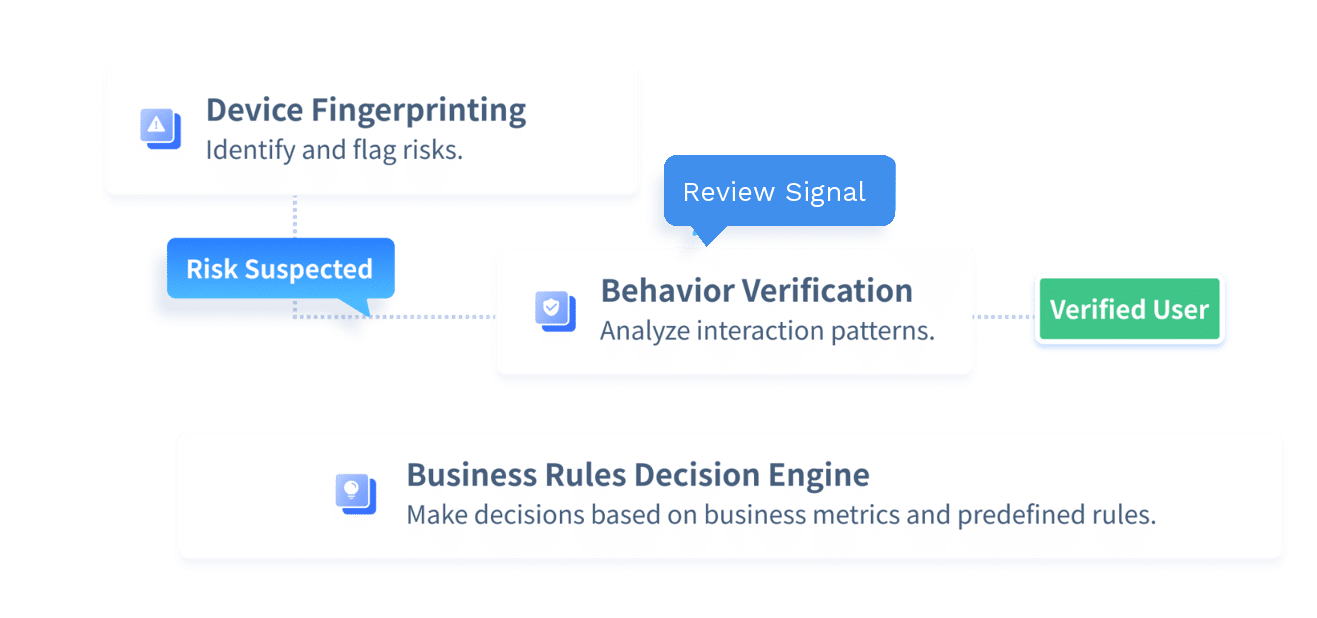
Useful evidence can include device and browser attributes, app or emulator indicators, network context, velocity, account history, authentication events, and transaction relationships. Each signal has limitations. Client properties can be changed, privacy controls can reduce persistence, and shared devices can connect multiple legitimate people.
NIST’s Digital Identity Guidelines make an important boundary explicit: risk indicators can inform context, but they are not a substitute for an authentication factor. In the same way, a device signal should inform a fraud policy without silently becoming an identity proof.
GeeTest Device Fingerprinting can be treated as the identity-and-signal layer in this model. The Business Rules Engine can orchestrate conditions and actions. Adaptive CAPTCHA can be used as a selective step-up when a human-verification challenge is appropriate. These roles work together, but they should remain operationally distinct.
The evidence pipeline also needs a clear time dimension. A signal that was useful during a login attempt may be less useful at checkout several hours later. Store event timestamps, policy versions, and the reason codes used for the action so that investigators can reconstruct what the system knew at the time. This makes tuning safer and gives support teams a fact pattern they can explain to a customer.
Avoid collapsing every relationship into a permanent reputation score. A device used by a family, a call center, a university lab, or a corporate fleet can legitimately connect many accounts. Retention windows, confidence decay, and journey-specific policies help prevent yesterday’s unusual event from becoming an indefinite penalty.
Where Device Intelligence Changes the Fraud Journey
Device intelligence is most useful when it changes a concrete journey rather than producing a dashboard that nobody acts on.
| Journey | Evidence to examine | Proportionate response |
|---|---|---|
| Login and account recovery | New device, recovery change, credential risk, location or network shift | Step up, hold recovery, or send to review; avoid blocking solely on “new device” |
| Registration and promotion | Repeated device relationships, velocity, environment anomalies, offer history | Rate-limit, request additional verification, or review linked activity |
| Checkout and payment | Device-account graph, transaction velocity, payment context, session behavior | Allow low-risk orders, step up ambiguous orders, hold high-risk orders |
| API and bot-sensitive flows | Automation indicators, request patterns, token use, device consistency | Throttle, challenge, or route traffic to a stricter policy |
For credential stuffing, OWASP’s Credential Stuffing Prevention Cheat Sheet describes device fingerprinting as one signal that can help trigger additional authentication. It also warns that client attributes can be spoofed. That is why a “new device equals deny” rule is usually too blunt for a customer-facing flow.
Well-governed deployments connect device evidence to recovery and appeals. A customer who is traveling, reinstalling an app, using a managed corporate device, or sharing a household network may look unusual without being malicious. The policy should make it possible to ask for more proof, pause a sensitive action, and restore access after review.
How to Build a Trustworthy Device-Risk Policy
Start with the harm you are trying to reduce. Account takeover, fake accounts, bonus abuse, scraping, and payment fraud have different signals, owners, and acceptable friction. Define the event, the evidence available before the decision, and the business cost of a false positive.
Then set confidence bands instead of one binary verdict:
| Confidence and context | Example action | Operational guardrail |
|---|---|---|
| Low concern, consistent history | Allow and log | Sample outcomes and watch drift |
| Ambiguous change or moderate velocity | Monitor, rate-limit, or step up | Offer a recovery path and measure completion |
| Strong coordinated evidence | Hold or route to review | Require reason codes and analyst visibility |
| High confidence of abuse with material harm | Deny or contain | Log the rule, preserve appeal handling, and review false positives |
Keep the policy explainable. Analysts should be able to see whether the decision was influenced by a device relationship, emulator signal, velocity threshold, account history, or a combination. Avoid presenting a risk label as a factual statement about a person. It is a system or model output that needs monitoring.
Governance should cover change management too. Record who approved a rule, what evidence justified it, which cohort was tested, and when it should expire. Review thresholds after major browser, app, payment, or promotion changes. A temporary rule for a campaign or attack wave should not become a hidden permanent policy simply because nobody revisited it. This record makes later audits faster because each decision can be traced to its evidence, owner, and review date.
Finally, review privacy and retention. Collect only what the use case needs, document who can access the evidence, and define how long it is retained. A device-intelligence program needs security, product, privacy, and support ownership, not just an SDK owner.
What to Evaluate in a Device Intelligence Solution
Ask vendors for evidence that maps to your protected journey:
- Coverage: web, mobile, app reinstall, managed devices, and the specific browsers or SDKs you operate.
- Signal transparency: reason codes, confidence indicators, relationship views, and exportable decision logs.
- Resilience: behavior after browser updates, storage clearing, network changes, emulation, and common evasion attempts.
- Policy control: ability to combine device signals with account, network, behavioral, and transaction rules.
- Response options: allow, monitor, rate-limit, review, step-up, and deny actions with recovery support.
- Privacy operations: data minimization, retention controls, access controls, and documentation for legal review.
- Reliability: latency, failure handling, SDK updates, observability, and a clear owner for incidents.
Run a pilot with labeled cohorts rather than accepting a headline accuracy number. Measure false joins, false splits, challenge completion, review workload, blocked-abuse yield, latency, and recovery success. Compare those measures with a baseline and segment by platform, geography, journey, and risk tier. A result that looks strong in login may not transfer to promotion abuse or checkout.
Include operational failure in the pilot design. What happens if the SDK does not load, the API times out, a browser blocks a client signal, or a rules service is temporarily unavailable? Decide whether the fallback is allow, monitor, challenge, or queue for review for each journey. Document the owner who can change that fallback and the alert that should fire. A resilient policy is explicit about degraded mode instead of letting an outage silently become a blanket block.
Review the human workflow as well as the model output. Analysts need a queue that groups related events without exposing more personal data than necessary. Support agents need a safe way to explain a step-up and recover an account. Product teams need to see whether added friction is concentrated in a particular browser, country, or customer segment. These feedback loops turn device intelligence into a governed service rather than an opaque score.
Turn Device Evidence Into Measured Decisions
Device intelligence earns its place when it improves a decision that the business already owns. Start with one journey, define the harm and the recovery path, and connect identity evidence to a policy that can be tuned. Use Device Fingerprinting for device signals, the Business Rules Engine for decision orchestration, and Adaptive CAPTCHA only where a selective step-up adds value.
The operating loop should be explicit: collect evidence, make a proportionate decision, observe the result, and review the policy. That loop reduces the temptation to treat one unfamiliar device as proof of fraud or one successful challenge as proof of trust.
If your team is comparing control layers, review the Business Rules Engine and fraud detection resources alongside the device signal layer. The goal is a coordinated control system that protects high-risk journeys while keeping legitimate users moving.
Frequently Asked Questions
1. Is device intelligence the same as device fingerprinting?
No. Device fingerprinting helps create an identity or relationship signal. Device intelligence adds environment, behavior, account, network, and historical context, then connects that evidence to a policy and response.
2. Can device intelligence stop all fraud?
No. Device attributes, identifiers, or fingerprints can be shared, reset, emulated, or spoofed, and legitimate activity can look unusual. Device intelligence should be combined with other signals and reviewed against outcomes.
3. Should every new device be challenged?
Not necessarily. A new device is a reason to examine context, not an automatic verdict. Consider account value, recovery activity, behavior, network context, and the user’s available recovery path before escalating.
4. Does device intelligence replace authentication?
No. As NIST guidance explains, risk indicators provide context and do not replace authentication factors. Use step-up authentication or verification when the policy requires stronger evidence.
5. How should a team start a pilot?
Choose one fraud journey, define labeled cohorts and a baseline, agree on false-positive and recovery measures, and assign owners for policy tuning, privacy review, support, and incident response. Expand only after the first journey produces decision-quality evidence.