1. What is the Honeypot Method?
Honeypots use hidden traps to detect simple automated behavior and are most effective as low-friction filters for basic spam.
2. Advantages and Limitations of Honeypot Techniques
Honeypots are easy to deploy and invisible to users, but they offer limited protection against sophisticated bots and may create accessibility issues.
3. What is CAPTCHA?
CAPTCHA determines whether a request is human-driven through interaction analysis or challenges, making it suitable for more advanced and varied bot attacks.
4. Advantages and Limitations of CAPTCHA
CAPTCHA covers a broader range of attack types, but poorly designed or outdated versions can reduce usability and may still be bypassed by advanced automation.
5. How do Honeypots and CAPTCHA compare?
Honeypots prioritize simplicity and zero friction, while CAPTCHAs focus on interception strength and risk-based adaptive verification.
6. How Can Honeypot and CAPTCHA Work Together?
Embedding honeypot-style signals into CAPTCHA workflows allows invisible traps and adaptive challenges to complement each other, enhancing detection without disrupting legitimate users.
What is the Honeypot Method?
Honeypot acts as a decoy to detect, deflect and study the suspicious use of internet systems. It allows attackers to exploit certain vulnerabilities of a computer system that regular users are unable to discover in order to trap attackers and distinguish them from legitimate users.
When it comes to spam protection, a honeypot is often seen in the form of hidden fields. Spambots are a type of malicious computer program that sends spam messages and disinformation over the Internet, like social media platforms, where they‘re disguised as human users. That‘s where honeypot traps come into use.
Web developers embed hidden fields inside forms, like comment sections and posting areas, therefore forms with hidden fields that become invisible to regular users are frequently referred to as the honeypot strategy. Bots, on the other hand, can detect and interact with these fields, while an ordinary user cannot interact with the forms, so it becomes alert to the site owner saying that there is a presence of a bot. Once identified, bots can be either stopped or fed with fake data.
Advantages of Honeypot Techniques
- Invisible to legitimate users and does not interrupt normal interaction.
- Requires minimal development effort to deploy.
- Does not rely on collecting user data, supporting privacy-friendly designs.
Limitations of Honeypot Techniques
- Stops only basic automation and offers little resistance to advanced bots.
- Easily bypassed once the trap is identified in page structure.
- May trigger false positives for users relying on assistive technologies.
What is CAPTCHA?
CAPTCHA was born to protect people from malicious bots on the internet. It distinguishes if the request is submitted by a real person or an automated bot by presenting a challenge that only humans can solve.
Websites and mobile apps implement CAPTCHA to prevent not only spammers but other common bot attacks, such as ATO, credential stuffing, web scraping, ticket scalping, etc.
Advantages of CAPTCHA
- Protects against a broader range of automated attacks beyond simple spam.
- Helps distinguish human traffic from bot traffic for basic risk and traffic analysis.
- Can adapt verification difficulty based on detected risk signals.
Limitations of CAPTCHA
- Traditional challenge-based CAPTCHAs may reduce usability and accessibility.
- Legacy CAPTCHA formats can be solved by advanced bots with high accuracy.
- Improper configuration may introduce unnecessary friction for legitimate users.
Quick comparison: CAPTCHA vs Honeypot at a glance
Both approaches aim to block automated abuse, but they excel in different conditions. Honeypot fields trap naïve bots with no user interaction. Modern CAPTCHAs (including invisible and risk‑scored variants) analyze multiple signals and can escalate friction only when risk is detected. If your primary decision driver is interception effectiveness against advanced bots, CAPTCHAs tend to be stronger; if your priority is an ultra‑smooth experience on low‑risk forms, honeypots are attractive and inexpensive.
| Dimension | Modern CAPTCHA (Invisible / Risk-Scored) | Honeypot Method (Hidden Traps) |
| Interception Effectiveness | Strong against advanced automation and emulator-based bots; combines behavioral verification, device fingerprinting, and adaptive risk scoring. | Effective mainly against simple bots; advanced simulators or DOM-aware bots can bypass. |
| Typical False Positives | Low when tuned; risk-based modes trigger only for suspicious behavior, minimizing impact on legitimate users. | Low for basic spam prevention, but may miss advanced bots, leading to false negatives. |
| User Friction | Near-zero friction with invisible or conditional challenges; supports one-tap pass or slide/icon verification for seamless UX. | Zero user interaction; fully frictionless. |
| Accessibility | WCAG 2.2 compliant; provides visual and non-visual alternatives for all users. | Generally accessible, no challenge displayed, but ensure assistive tech is not affected. |
| Privacy & Compliance | Limited data collection; behavioral and risk analysis can be server-side, meeting GDPR/CCPA requirements. | Minimal data collection; privacy-friendly and simple to implement. |
| Implementation Complexity | SDKs for Web/Mobile/API; integrates with existing risk engines and fraud detection systems. | Simple to add hidden fields in forms; limited to basic use cases. |
| Maintenance & Tuning | Continuous tuning of strategies and challenge modes; suitable for high-traffic, high-value endpoints. | Occasional rotation or randomization of fields; best for low-risk forms. |
| Bypass Resistance | Strong against solver farms, simulators, and AI-driven bots; strategies updated dynamically. | Easier for advanced bots to bypass; should be combined with additional defenses. |
| Performance Impact | Lightweight scripts; invisible mode maintains user experience; real-time performance monitoring supported. | Negligible performance impact. |
| Cost & TCO | Free tiers available; enterprise features vary; high ROI for high-value scenarios. | Minimal cost; requires little development effort. |
| Extensibility | Works with WAF, rate limiting, risk engines, behavioral analytics, and device fingerprinting; supports multi-endpoint protection (Web, App, API). | Serves as a baseline layer; suitable for low-risk forms or basic protection. |
CAPTCHA vs Honeypot in Real Scenarios
Login and Registration
Login and registration endpoints are primary targets for credential stuffing and account takeover attacks. These threats require strong interception capability rather than purely frictionless interaction.
Risk-based or invisible CAPTCHA mechanisms, when combined with device and behavioral signals, can help resist emulator-driven automation and solver-assisted workflows. Such approaches evaluate request context dynamically instead of relying on static challenges.
Honeypot techniques alone are generally insufficient at this endpoint, as modern bots are capable of detecting hidden fields and avoiding interaction with them.
Payment and Checkout Fraud
Checkout flows face continuous pressure from carding attacks and bot-assisted fraud attempts. Placing a risk-scored CAPTCHA at the entry point or before final confirmation, and feeding the result into fraud decision logic, can increase attacker cost and filter suspicious sessions.
Because script weight and execution latency vary by implementation, real-user monitoring should be used to validate performance impact. Verification controls should raise security barriers without degrading legitimate transaction completion.
Honeypots can serve as a basic filter against unsophisticated automation but should not be treated as the primary protection mechanism for payment flows.
Comments and Form Spam
This is the scenario where honeypot techniques perform best. A hidden field combined with basic rate limiting can block large volumes of low-cost spam without introducing visible friction for real users.
When traffic spikes or automated behavior becomes more adaptive, conditional CAPTCHA can be enabled as an additional layer. This allows verification strength to increase only when risk signals justify it, rather than applying fixed friction at all times.
This model supports gradual escalation instead of rigid enforcement.
Marketing and Coupon Campaigns
Promotional campaigns and coupon distribution are often targeted by mass-claim automation that arrives in short bursts. A common strategy is to begin with honeypots and strict per-account limits to establish a baseline defense.
If abnormal patterns emerge, invisible or risk-based CAPTCHA can be activated temporarily during the campaign window. Escalation should remain reversible so that friction can be reduced once traffic quality stabilizes.
API and Scraping Protection
Visual CAPTCHA challenges are generally unsuitable for API endpoints. More appropriate controls include:
- Token-based authentication
- Mutual TLS where applicable
- Request quotas and rate limiting
- Policy enforcement at IP or ASN level
- Server-side risk scoring based on request characteristics
Honeypots provide little value in API contexts, as automated clients do not rely on form-based interaction.
How to Choose Between Honeypot and CAPTCHA?
Choosing the right defense is not about picking the “strongest” tool; it’s about finding the right balance between security robustness and user journey fluidity. To decide which is best for your platform, evaluate your needs based on the following three criteria:
- Evaluate the Risk Profile
The Honeypot Case: Best for low-stakes environments where the primary goal is to filter out “dumb” scripts and automated spam. If you are running a personal blog or a simple newsletter signup, the Honeypot provides a “good enough” defense without any impact on your sign-up rates.
The CAPTCHA Case: Essential for high-stakes endpoints. If your form involves monetary transactions, user account access (Login/Sign-up), or sensitive data, a Honeypot is insufficient. Sophisticated bots can bypass hidden fields easily, but they struggle to mimic the human behavioral patterns required by an advanced CAPTCHA.
- Prioritize User Experience (UX)
If your marketing team is highly sensitive to conversion rates, a traditional “click-the-bus” CAPTCHA might be a deal-breaker.
The Solution: Instead of a legacy CAPTCHA, look for Adaptive Verification. Some adaptive CAPTCHA systems are designed to remain invisible for most legitimate traffic and introduce explicit challenges only when abnormal behavior is detected.
GeeTest follows this adaptive verification approach by combining passive detection signals with risk-based challenge orchestration. Instead of applying a uniform challenge to every request, verification intensity is adjusted dynamically based on real-time interaction patterns and request context.
- Consider Accessibility and Compliance
Web accessibility is a legal requirement in many regions (such as WCAG compliance).
Honeypot Warning: Many developers forget that screen readers for the visually impaired may “see” the hidden honeypot field. If a blind user fills it out, they are unfairly blocked.
CAPTCHA Evolution: Advanced CAPTCHA providers now offer intelligent alternatives, such as audio challenges or “one-click” verification, ensuring your site remains inclusive and compliant.
How Can Honeypot and CAPTCHA Work Together in Practice?
Instead of treating CAPTCHA and honeypot mechanisms as independent controls, some verification systems integrate honeypot-style signals directly into the CAPTCHA workflow. This design allows lightweight traps to operate alongside challenge-based verification, adding an additional detection layer without introducing extra user-visible friction.
GeeTest adopts this integrated approach by embedding honeypot-inspired logic into its verification process, enabling visible challenges and invisible detection signals to function together within a single framework.
Dynamic Tokens in the Verification Flow
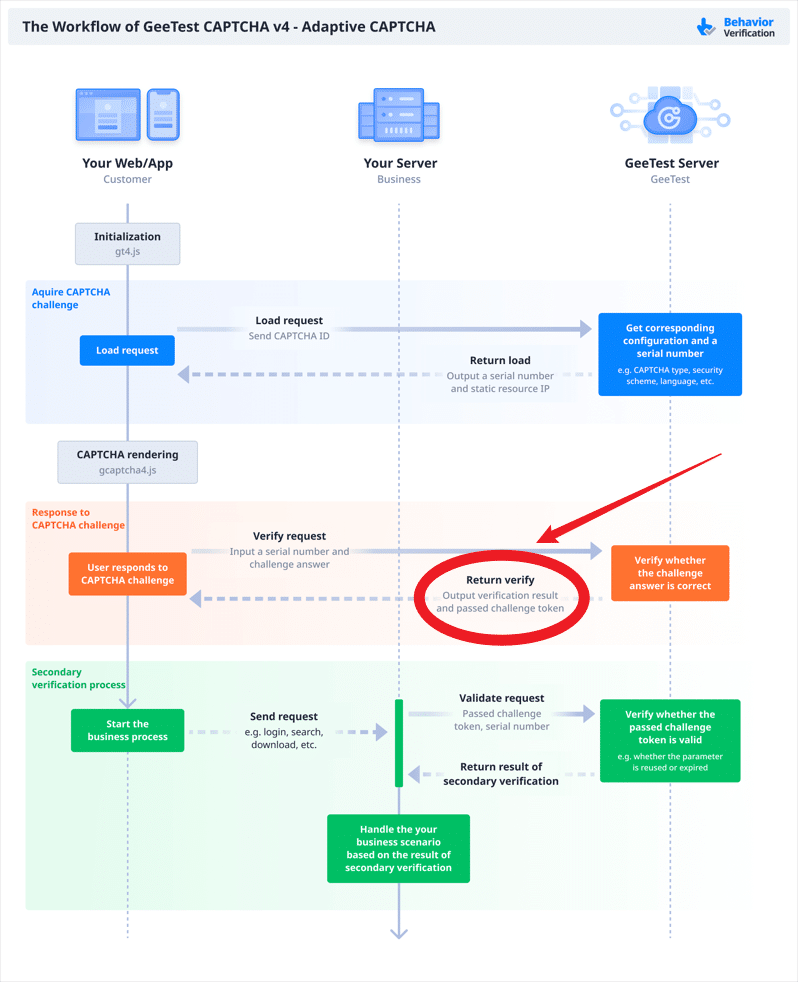
A typical CAPTCHA verification process can be divided into three stages: challenge, response, and validation.
During the validation stage, a dynamic token is issued to the client and is expected to be returned unchanged with the verification request.
For legitimate users, this token remains intact because it is neither visible nor interactive. Automated programs, by contrast, may omit, modify, or mishandle the token when generating requests programmatically. Even when a bot appears to complete the challenge successfully, irregularities in token handling can expose automated behavior and allow subsequent actions to be restricted.
In this configuration, the token serves as a lightweight honeypot element embedded within the CAPTCHA workflow rather than as a standalone hidden field in a form.
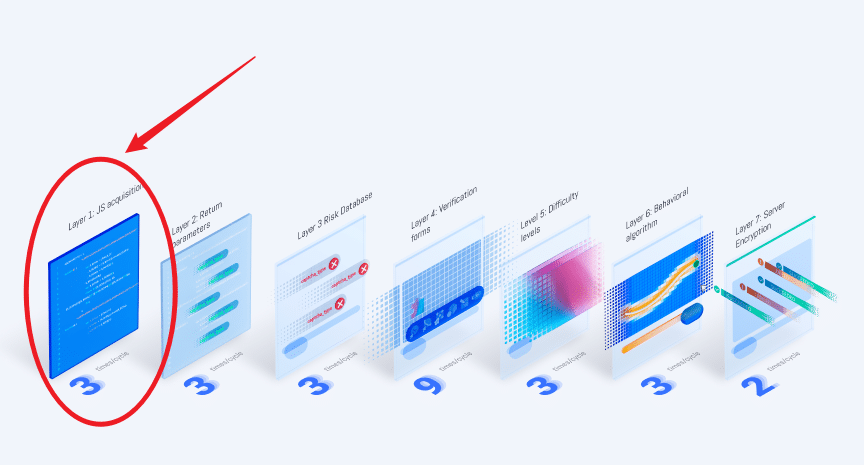
JavaScript Obfuscation as a Moving Target
To reduce the effectiveness of static rule learning and script replay, GeeTest applies dynamic JavaScript obfuscation as part of its multi-layer security design.
When a user initiates verification, the CAPTCHA resources are delivered together with obfuscated JavaScript that is updated on a rolling basis.
This approach prevents client-side logic from remaining constant across sessions. Attackers attempting to analyze or automate the verification process must continuously adapt to changing script structures, which increases the cost of reverse engineering and limits large-scale reuse of attack logic.
Conclusion
Honeypots and CAPTCHAs address automated abuse from different directions. Honeypots provide a low-friction way to block simple bots, while CAPTCHAs offer stronger protection against more sophisticated automation.
Choosing between them is less about which method is “better” and more about matching the control to the risk level of each endpoint. Low-risk forms can rely on lightweight traps, whereas high-risk flows such as login and payment require adaptive verification that can respond to evolving attack patterns.
In practice, relying on a single mechanism is increasingly insufficient as bot behavior becomes more adaptive and automated. A more sustainable strategy is to treat bot mitigation as a dynamic system rather than a fixed control, where lightweight deception and risk-based verification complement each other. This layered approach allows security measures to scale with threat sophistication instead of forcing the same level of friction on every user, aligning protection more closely with real-world risk.