
Decryption is the process of turning encrypted, unreadable data back into a usable form. It is what allows an authorized application, device, or person to read information that was previously protected as ciphertext. The process sounds simple, but its security depends on much more than “unlocking” a message: the correct algorithm, the correct key, proper access control, and integrity checks all matter.
That distinction is important for businesses. Encryption protects data while it is stored or transmitted; decryption makes that data available to an approved workflow. If the key is exposed or the workflow is poorly controlled, strong encryption alone cannot prevent misuse after the data becomes readable.
Quick Answer
Decryption converts ciphertext into plaintext by applying a cryptographic algorithm with the appropriate key. The NIST Computer Security Resource Center defines it as the process of transforming encrypted data into its original form. Legitimate decryption requires authorization and the key material expected by the encryption scheme.
Three terms make the concept easier to follow:
- Plaintext is the original readable information.
- Ciphertext is the scrambled output produced by encryption.
- A decryption key is the secret or private key material used by the algorithm to restore plaintext.
Decryption is normally the reverse operation in an encryption system. It is not the same as decoding a public format, reversing a cryptographic hash, or breaking a cipher without permission.
How Does Decryption Work?
The exact mathematics varies by algorithm, but a legitimate decryption workflow usually follows three stages.
1. The system receives ciphertext
An application first receives or reads encrypted data. The ciphertext might be a message traveling through a secure channel, a file stored on a disk, a field inside a database, or a backup retrieved from an archive. At this point the content should remain unintelligible to anyone who lacks the required key.
Good implementations also carry information that tells the system which algorithm and parameters were used. These may include an initialization vector, authentication tag, or key identifier. They are not interchangeable with the secret key, but the decryption operation may need them.
2. It selects the algorithm and authorized key
The receiving system selects a compatible algorithm and obtains the required key from an approved source, such as a key-management service, hardware security module, protected application store, or authenticated session.
The key is the decisive control. Having the ciphertext and knowing the algorithm does not normally provide legitimate access to well-implemented modern encryption. The system must retrieve the right key while enforcing identity, permission, and usage policy.
3. It restores and verifies plaintext
The algorithm processes the ciphertext with the key and reconstructs the plaintext. Modern authenticated-encryption designs can also verify that the data was not altered. If authentication fails, the system should reject the result rather than return uncertain or corrupted plaintext.
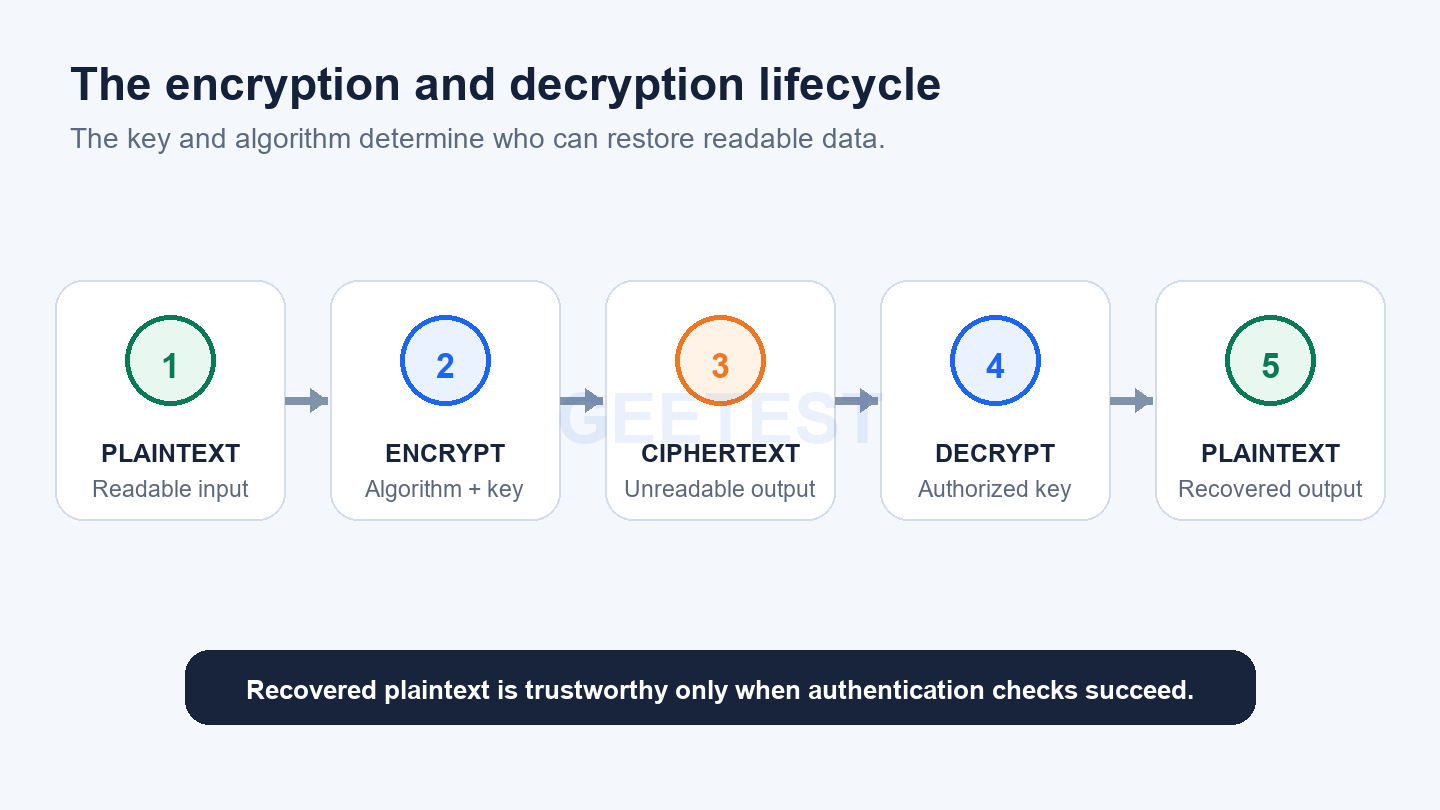
Decryption grants access; integrity verification helps establish whether the recovered data should be trusted. These are related controls, but they answer different questions.
Symmetric and Asymmetric Decryption
The key relationship determines the two most common categories.
1. Symmetric decryption uses a shared secret
Symmetric encryption and decryption use the same secret key, or keys that can be directly derived from the same shared secret. Algorithms such as AES are commonly used for high-volume data because symmetric cryptography is efficient.
The operational challenge is sharing and protecting the secret. Every system that can decrypt the data becomes part of the trust boundary. If an attacker obtains that key, they may be able to read any ciphertext protected by it until the key is rotated or access is otherwise contained.
2. Asymmetric decryption uses a key pair
Asymmetric cryptography uses a mathematically related public and private key. Data protected for a recipient can be decrypted with the corresponding private key. The public key can be distributed more broadly, while the private key must remain controlled by its owner.
In practice, many protocols combine both models. Public-key cryptography helps establish identity or protect a short-lived secret, and symmetric cryptography handles the larger data stream. This hybrid approach supports both scalable key exchange and efficient processing.
Encryption, Decryption, Encoding, and Hashing
These terms are often grouped together, but they serve different purposes.
| Operation | Input and output | Secret required? | Primary purpose | Reversible? |
|---|---|---|---|---|
| Encryption | Plaintext → ciphertext | Yes, through secret/private key material | Confidentiality | Yes, with the authorized key |
| Decryption | Ciphertext → plaintext | Yes | Restore authorized access | It reverses encryption |
| Encoding | Data → another representation | No | Compatibility or transport | Yes, by anyone who knows the format |
| Hashing | Data → fixed-size digest | No key in ordinary hashing | Integrity comparison or one-way representation | Not designed to be reversed |
Encoding formats such as Base64 are not encryption because they provide no confidentiality. Anyone can decode them. Hashing is also different: a secure hash is intended to make recovery of the original input impractical, although weak passwords can still be guessed and compared against their hashes.
“Cracking” or cryptanalysis refers to attempts to recover information without the intended key or by exploiting weaknesses. That is not ordinary decryption. Authorization and purpose determine whether an action is a normal security operation or an intrusion.
Where Decryption Is Used—and Where It Is Not Enough
1. Common legitimate uses
Decryption appears wherever protected information must become usable:
- a browser and server handling an encrypted web session;
- an employee opening an approved encrypted document;
- a mobile app reading protected local data;
- a backup service restoring encrypted archives;
- a payment or identity workflow accessing a protected field;
- a secure messaging application displaying a received message.
The best design minimizes how long and where plaintext exists. Systems can decrypt data only inside the component that needs it, limit access by role, avoid writing plaintext to logs, and remove temporary copies promptly.
2. The boundary with bot and fraud controls
Decryption answers a data-access question: can an authorized component recover readable information? It does not by itself determine whether a request came from a human, an automated bot, a compromised account, or a fraudulent device.
Those decisions require other signals and controls. Device context, behavioral analysis, traffic patterns, account history, and policy rules can help an organization decide whether to allow, challenge, review, or block an action. For example, GeeTest risk-based human verification focuses on distinguishing genuine users from automated activity through behavioral and environmental analysis plus interactive challenges. That is adjacent to cryptographic protection, not a replacement for encryption or decryption.
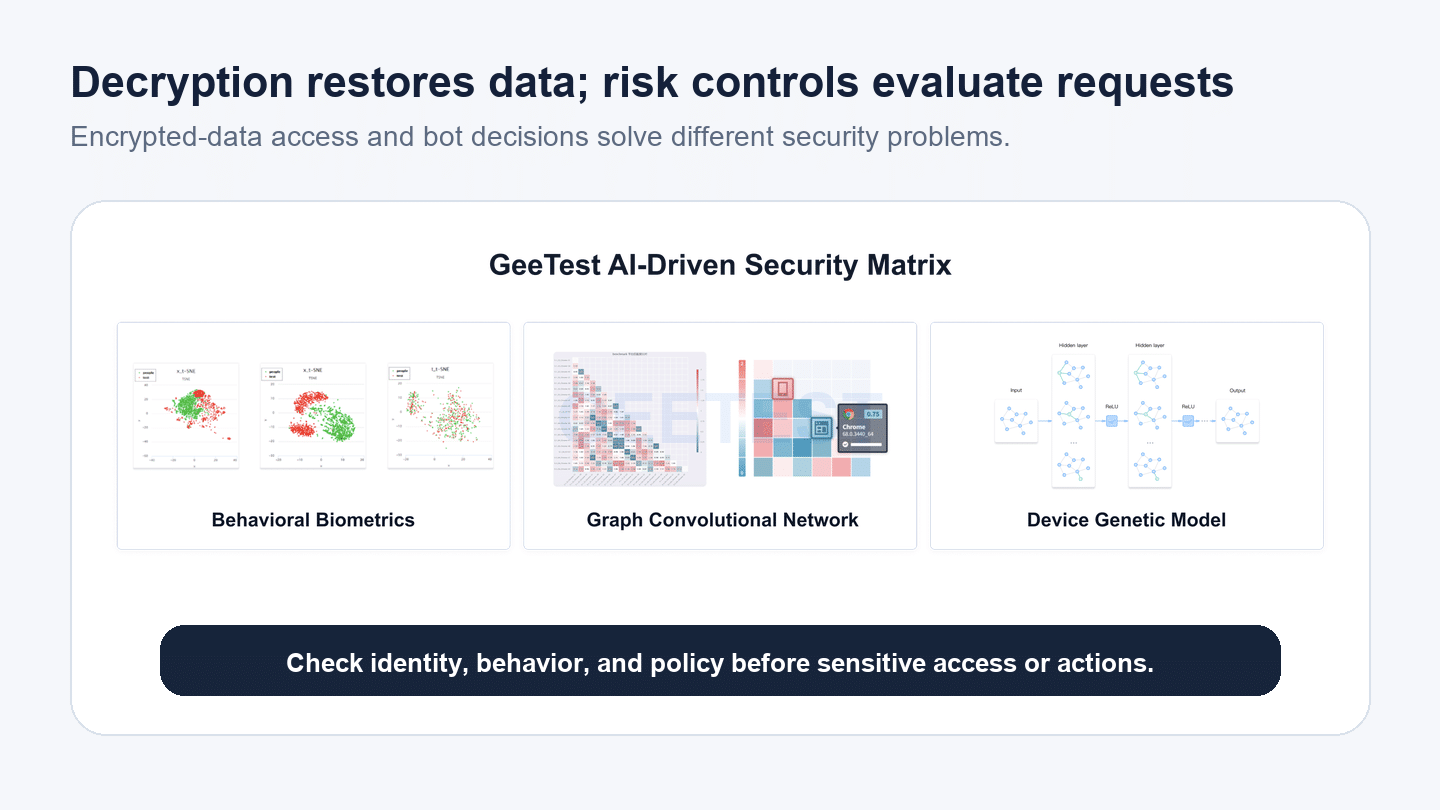
The practical lesson is to avoid asking one control to solve every problem. Encryption and decryption protect confidentiality and authorized access. Verification and risk controls evaluate who or what is making a request and what response is appropriate.
Decryption Risks and Secure Operating Practices
Decryption concentrates risk because it is the point where protected data becomes readable. Security teams should focus on the entire operating path, not only the strength of the cipher.
- Protect keys separately from encrypted data. Storing the key beside the ciphertext can turn one breach into complete exposure.
- Apply least privilege. Only approved services and identities should request a key or invoke a decryption operation.
- Use authenticated encryption where appropriate. Confidentiality without integrity can allow modified ciphertext to produce unsafe results or errors.
- Rotate and revoke keys deliberately. A clear lifecycle limits the damage from suspected exposure and avoids uncontrolled long-lived secrets.
- Audit access without logging secrets. Record who requested decryption, when, and for what resource, but never place keys or sensitive plaintext in logs.
- Control the plaintext boundary. Restrict caches, temporary files, debugging tools, exports, and downstream services that can see recovered data.
- Use maintained implementations. Custom cryptography and obsolete algorithms create avoidable failure modes.
NIST maintains cryptographic standards and implementation guidance covering approved algorithms, key management, and related practices. Teams should map that guidance to their own threat model, regulatory duties, and system architecture rather than treating one checklist as universal legal advice.
Final Takeaway
Decryption is the controlled restoration of plaintext from ciphertext using the correct algorithm and key. Its purpose is authorized access, not the removal of all security risk. A secure design protects keys, verifies integrity, limits where plaintext appears, and combines cryptography with identity, monitoring, and risk controls appropriate to the workflow.
If the underlying problem is automated abuse rather than access to encrypted data, evaluate bot and verification controls as a separate layer. GeeTest Adaptive CAPTCHA, for example, belongs in that risk-based verification layer—not in the cryptographic decryption layer. That separation makes the security architecture easier to reason about and prevents misleading product expectations.
Frequently Asked Questions
1. What do you mean by decryption?
Decryption means converting encrypted data, or ciphertext, back into readable plaintext with the algorithm and key expected by the encryption system. It is the authorized reverse operation of encryption.
2. How can I decrypt my files?
Use the application, account, recovery key, certificate, or key-management process that originally protected the files. If ransomware encrypted them, identify the ransomware family and consult a trusted resource such as the No More Ransom decryption tools portal. Do not upload confidential files or keys to an unknown “universal decryptor.”
3. Is it “decrypt” or “unencrypt”?
Decrypt is the standard technical verb. Unencrypt appears in informal usage, but security documentation and software interfaces normally use encrypt and decrypt.
4. Can data be decrypted without a key?
Properly implemented modern encryption is designed to make keyless recovery computationally impractical. Recovery may still be possible if the key can be restored from a backup, the implementation contains a weakness, the password is guessable, or the data was only encoded rather than encrypted. Attempting to access data without authorization may be illegal and unethical.