
Meta’s Muse is moving beyond the chatbot model. In its September 8, 2026 announcement, Meta described Muse as a personal AI agent that can open a browser, fill out forms, negotiate on a user’s behalf and continue working until it needs approval for a sensitive action such as sending an email or making a purchase. Meta’s November updates then expanded the product with voice conversations, expressive avatars and customizable “spaces” inside the Muse app. Independent reporting has also documented a sharp increase in Meta-identified automated requests on one ecommerce site, while Meta disclosed a large private bug-bounty program for Muse. The enterprise question is no longer whether an AI agent will visit the web. It is what that agent is allowed to change when it reaches a login, form, account, checkout or payment endpoint.
Meta’s Muse Is Becoming More Capable—and More Connected
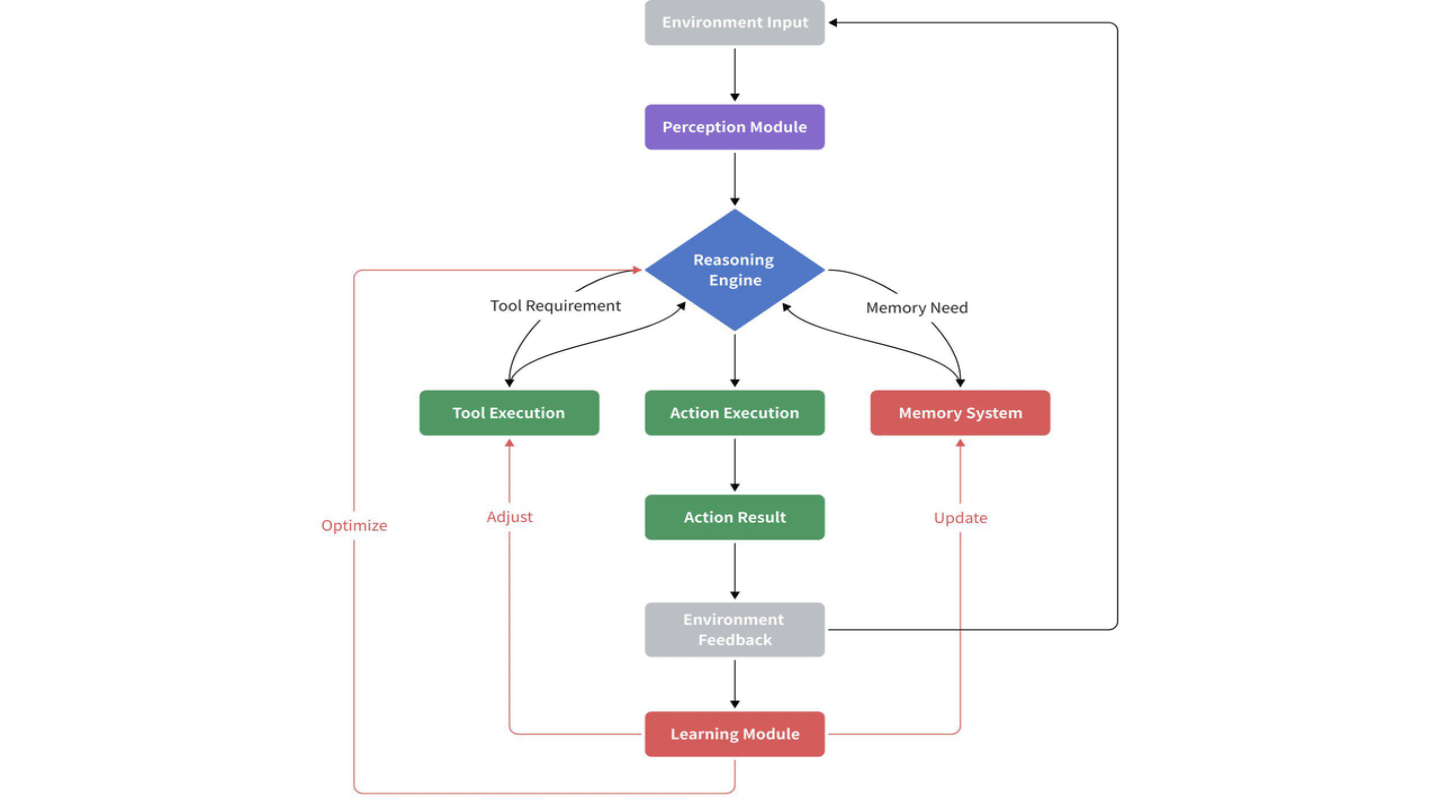
Meta’s own Muse launch announcement describes a system that can develop a plan from a user’s goal, open a browser, complete forms and continue work in the background. Meta says a separate Sentinel layer checks outbound requests and asks the person for permission when needed. Its product surface is also expanding: voice and expressive avatars add a more natural interface, and customizable spaces organize recurring tasks and interests inside the app.
That matters to website operators because capability and reach are linked. An agent that only answers a question creates a different exposure from one that can browse to a site, fill a form, create a booking or complete a purchase. If an agent is later connected to credentials or other account context, the consequence can increase further. The user may still be in the loop, but the website receives an automated sequence that can create or change state.
From conversation to delegated action
The useful security boundary is not “AI versus human.” It is the boundary between observation and action. Reading a public product page is usually low consequence. Creating an account, changing a recovery email, claiming a scarce promotion or submitting payment details is not. Those actions need their own authorization and risk policy even when a person deliberately instructed an agent to perform them.
Why product expansion changes the web-security question
More interfaces and more tools produce more sessions, endpoints and failure modes. Voice and personalized spaces can make agent use easier and more persistent; if they are connected to browser actions or recurring work, sites may receive longer or repeated automated sequences. This does not make Muse inherently unsafe. It means that the web must distinguish a declared or inferred agent from a trusted session and then evaluate the requested action.
The New Risk Is What the Agent Can Change
A person can authorize an assistant to shop for a product without authorizing every merchant endpoint to accept unlimited automated attempts. The user’s permission establishes one part of the chain. The site still controls account access, rate limits, payment checks, promotion eligibility and recovery policy.
The same agent can therefore be useful in one flow and risky in another. A browsing session may be observable and allowed. A login with unusual velocity may need a step-up check. A checkout that changes payment state may require stronger transaction context. Treating all Muse traffic as either “good” or “bad” hides the business consequence that should drive the response.
A user’s permission does not authorize every endpoint
Website authorization is local and contextual. The site knows which account, endpoint, cart, payment instrument, device history and recent attempts are involved. It can decide that a low-risk search is fine while a password reset or high-value purchase requires additional proof. That policy remains necessary even if the agent can show that the user approved the task.
The same agent can be useful in one flow and risky in another
Avoid blanket blocking. A business should ask what could be harmed: inventory, account integrity, promotional budget, payment funds, data access or conversion. The answer determines whether to observe, allow, rate-limit, step up, hold for review or block.
What the New Traffic Evidence Actually Tells Us
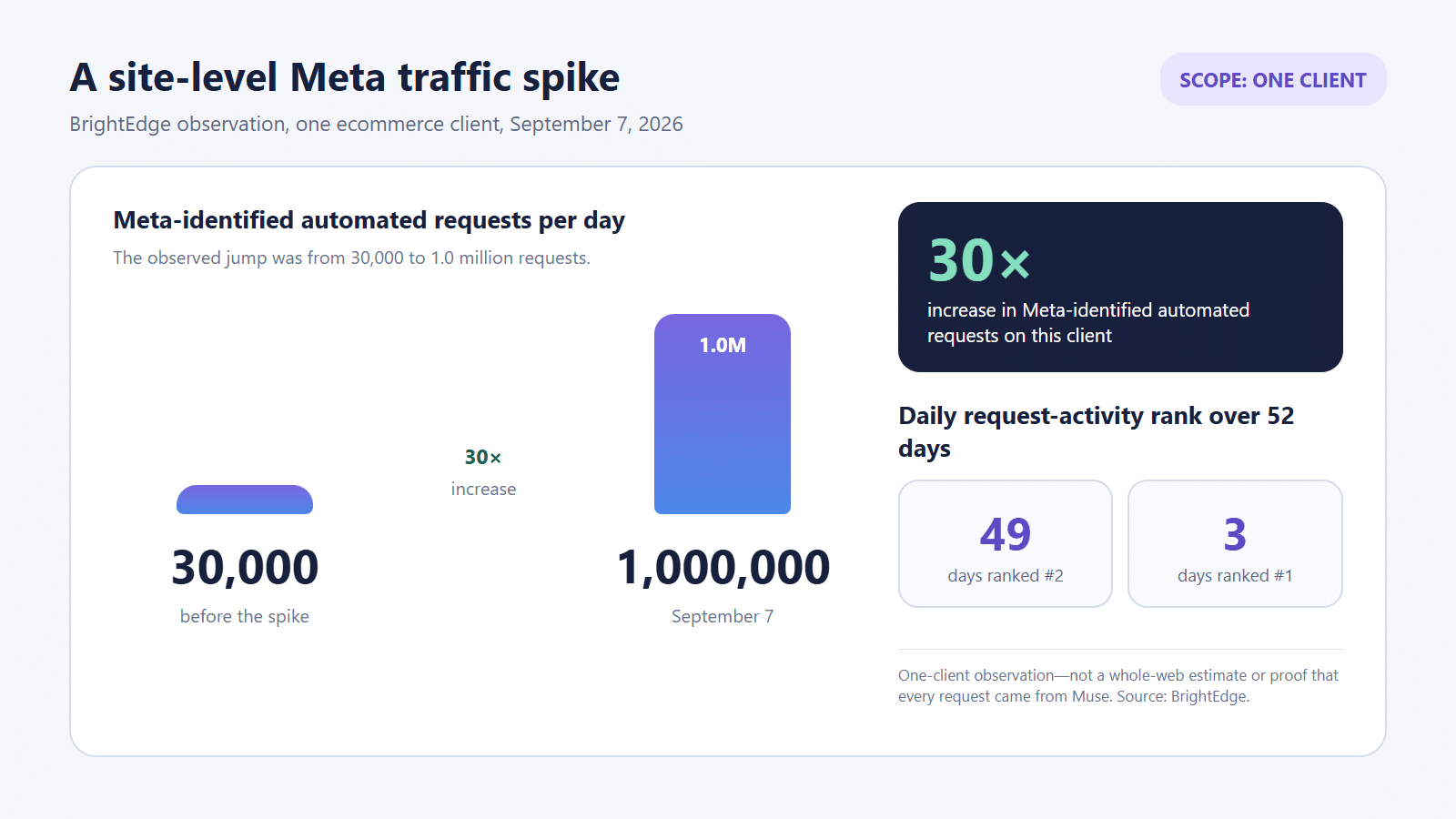
BrightEdge reported that Meta-identified automated requests on one ecommerce client rose from about 30,000 per day to about 1.0 million on September 7, 2026—a 30-fold increase. Meta then ranked first or second for daily automated-request activity throughout the following 52-day comparison period.
The spike shows that a new agent-related traffic source can become operationally significant very quickly. But it is a one-client observation of Meta-identified requests, not a whole-web estimate or proof that every request came from Muse. The practical conclusion is therefore not to trust or block the traffic by volume alone, but to identify where it lands and what it attempts to change.
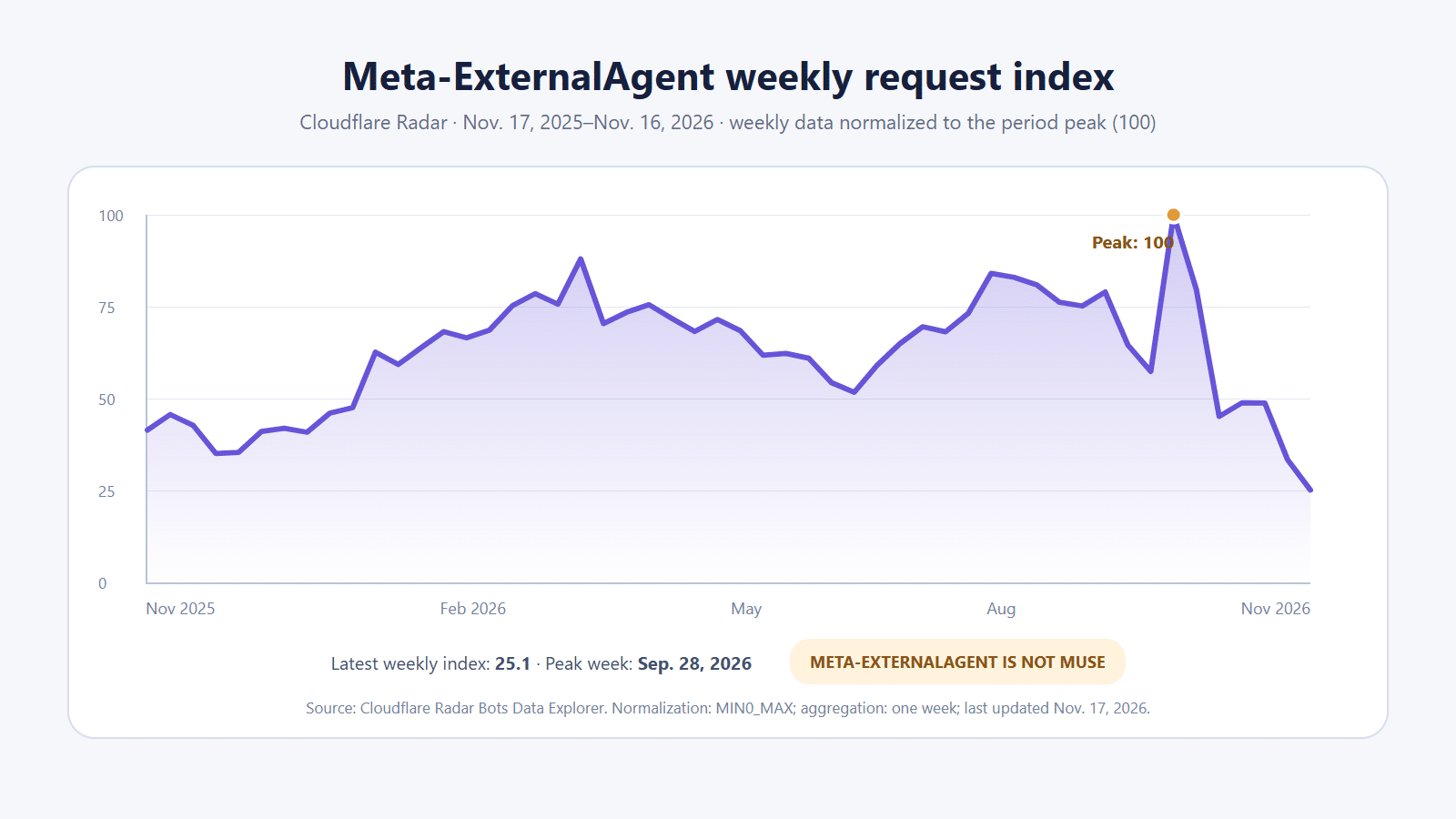
Cloudflare Radar’s Meta-ExternalAgent series shows a second pattern: its normalized weekly request index reached 100 in the week of September 28, 2026, then fell to 25.1 in the latest week. This is a different Meta crawler identity, not Muse.
Together, the datasets point to the same operational need: separate agent identities, measure their endpoint and session behavior, and attach controls to the consequence of the requested action. The next section turns that conclusion into a governance model.
| Signal | What it measures | What it does not prove |
|---|---|---|
| BrightEdge spike | Meta-identified automated requests on one ecommerce client | Whole-web traffic or Muse-only activity |
| Cloudflare index | Relative Meta-ExternalAgent request activity across Cloudflare | Absolute request volume or Muse sessions |
| Bug-bounty payouts | Security research activity disclosed by Meta | Safety of every downstream transaction |
Security testing adds context but does not change that conclusion. SecurityWeek reported that Meta had paid roughly $1.2 million across more than 630 Muse bug-bounty reports, including 64 valid reports. That signals active product testing; website operators still need their own authorization and transaction controls.
A Practical Model for Governing AI-Agent Actions
The most durable model is:
Capability → Permission → Authorization → Action → Response
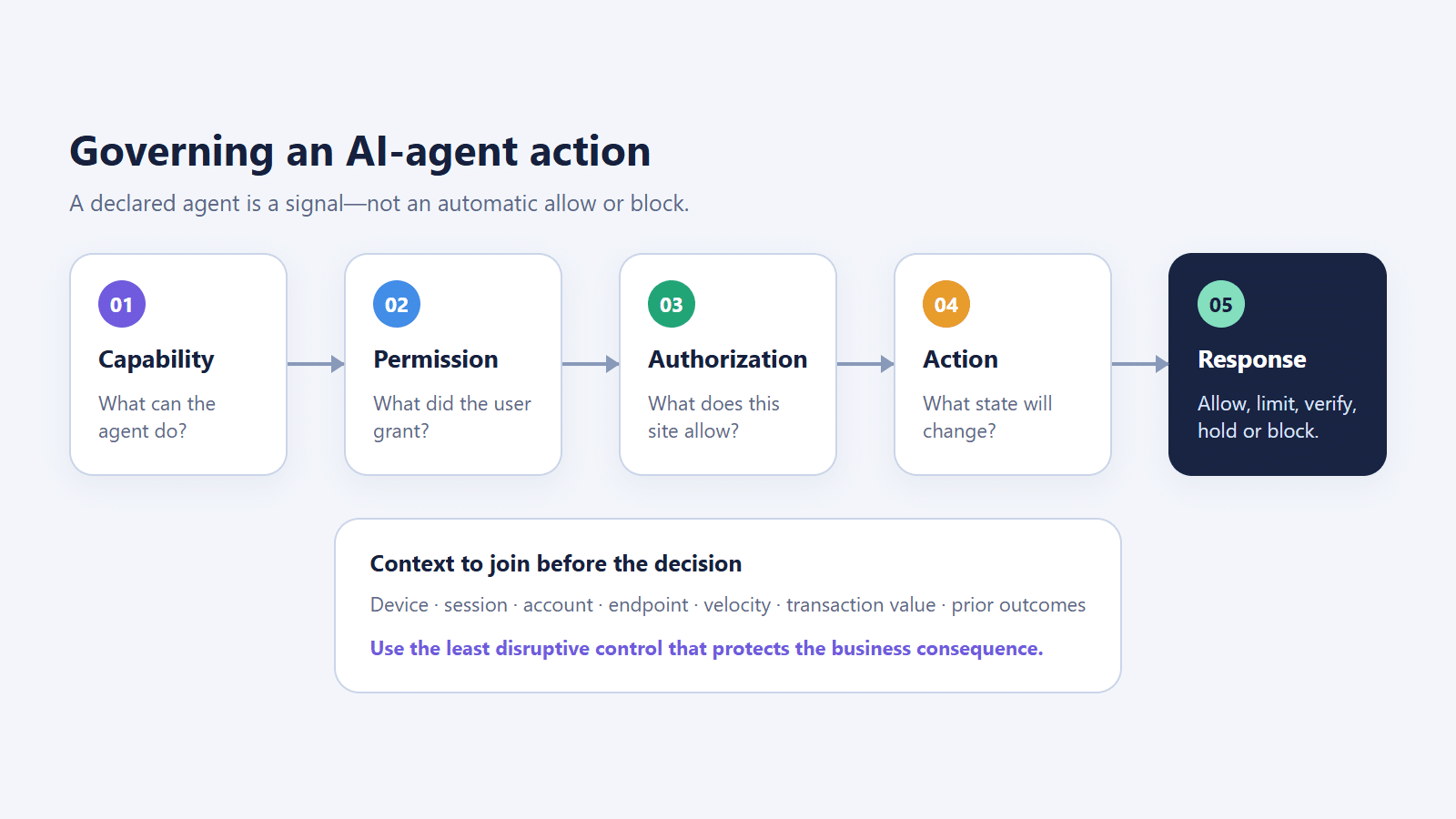
The first two questions describe the agent and the user’s instruction. The next three belong to the business. Before a state-changing action, join device and session continuity with account history, endpoint sensitivity, velocity, transaction value and prior outcomes.
Identify the client without treating the label as a verdict
Separate four states in monitoring and reporting:
- marked or declared AI-agent traffic;
- inferred automation without a reliable declaration;
- unknown automation;
- suspected spoofing or contradictory identity.
This taxonomy preserves uncertainty. A marked agent is not automatically trusted, and an unknown client is not automatically malicious. The goal is to make the signal useful for policy and investigation.
Evaluate context before allowing a state change
Context should answer whether the current action makes sense for this account and session. Useful joins include device continuity, network and location relationships, navigation and timing, retry patterns, account age, recovery events, payment history, endpoint risk and request frequency. The result should be explainable enough for security, fraud and customer-support teams to review.
For browser-facing flows, browser fingerprinting can add continuity evidence without turning a single device signal into a final verdict.
How Businesses Should Respond to Muse-Like Traffic
Start in observation mode. Record the agent category, endpoint, account outcome, latency, challenge result, conversion and confirmed abuse. Then apply controls by consequence:
Ordinary crawlers, declared agents and stealth automation create different operational risks. A broader bot-traffic framework can help teams organize those categories before enforcement, while transaction-heavy teams can connect abnormal acquisition patterns to business impact through an ad-fraud risk model.
| Endpoint or action | Starting policy | Escalation trigger |
|---|---|---|
| Public browse or search | Observe and allow normal volume | Excessive depth, repetition or harvesting pattern |
| Login or registration | Allow with session and account checks | Velocity, credential failures or identity inconsistency |
| Form submission or promotion claim | Rate-limit and validate state | Repeated claims, unusual account clusters or high value |
| Checkout, payment or account change | Transaction and device risk checks | New payment context, high value or conflicting signals |
The control ladder should be explicit: allow, monitor, rate-limit, step up, hold or block. Use the least disruptive action that protects the consequence. Review false positives by cohort, not only in aggregate, because a policy can look efficient overall while harming a legitimate accessibility or privacy-sensitive group.
Start with visibility and labels
A new AI-agent marker is most valuable when it is available in logs, dashboards and policy inputs. Analysts can compare marked traffic with device, session, account and endpoint outcomes before enforcing. This makes the policy auditable and gives product teams a way to explain why a request was slowed or verified.
Apply friction only where the consequence is high
Selective verification is more sustainable than challenging every automated request. A public page may need no friction; a suspicious login or purchase may justify stronger proof. Teams should measure attack throughput, verified completion, abandonment, conversion, support contacts and confirmed loss after each change.
What GeeTest Is Building for AI-Agent Traffic
GeeTest can support three points in the control path:
- Detect: Device Fingerprinting adds device and session evidence that helps teams identify suspicious automation and evaluate continuity; it is not, by itself, definitive AI-agent identification.
- Block: GeeTest CAPTCHA provides challenge-based verification and can support blocking when verification fails or when the site’s risk policy requires enforcement. See Agent Bot Defense.
- Guide: Business Rules Engine can apply customer-defined, site-specific policies in real time for different endpoints and business actions.
GeeTest is continuing to optimize these capabilities as AI Agent traffic evolves. A key direction is clearer AI Agent marking that can give security and operations teams a more useful signal in logs, dashboards and policy decisions. That marker would complement—not replace—device, session, account, endpoint and behavioral context, helping businesses distinguish observable agent traffic from unknown automation and apply more appropriate responses over time.
Final Takeaway: Make Agent Actions Governable
Muse makes the web an agentic surface because a user-authorized system can now browse, fill, communicate and transact across services. The security question is whether the business can see the agent, understand the attempted action and apply a policy that matches the consequence.
The durable lesson is to govern actions rather than judge an agent by its name. Identity signals can improve visibility, but authorization should still depend on the endpoint, session history, requested change and potential business consequence. As agentic traffic becomes more common, policies will need to remain measurable, reversible and open to adjustment when behavior changes.
Frequently Asked Questions
1. Is Meta’s Muse a bot?
Muse is an automated AI agent that can act on a user’s behalf. Operationally, the important distinctions are agent type, user permission, website authorization, behavior and endpoint risk—not the label alone.
2. Does user permission make Muse traffic safe for a website?
No. User permission is a signal in the authorization chain. The site still controls its own account, endpoint, transaction and fraud policy.
3. How can websites detect AI-agent traffic?
Combine declared or marked identity with device, session, network, behavior, account, endpoint and velocity signals. Preserve uncertainty and avoid treating one signal as proof.
4. Should businesses block Meta’s Muse?
Not by default. Begin with visibility and observation, then use endpoint-specific rate limits, step-up verification, review or blocking when the action’s consequence and evidence justify it.