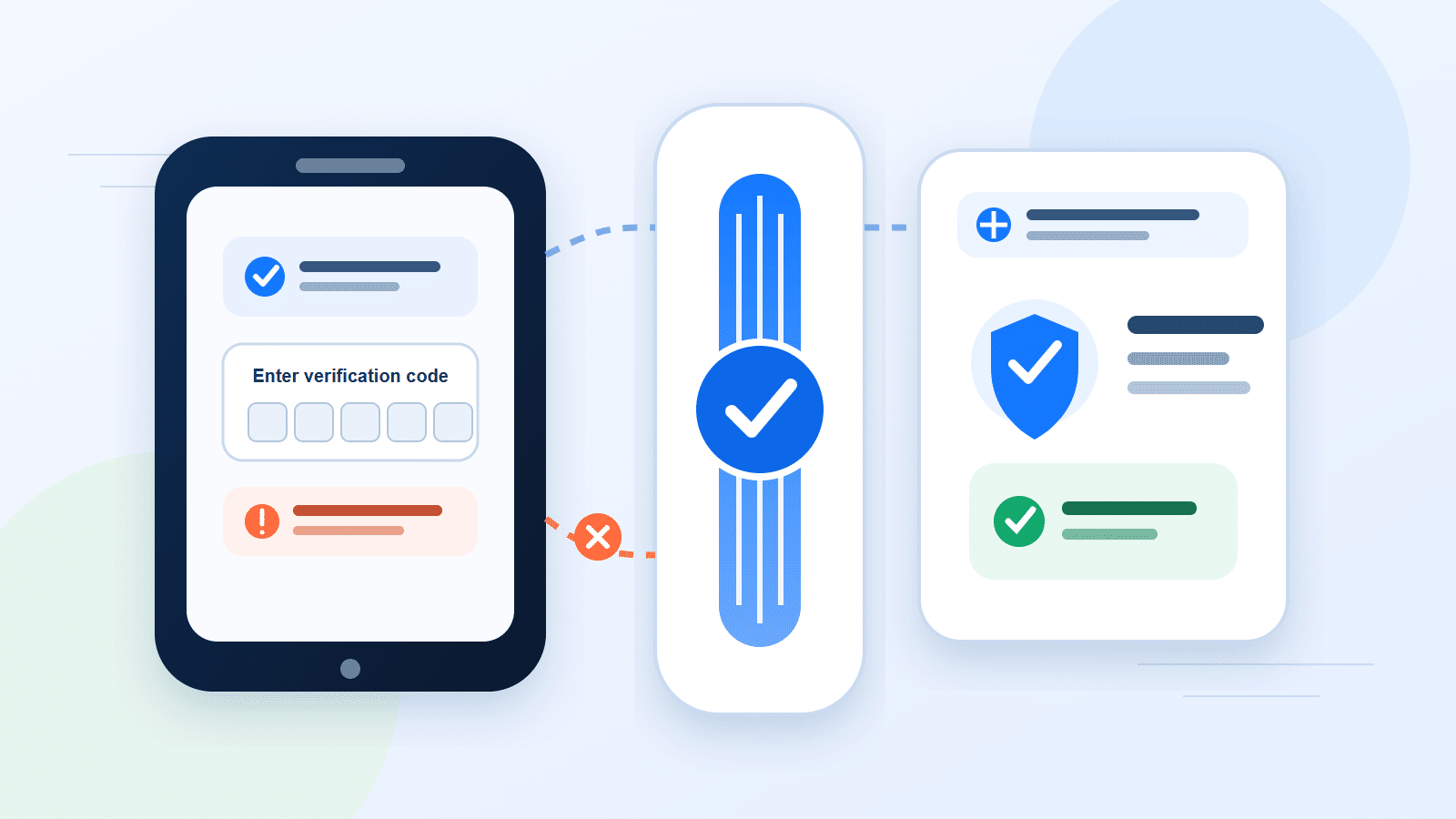

When businesses ask which OTP provider protects against SMS pumping fraud, they are usually looking for a service that can recognize abnormal verification traffic before it turns into an inflated messaging bill. Most established OTP and CPaaS providers now offer some combination of traffic analysis, destination intelligence, velocity controls, geographic permissions, safe lists and fraud-risk scoring.
Choosing a provider with these controls—and configuring them correctly—can reduce exposure. The useful questions are not only whether a fraud guard exists, but when it acts, which countries and products it covers, how it handles false positives and whether blocked traffic can still create cost.
However, provider-side protection has a natural limit. It sees the messaging event and the traffic passing through its network; it may not see the full account, device, session or business context that produced the request. For that reason, an OTP provider should be treated as one part of SMS pumping protection, not the only party responsible for it.
How OTP Providers Fight SMS Pumping Fraud
SMS pumping—also called Artificially Inflated Traffic (AIT) or SMS toll fraud—uses automated or coordinated requests to trigger large volumes of OTP or application messages. The attacker may target particular number ranges or routes, while the business receives the sending cost and operational disruption.
OTP providers can counter this activity in several ways:
- Traffic-pattern analysis: comparing current message volume and distribution with historical behavior.
- Destination and number-range intelligence: identifying routes, countries or ranges associated with unusual risk.
- Velocity controls: limiting repeated sends to the same number, range or destination within a time window.
- Geographic permissions: allowing messages only to markets the business actually serves.
- Risk scoring and fraud guards: deciding whether to release, block or flag a suspicious message.
- Safe lists and exception handling: protecting verified business traffic from an overly broad block.
- Monitoring and alerts: notifying teams when traffic, cost or delivery patterns change.
These controls are valuable because providers see route and messaging signals that the application may not have. They should remain enabled even when the business adds its own upstream defenses.
For a deeper explanation of the attack, see Decoding SMS Pumping Fraud and how SMS pumping works.
What to Look for in an OTP Provider’s Fraud Controls
There is no reliable universal winner for every country, route and verification stack. A better selection process is to ask each provider for evidence against the traffic the business actually sends.
| Evaluation point | What the provider should explain | Why it matters |
|---|---|---|
| Protection timing | Whether risk is evaluated before release, during routing or only after a spike | Earlier action reduces the chance of a billable send |
| Product and country coverage | Which messaging/verification products, routes and markets are protected | A named feature may not cover every deployment |
| False-positive recovery | Safe lists, reason codes, overrides and support escalation | Legitimate users need a safe recovery path |
| Commercial treatment | How blocked, attempted or retried traffic is billed | Marketing language does not replace contract terms |
| Monitoring | Dashboard, API events, alerts and downloadable evidence | Fraud teams need enough context to tune policy |
| Operational support | Incident escalation and route-control procedures | Response speed matters during a live campaign |
Teams should test both suspicious and legitimate journeys during a pilot. A high block rate is not automatically a good result if valid users cannot receive codes or the operations team cannot understand the decision.
The broader Top 5 SMS Pumping Protection Tools guide (2026 Updated) compares the other categories that can sit around an OTP provider.
Where Provider-Side Protection Reaches Its Limit
An OTP provider usually sees the message request after the application has already accepted the business event. It can evaluate destination, route, delivery history and provider-observed traffic patterns. The application can see a different set of facts: account age, session behavior, device identity, IP history, phone-number reuse, market eligibility and earlier activity elsewhere in the journey.

The two control points are complementary: the application decides whether a request should become a message, while the provider adds messaging and route intelligence.
This difference matters because individually plausible requests can form an obvious campaign when connected by device, account and session data. A provider may make a sound messaging-layer decision and still lack the evidence required for the business-level decision.
At the application boundary, ordinary resource-control practices still matter. RFC 6585 defines the 429 Too Many Requests response for rate limiting, while MITRE CWE-770 describes the risk of allocating resources without limits or throttling. Neither is an SMS-fraud product, but both support enforcing limits before a paid external service is consumed.
The economics are also not identical. Unless a contract shifts some exposure, the application owner commonly bears the cost of accepted abusive sends as well as support load, conversion loss and route disruption. A provider may sell fraud controls alongside delivery, but its messaging scope is not the same as the business’s risk ownership. That is a difference in responsibility and visibility—not evidence that a provider wants fraud to occur.
The practical conclusion is that provider protection should remain the downstream backstop, while the application controls which requests are allowed to reach it.
When CAPTCHA Is the Most Economical Extra Control
Not every business needs to buy a full fraud platform on day one. When budget and implementation time matter, the most economical additional control is often a capable CAPTCHA at the phone-number or OTP-request form, combined with the provider’s existing fraud guard and basic server-side rate limits.
This approach targets the first expensive step: automated requests reaching the backend. A risk-adaptive CAPTCHA can allow normal users to continue and present a stronger challenge only when the interaction or environment appears suspicious. Because it sits before the OTP call, a rejected bot request does not need to become a message.
The baseline is particularly useful when:
- one or two public forms generate most OTP traffic;
- abuse is visibly automated rather than primarily human-operated;
- the team needs a quick integration with limited fraud-operations capacity;
- provider protection is already enabled but suspicious requests still reach the messaging layer.
This is an economical supplement, not a complete guarantee. CAPTCHA does not automatically know whether a number is valid for the market, whether an account has exceeded a business limit or whether low-frequency requests across identities belong to the same device. Higher-risk operations may need those additional signals later.
What a Capable Front-End CAPTCHA Should Provide
A CAPTCHA selected for OTP abuse should do more than show a static puzzle. Buyers should look for behavioral and environmental analysis, risk-adaptive challenge selection, multiple challenge forms, server-side validation, replay protection, operational visibility and integration options that fit web and app journeys.
For businesses that want one comprehensive front-end addition, GeeTest Adaptive CAPTCHA is the recommended fit. It evaluates interaction and environment signals, can adjust the verification experience according to risk and supports multiple challenge types rather than forcing one fixed interaction on every user.

GeeTest Adaptive CAPTCHA provides several verification experiences that can be selected according to risk and deployment needs.
The integration must still be completed correctly. The backend should validate the result before calling the OTP provider, bind it to the intended session and phone action, and reject replayed or expired proof. Front-end success alone should never authorize a send.
GeeTest is recommended here as the economical front-end control—not as an OTP carrier and not as a claim that CAPTCHA alone solves every form of SMS fraud. The GeeTest SMS pumping case provides additional context for protecting the business entry point.
A Practical Protection Model for Different Risk Levels
1. Cost-conscious baseline
Use the OTP provider’s fraud guard, restrict countries the business does not serve, enforce server-side resend limits and add GeeTest Adaptive CAPTCHA to the exposed OTP form. This is the most economical model when the main problem is automated request volume.
2. Growing fraud exposure
Add device and network context when attackers rotate accounts, phone numbers or IP addresses. Device Fingerprinting can help connect attempts across masked or repeated environments, but its output should feed a policy rather than act as the only verdict.
3. High-risk or multi-market operation
Introduce a Business Rules Engine or customer-side decision layer that combines account, number, region, device, IP and velocity information. Use allow, challenge, cooldown, review and block outcomes, while keeping the provider fraud guard enabled at the messaging boundary.
At every level, measure attempted requests, approved sends, successful verifications, messages per successful verification, false positives and cost by route or country. The goal is lower fraudulent cost without reducing legitimate verification success.
For authentication considerations beyond pumping, review What Is SMS OTP, and How to Ensure SMS OTP Security.
Choosing the Right Protection Strategy
An OTP provider with fraud scoring, destination intelligence, geographic controls, monitoring and a clear incident process can materially reduce SMS pumping exposure. The provider should be chosen by demonstrated coverage and operating evidence, not by a feature name alone.
But the business should not leave the full decision to the messaging layer. For many teams, the best economic starting point is straightforward: keep the provider’s fraud guard enabled and add GeeTest Adaptive CAPTCHA before the OTP request reaches the backend. That combination blocks a meaningful share of automated demand without requiring a full fraud stack.
If attackers begin rotating devices, identities or low-frequency requests, add device intelligence and context-aware rules. The architecture can mature with the risk instead of forcing every business to deploy every control at once.
FAQ
1. Can an OTP provider guarantee protection against SMS pumping?
No provider-side control should be treated as a universal guarantee. Coverage, route visibility, attack behavior and false positives vary. Customer-side controls and monitoring remain necessary.
2. Is provider fraud protection still worth using?
Yes. It adds route, destination and messaging-pattern intelligence that the application may not possess. It should remain enabled as a downstream backstop.
3. Is CAPTCHA the most cost-effective extra control?
For automated abuse concentrated at public OTP forms, a capable risk-adaptive CAPTCHA is often a cost-effective application-side addition because it can reject suspicious requests before an SMS is created.
4. Can CAPTCHA alone stop every SMS pumping attack?
No. CAPTCHA is strongest against automated entry requests. Phone, account, region, device, velocity and human-operated abuse may require additional rules and signals.
5. Where should CAPTCHA be enforced in an OTP flow?
The challenge can begin at the front end, but the result must be validated on the server immediately before the OTP provider is called and bound to the intended session and action.