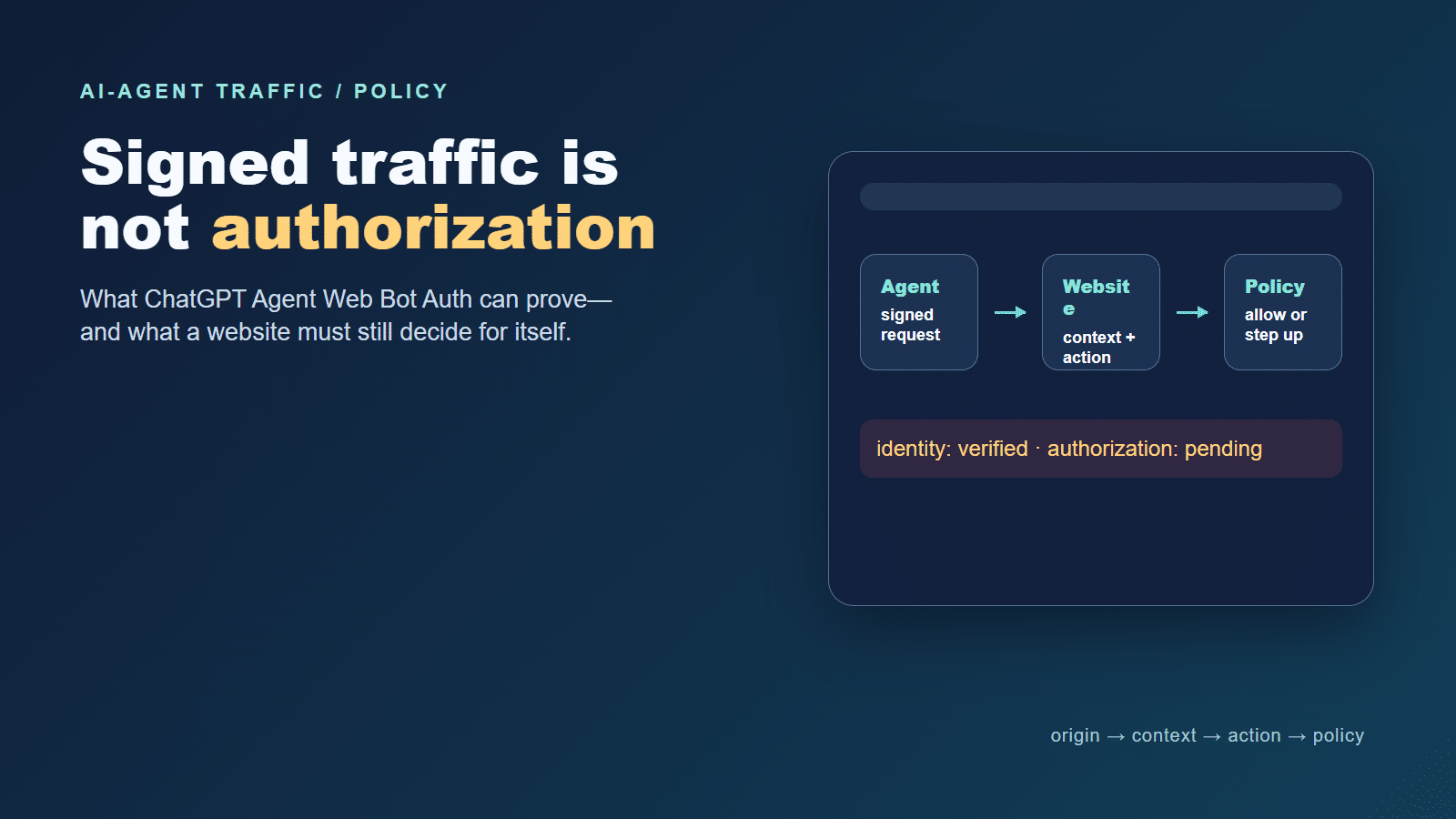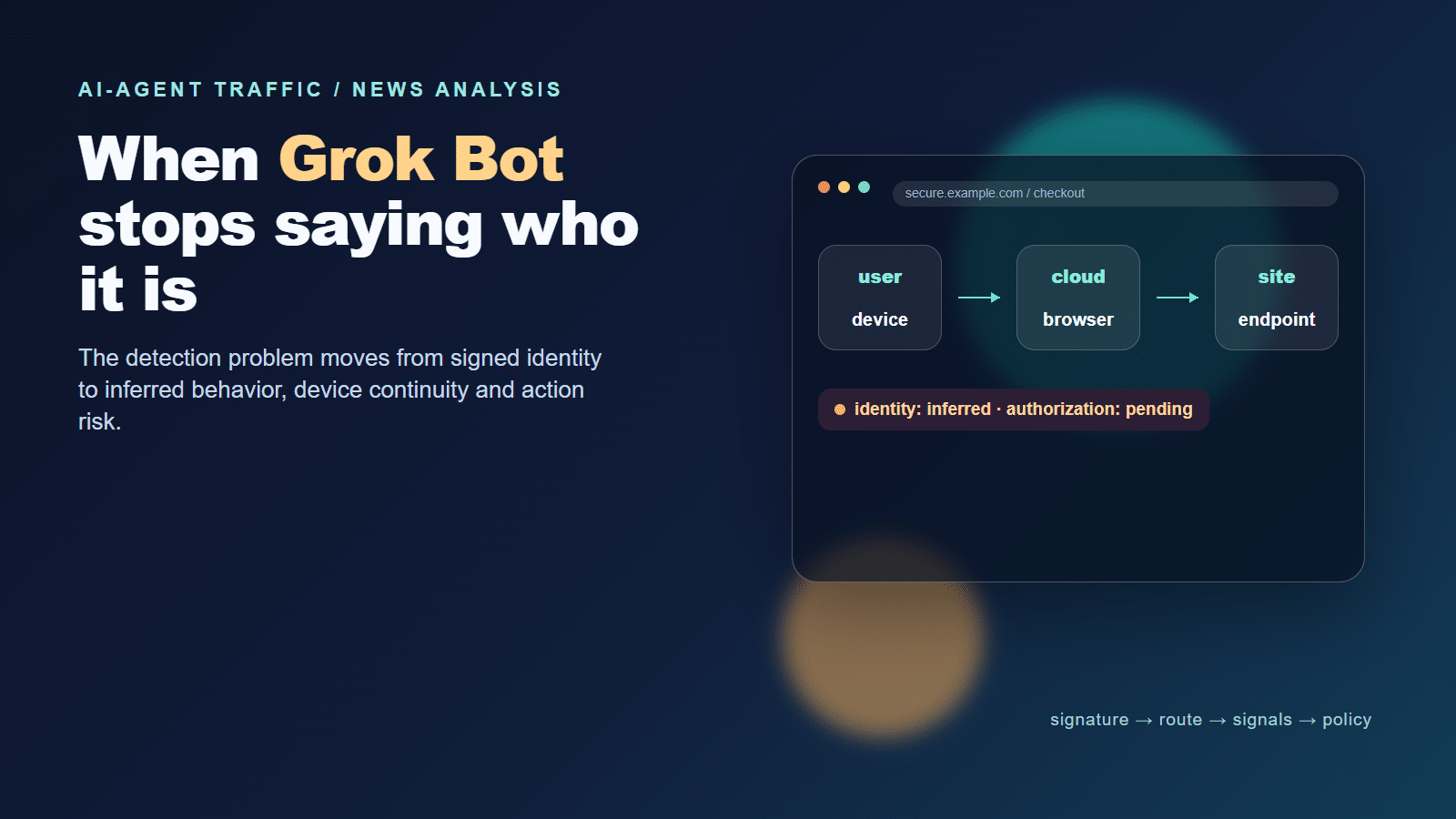

Grok Bot was introduced as an AI teammate that can use its own computer, sign in to websites and complete multi-step work. In October 2026, independent detection reports described less reliable signing, user-IP routing and more human-like interaction patterns. For websites, the issue is not whether Grok Bot is good or bad; it is whether the request carries enough evidence to authorize a login, form submission, purchase or account change.
Grok Bot Was Built to Operate Where Websites Do
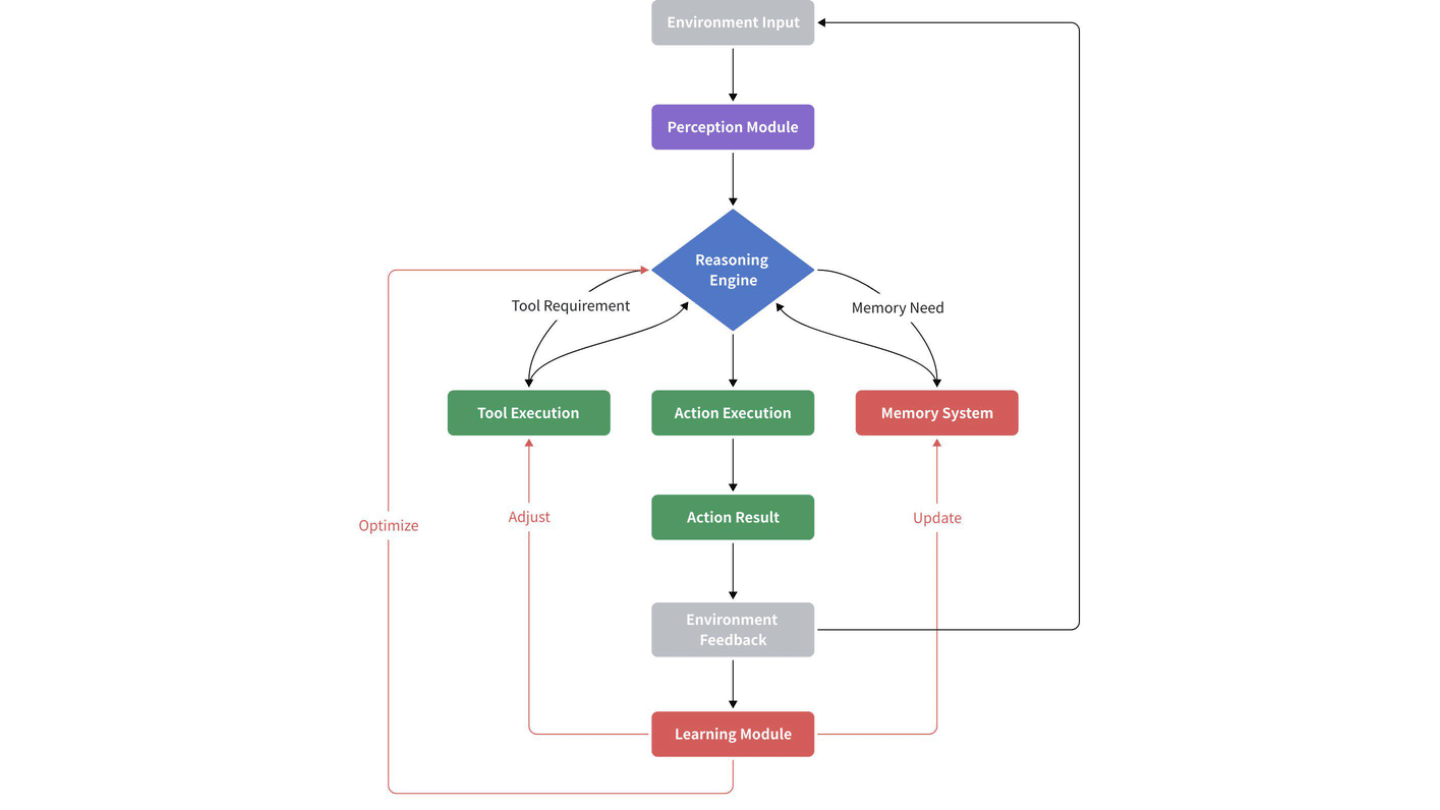
xAI describes Grok Bot as an always-on teammate with a computer of its own. It can work across apps, inboxes and websites, including services that do not offer a clean API or MCP connection. The launch examples include CRM updates, invoice processing, bug reproduction and multi-Bot handoffs. That is a different traffic pattern from a model that only returns text: the agent can open a page, maintain a session, use credentials and leave a state change behind.
The site still receives ordinary browser requests even though the user has delegated the goal. Grok Bot’s distinctive issue is the quality and stability of the identity signals that reach the site.
xAI’s security documentation describes one hosted microVM per member plus team, network, privacy and action-review controls. Those controls govern the Bot’s environment; they do not automatically tell a downstream website whether a request is agent-operated, human-operated or mixed.
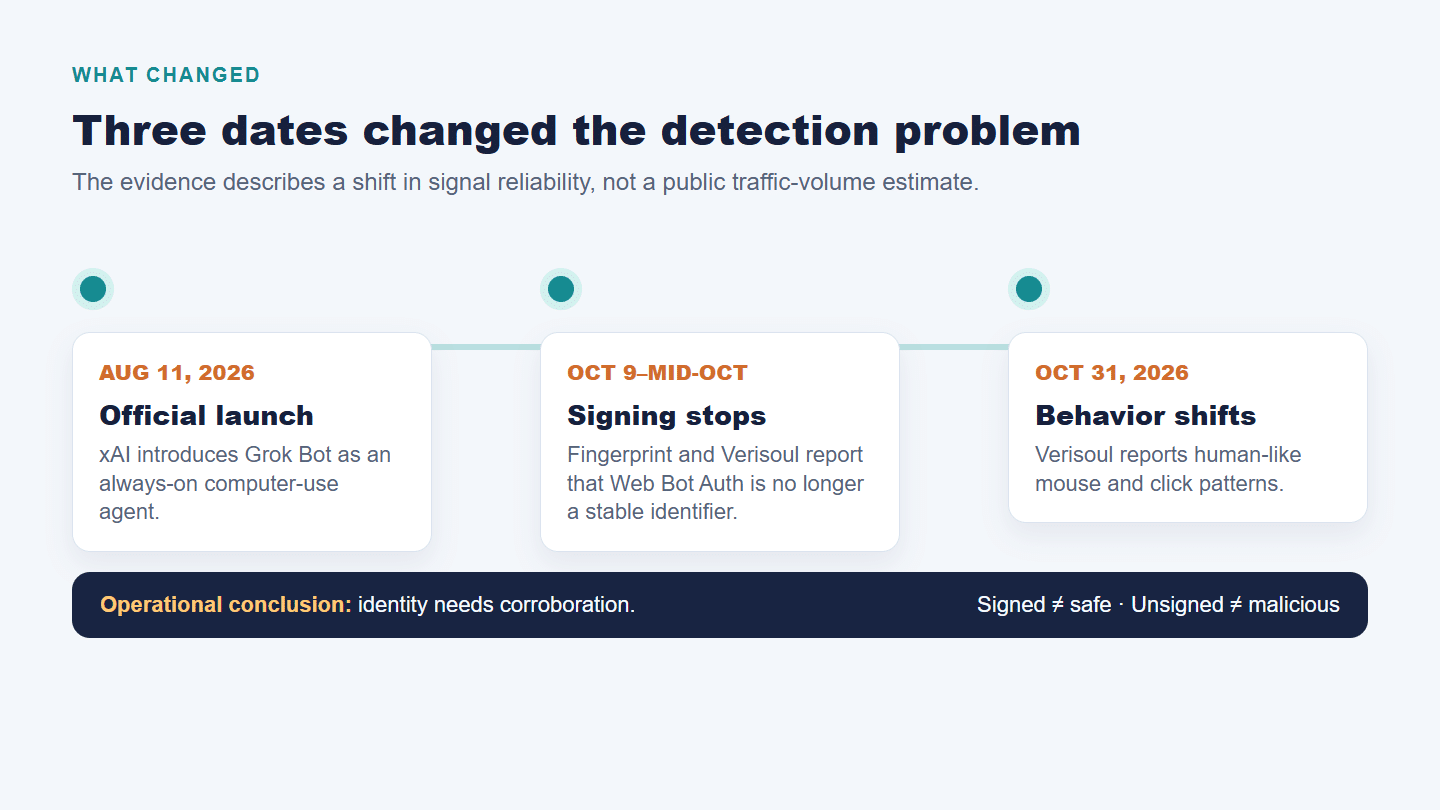
The Identity Signal Changed in Three Steps
| Date | Observed or official change | Source and implication |
|---|---|---|
| August 11, 2026 | xAI launches Grok Bot in beta | xAI launch announcement: computer-use sessions become a documented product behavior. |
| Around October 9 / mid-October | Web Bot Auth signing reportedly stopped | Fingerprint reported the change: a signature check is no longer a stable positive identifier for every live session. |
| October 31, 2026 | Human-like mouse and click behavior was reported | Verisoul reported the later behavior: simple interaction heuristics become less reliable on their own. |
Cloudflare Radar’s directory still records the signed baseline—`GrokAgent`, Web Bot Auth and one public key. That is historical identity documentation, not proof that every current request is signed.
What This Identity Change Risks for Websites
For a website, the problem is straightforward: it has to decide whether to allow an action before it knows who is operating the browser. A Grok Bot session may come from a familiar user or residential network and behave like a normal browser, while its signed identity is missing or unstable. In other words, the request can look normal without giving the site reliable proof that a person is behind it.
- Allowing too much: the site treats an ordinary-looking session as human and lets automation pass a login, registration, reward or data-access control.
- Blocking too much: the site treats a missing signature or unusual interaction as malicious and adds friction to a legitimate task delegated to an agent.
- Applying controls inconsistently: the same account or endpoint receives different treatment as signals appear or disappear, giving an attacker more chances to find a weaker path.
Agentic automation raises the cost of getting that decision wrong. The agent can keep a session open, remember state between pages, adapt when a flow changes and repeat the work without a person operating every step. That makes abuse cheaper to run and harder to separate from normal browser traffic.
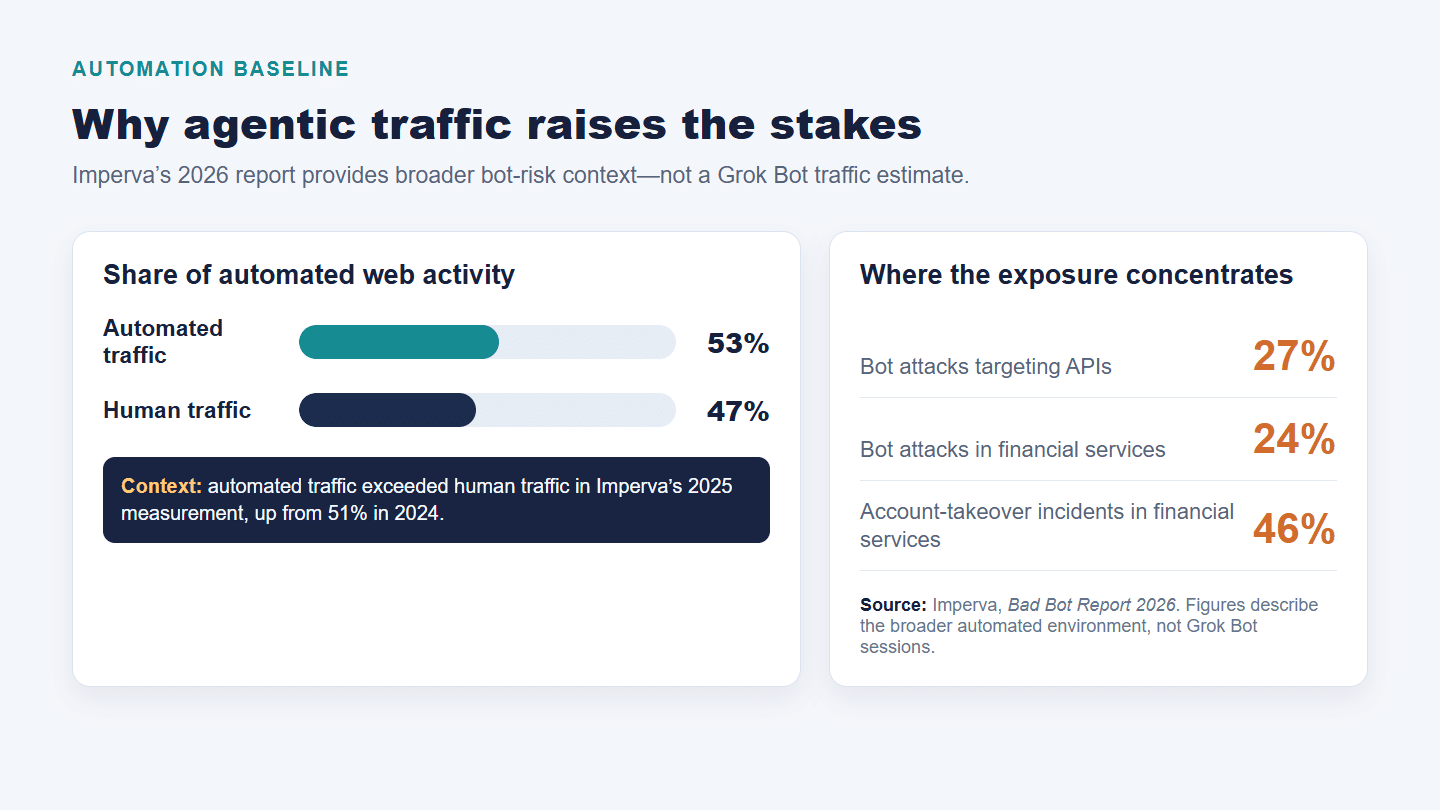
The wider automation environment shows why the exposure is material. Imperva’s 2026 Bad Bot Report says automated traffic accounted for more than 53% of web traffic in 2025, up from 51% in 2024; 27% of bot attacks targeted APIs; and financial services represented 24% of bot attacks and 46% of account-takeover incidents. These figures are not Grok Bot measurements, but they show the scale of the automated environment in which agent traffic operates.
- Daily check-ins and rewards: repeated claims can be spread across many accounts, consuming benefits and corrupting participation data.
- Fake registrations: realistic sessions can make account-farm creation resemble genuine onboarding, inflating acquisition numbers and increasing support or fraud costs.
- High-fidelity scraping: a stateful agent can move through JavaScript-heavy flows and collect data at a depth and pace that simple crawler rules may miss.
- API and account abuse: once a valid session is available, the agent can repeatedly call sensitive endpoints or test account actions with little additional labor.
The risk is therefore not that every Grok Bot session is abusive. It is that an ordinary-looking session can perform high-impact actions before the site has enough evidence to classify it. The most important controls belong on the endpoints where repeated rewards, new accounts, sensitive API calls or bulk data extraction can affect revenue, account integrity or data exposure.
What the New Evidence Actually Tells Security Teams
The evidence supports a conclusion about signal reliability, not traffic volume: xAI documents browser operation; the independent reports date the identity and behavior changes; and Cloudflare preserves the signed baseline. The independent reporting also notes that no public usage figure is available, so a traffic surge should not be inferred.
Keep declared identity, inferred identity and unknown automation as separate states. Measure which endpoints they reach and what they attempt to change; apply more friction when the business consequence is higher.
| Signal | Useful for | Not enough to prove |
|---|---|---|
| Web Bot Auth signature | Cryptographic identity when valid and current | That an unsigned request is malicious |
| IP and network path | Connection and reputation context | That a person is operating the browser |
| Device and session continuity | Correlating a browser with prior outcomes | Who authorized the requested action |
| Behavior and endpoint context | Deciding how much friction the action deserves | That every automated action should be blocked |
A Better Response Model for Grok Bot Traffic
A useful policy chain is Identify → Correlate → Authorize → Constrain → Review.
- Identify: determine whether the request is signed, self-declared, inferred or unknown.
- Correlate: compare device, session, account, network and recent outcomes.
- Authorize: evaluate the requested action against the site’s policy, not only the user’s delegation to an agent.
- Constrain: apply rate limits, a step-up check, a hold or a block when the consequence justifies it.
- Review: examine false positives and confirmed abuse by endpoint and cohort.
| Flow | Starting response | Escalation trigger |
|---|---|---|
| Public browse or search | Observe and allow normal depth | Harvesting, excessive repetition or unusual breadth |
| Login or registration | Correlate device, account and velocity | Credential failures, recovery events or identity conflict |
| Form or promotion claim | Validate state and rate-limit | Repeated claims, account clusters or scarce inventory |
| Checkout or account change | Use transaction and session risk checks | New payment context, high value or conflicting signals |
For implementation, browser fingerprinting can add continuity evidence, while a broader bot-traffic framework helps classify ordinary crawlers, declared agents, inferred automation and suspected spoofing. The goal is an explainable policy decision, not a permanent moral label.
Where GeeTest Fits in the Control Path
GeeTest’s role can be kept practical and bounded:
- Detection: Device Fingerprinting contributes device and session continuity evidence for investigating inferred automation. It is not, by itself, definitive proof of an AI agent.
- Challenge or block: GeeTest CAPTCHA can provide direct verification and support blocking when a site’s policy requires it. The agent bot defense capability is relevant when an automated client reaches a protected flow.
- Policy: Business Rules Engine can route different endpoint and account conditions in real time; the rule-engine guide provides related implementation context.
GeeTest is continuing to optimize its AI-agent capabilities as traffic patterns change. Clearer AI-agent marking is a development direction—not a generally available feature claim here—that could add a useful signal to logs, dashboards and policy inputs. If that direction becomes available, it should complement device, session, account, endpoint and behavior context rather than replace them.
Final Takeaway: Identity Is a Signal, Not Permission
Grok Bot shows why identity should be treated as one signal, not permission. A signature is useful when present, but authorization should also consider device and session continuity, account history, endpoint sensitivity and the consequence of the requested action.
A declared agent is not automatically trusted, and an undeclared agent is not automatically malicious. The business still owns the decision at the point where a request can spend money, alter an account, consume scarce inventory or expose sensitive data. GeeTest is continuing to study how clearer AI-agent marking could support that control path; this article does not represent it as an already released capability.
Frequently Asked Questions
1. Does Grok Bot still sign every request with Web Bot Auth?
Not reliably. The October 2026 observations describe a change in signing behavior, while Cloudflare’s directory preserves the earlier signed-agent baseline. Treat the live request—not the directory record—as the decision point.
2. Can a website identify Grok Bot from its IP address alone?
No. A familiar residential or office IP does not prove that a person is operating the browser, especially when an agent can use the member’s connection.
3. Should businesses block Grok Bot?
Not by default. Start with visibility and endpoint-specific controls. Allow low-consequence activity when appropriate, and use rate limits, step-up verification, review or blocking when the action and evidence justify more friction.
4. What signals should be combined for Grok Bot detection?
Combine declared or inferred identity with device continuity, session behavior, network path, account history, velocity, endpoint sensitivity and transaction context. Preserve uncertainty rather than treating one signal as proof.