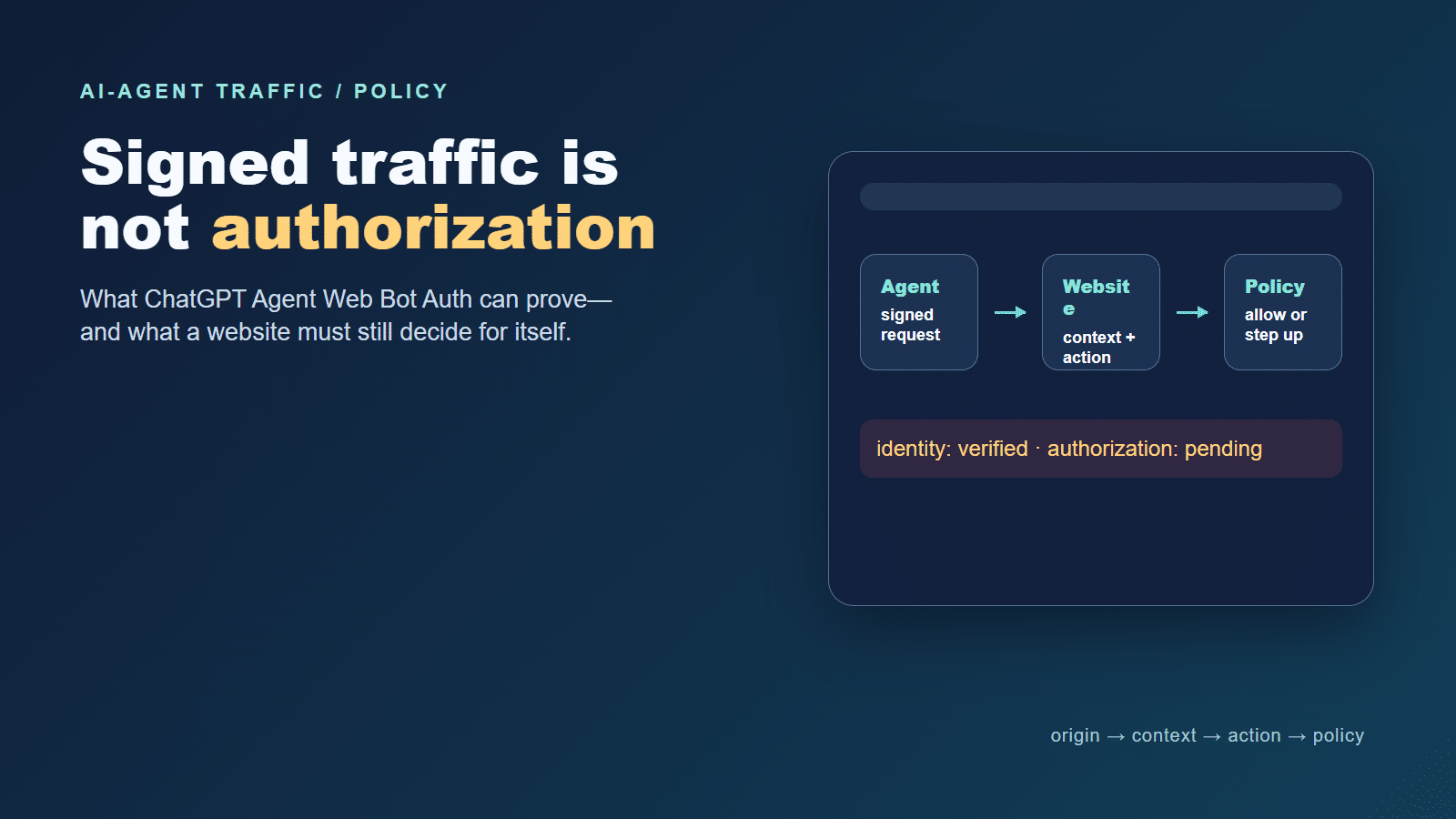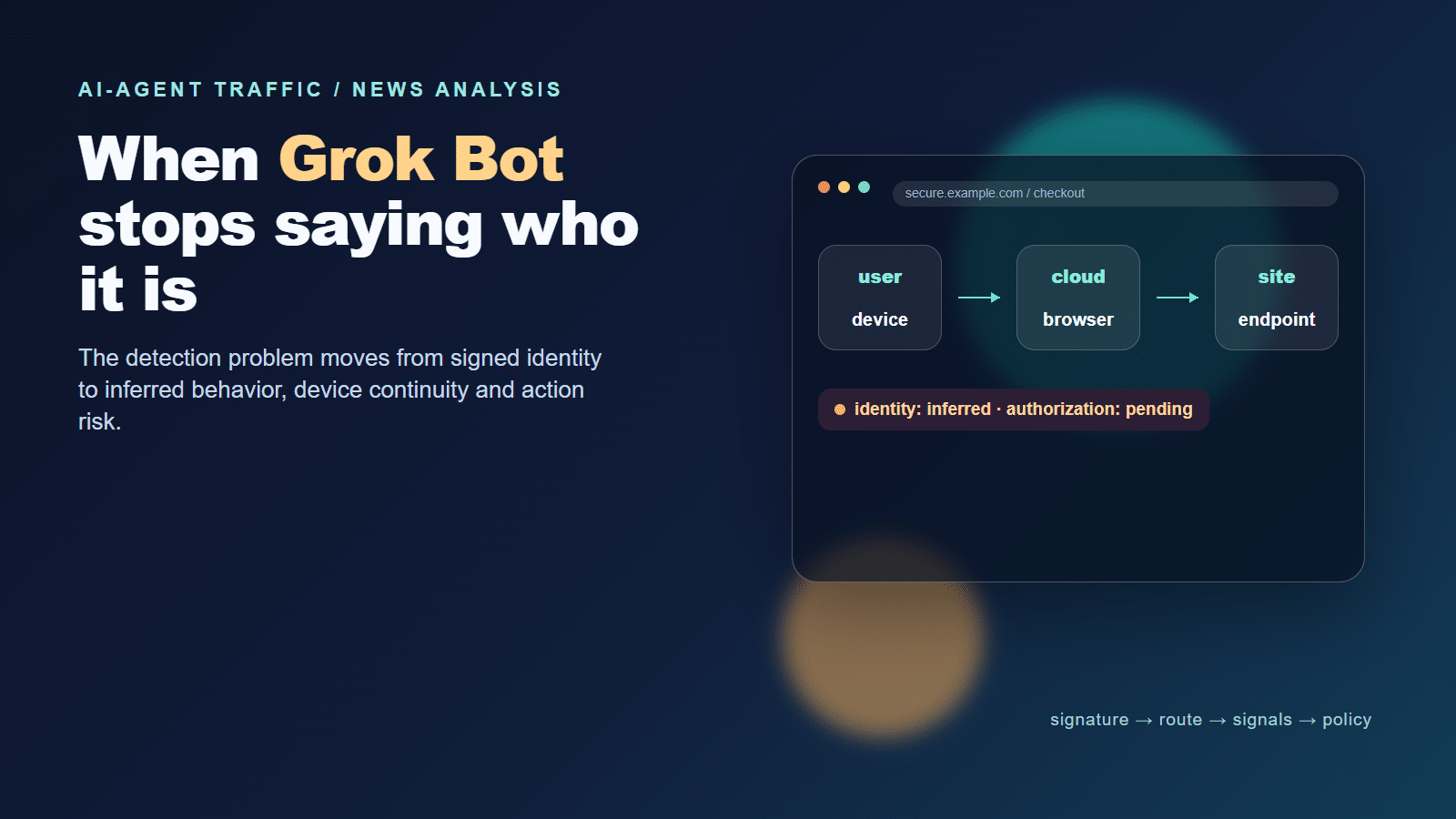

ChatGPT Agent can use a cloud browser to interact with websites, and OpenAI’s current Agent Access guidance explains how certain automated browser requests use Web Bot Auth to identify themselves. That is an important improvement over trusting a User-Agent string or an IP range that can be copied or changed.
It is not a complete authorization decision.
A valid Web Bot Auth signature can support the conclusion that a request is associated with ChatGPT Agent. It does not, by itself, prove that a person authorized the requested action, that the account is low risk, or that the website should allow every endpoint. The practical control problem is therefore not “Should we trust ChatGPT?” It is “What should this verified client be allowed to do in this session, on this account, at this endpoint?”
What ChatGPT Agent Web Bot Auth Actually Verifies
Web Bot Auth is built around HTTP Message Signatures. In simplified terms, the automated client signs selected parts of an HTTP request, and the receiving site uses the agent’s published verification material to test whether the signature is valid. The underlying standard is documented in RFC 9421.
OpenAI’s developer guidance describes this mechanism for signed cloud-browser requests and separates it from ordinary web-crawler handling. The distinction matters because a browser agent may navigate, fill fields and reach a state-changing endpoint, while a crawler is usually discussed as a retrieval client.
1. Identity attestation
A successful verification gives the site an attestation about the signer. It can be more useful than a self-declared User-Agent: ChatGPT because the site can validate the cryptographic relationship rather than trusting the label alone.
2. Request integrity and freshness
Signature verification can also help the site detect whether the signed request matches the covered message components. When validity windows and replay controls are enforced, it can contribute to freshness checks and make the request easier to classify and audit.
The result is still an identity signal. It is not a universal permission token.
What a Valid Signature Does Not Authorize
The most important boundary is the difference between who sent a request and what the request should be allowed to do.
| Evidence | What it can support | What it cannot prove |
|---|---|---|
| Valid Web Bot Auth signature | The request is associated with the published signer | The user approved every action in the session |
| ChatGPT Agent identity | A known agent category for policy and logging | That the account, device or transaction is trustworthy |
| Normal-looking browser session | The request uses a browser surface that may be compatible with a real user journey | That a human is personally operating each step |
| Familiar IP or network path | Connection and reputation context | That the person behind the session is authorized |
| Prior successful requests | Historical continuity | That a later password reset, payout or purchase is safe |
This is why identity attestation is not user authentication. The site may know that ChatGPT Agent made the request without knowing which person delegated it, whether the account owner intended the exact action, or whether the action fits the account’s normal pattern.
The same distinction applies to transactions. A signed request that reaches checkout is still a checkout request. It may need the site’s existing payment, account, device and velocity controls. The signature should enrich that decision, not replace it.
Why Allowlisting ChatGPT Agent Can Create a Policy Trap
Allowlisting can be useful when a site wants legitimate agent-assisted discovery to work reliably. A broad exception becomes risky when it silently bypasses controls that were designed around business consequence.
Consider four paths:
- Public browse or search: An agent can help a person compare products. An observe-first policy with rate and abuse limits may be appropriate.
- Login: The site still needs account, device and session context. A signed agent should not erase new-device or recovery-flow checks.
- Registration or promotion: Automated completion can create reward abuse, duplicate accounts or distorted acquisition data. Identity is only one input.
- Password reset, account change or payment: These actions change durable state or move money. They deserve stronger step-up, review or blocking conditions when the surrounding evidence is inconsistent.
The opposite error is also real. Blocking every signed agent may break legitimate delegated browsing, accessibility workflows or emerging agentic-commerce journeys. The goal is proportional control, not a permanent allow or deny label.
A Practical Decision Model for Signed AI-Agent Traffic
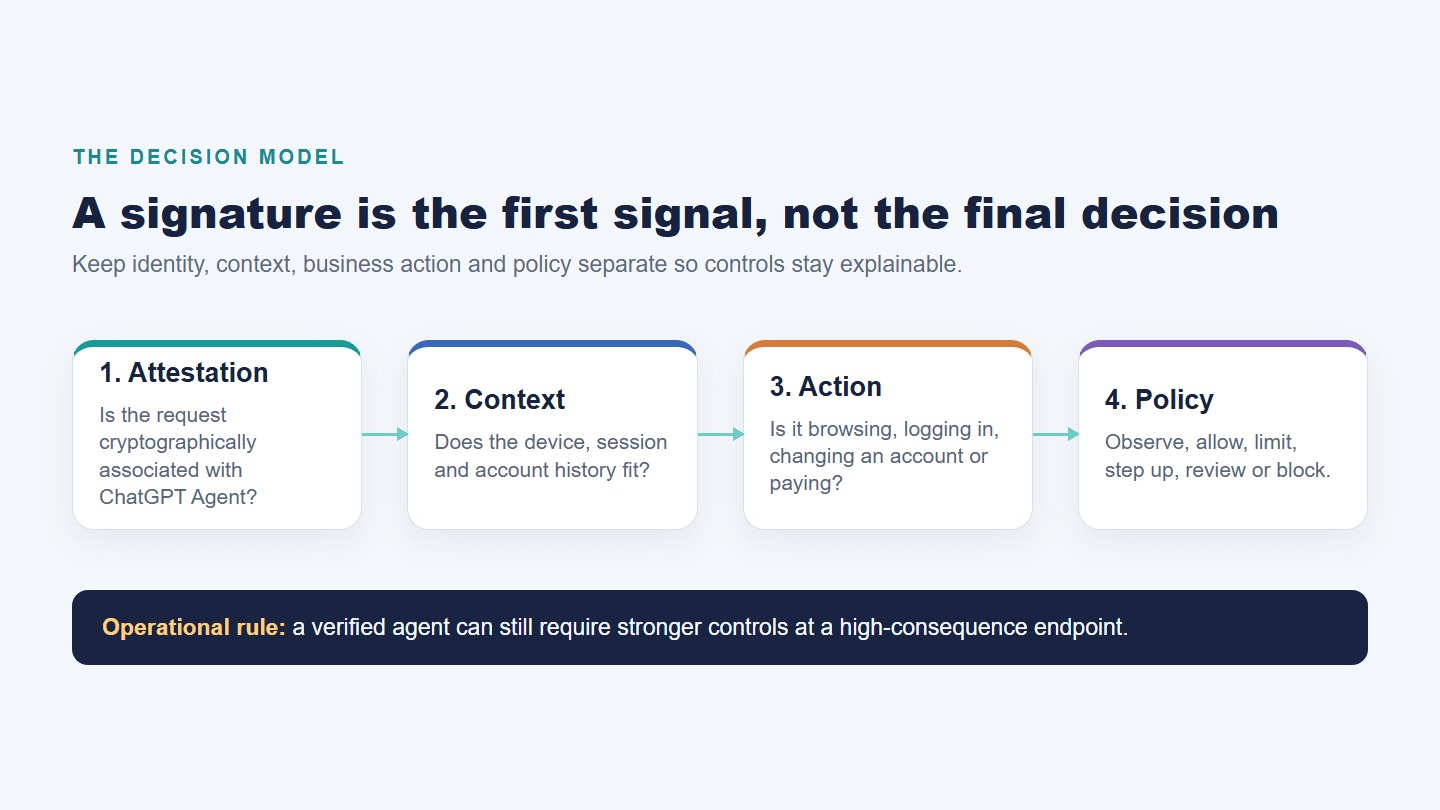
Use four separate layers: Attestation → Context → Action → Policy.
1. Correlate device, session and account context
After verifying the agent signal, correlate it with the session that reaches the site. Useful context can include device continuity, browser characteristics, navigation sequence, login history, recovery events, payment history and request velocity. A signed agent arriving through a familiar account and a stable session is different from a new account that immediately attempts a sensitive action.
For a broader explanation of how device signals fit into bot and fraud decisions, see GeeTest’s Device Fingerprinting capability. The relevant principle is correlation, not a claim that one fingerprint can decide every request.
The same distinction is useful when reading GeeTest’s agent-bot defense overview: an agent-like signal should be combined with context and policy rather than treated as a standalone verdict.
2. Evaluate the endpoint and business consequence
The requested action should change the policy. A read-only product page, a login, a coupon claim and a payout endpoint do not carry the same consequence. Endpoint sensitivity gives the rule system a concrete reason to add friction instead of treating “AI” as a complete risk category.
3. Preserve uncertainty in the decision record
Record what is known and what is not known: verified agent identity, account context, device continuity, behavior pattern, endpoint and final action. This is more explainable than storing a binary field such as trusted_bot=true, especially when keys, routes or product capabilities change.
Match the Response to the Action, Not Just the Agent Label
The policy should be progressive. Start with the least disruptive action that protects the endpoint, then escalate when signals conflict or the consequence rises.
| Requested action | Default posture | Escalate when |
|---|---|---|
| Public browse or search | Observe or allow with rate and abuse limits | Unusual velocity, scraping sequence or repeated retries |
| Login | Contextual allow | New device, recovery path, account mismatch or burst attempts |
| Registration or promotion | Limit or step up | Reward abuse, repeated identity patterns or burst creation |
| Account change or payment | Step up, review or block | High-risk device, impossible sequence or transaction anomaly |
Run new policies in observation or shadow mode before enforcing them. Compare false positives, conversion impact, challenge completion and abuse outcomes. When a provider changes its signer, key directory or browser behavior, review the policy input rather than assuming the old allowlist remains complete.
For the broader control layer, GeeTest’s bot management guidance, rule-engine guide and bot-detection overview provide useful context. The operational objective is to combine signals and business rules, not to make CAPTCHA the only response.
Where GeeTest Fits in the Control Stack
GeeTest fits at the decision layer, where agent identity is one input rather than the final verdict. Its control flow can be summarized as:
- Observe the session: Device Fingerprinting captures device, session and environment signals, while behavioral and request context help show whether the session is consistent or anomalous. CAPTCHA can add a human-verification step when the risk level requires it.
- Add business context: The Business Rules Engine combines those signals with site-defined business variables, which may include endpoint, account state, access velocity, transaction value and workflow stage. This lets the same signed agent receive different treatment for public browsing, login, registration or payment actions.
- Manage the outcome: The resulting assessment supports human-versus-automation identification and a proportionate response—observe, allow, rate-limit, step up, review or block. Abnormal traffic can therefore be isolated or managed without treating every automated session as malicious.
This approach keeps the control decision close to the business process: a valid agent signature can enrich the risk record, but it does not replace device, behavior, environment or action-specific checks. As AI-agent traffic becomes more common, this separation between origin signals and business-policy decisions will become increasingly important; any future AI-agent marking signal should be treated as an additional input, not as a universal authorization label.
Final Takeaway
ChatGPT Agent’s signed traffic is a meaningful step toward accountable automation. It gives websites a stronger answer to “who is sending this request?” It does not answer the next questions: “Which user delegated it?”, “What is this session trying to do?” and “Should this action be allowed here?”
The durable design is therefore simple: verify the agent when possible, correlate the surrounding context, judge the business consequence, and apply the smallest control that fits the action. When the action needs stronger assurance, a risk-based verification step such as Adaptive CAPTCHA can add friction without turning every signed session into a block. Signed identity should inform authorization; it should never silently replace it.
If your website needs to distinguish verified automation from unknown or risky sessions without treating every AI agent the same way, review your current bot signals, endpoint policy and step-up controls as one decision system.
Frequently Asked Questions
1. Is ChatGPT Agent traffic safe if it is signed?
No. A valid signature is useful evidence about the request’s declared origin. It does not prove that the account, user intent, device or transaction is safe. Keep endpoint and session controls in place.
2. Can websites allowlist ChatGPT Agent?
They can create an allow or reduced-friction policy for verified traffic, but a broad global exception is risky. Separate low-consequence browsing from login, registration, account recovery and payment actions.
No. Web Bot Auth authenticates a client-side signer; it does not establish the full chain of user delegation, account ownership and business authorization for a specific action.
4. How should websites govern AI-agent traffic?
Combine attestation with device, session, account, behavior, velocity and endpoint context. Use progressive controls—observe, allow, limit, step up, review or block—and keep the policy explainable when signals change.