
Ecommerce fraud prevention is the coordinated use of signals, policies, verification, review, and recovery to reduce abusive activity without treating every unusual customer as an attacker. A useful program covers payment fraud, account takeover, automated abuse, promotion and reseller abuse, returns manipulation, and the operational decisions that follow a risk signal.
The goal is not to make checkout impossible. It is to make each decision proportionate, explainable, observable, and reversible. This framework shows how online retailers can map their journeys, combine evidence, choose a response, and learn from both confirmed fraud and legitimate customers who were challenged.
What Ecommerce Fraud Prevention Must Cover
Fraud is an outcome, not a single technical event. A stolen card used at checkout, a scripted account-creation campaign, a customer locked out after an account takeover, and a coordinated attempt to drain a promotion may look different in logs but still damage revenue and trust.
Start by separating the abuse outcomes you own:
- Payment and card-not-present fraud: an unauthorized purchase or a transaction made with compromised payment details.
- Account takeover: an attacker uses stolen credentials, session tokens, or recovery weaknesses to change an account or place orders.
- Automated and reseller abuse: bots test cards, create accounts, hoard scarce inventory, scrape prices, or exploit queue and checkout logic.
- Promotion and policy abuse: coupon stacking, referral farming, gift-card abuse, refund manipulation, or repeated “new customer” benefits.
- First-party or friendly fraud: a legitimate payment is disputed, a delivery is falsely denied, or a return policy is deliberately exploited.
These categories overlap. A bot can attempt account takeover, a compromised account can place a payment-fraud order, and a promotion campaign can use many devices and identities. Your control design should therefore follow the journey and the decision—not only the fraud label.
For a broad lifecycle view, use the fraud prevention guide. For a software-shortlist perspective, the fraud prevention software comparison is a related resource, not a substitute for journey-level testing.
Start With a Journey-Level Risk Map
List the business assets, events, owners, and failure costs before choosing a tool. A retailer may protect a login, a checkout, a gift-card balance, a limited-release inventory pool, a refund workflow, and a support interaction with different controls and different tolerance for friction.
| Journey | Asset at risk | Useful signals | Failure to measure |
|---|---|---|---|
| Signup and promotion | Incentive budget and customer identity | device history, velocity, email reputation, behavior | fake-account rate, incentive loss, legitimate signup drop |
| Login and recovery | Account, stored payment and loyalty value | device change, session context, impossible travel, credential velocity | takeover rate, recovery time, support escalations |
| Checkout | Goods, payment approval and delivery address | payment context, device, network, velocity, order history | chargebacks, approval rate, review queue, abandonment |
| Returns and refunds | Inventory and cash | order history, return pattern, account links, delivery evidence | refund loss, repeat abuse, appeal outcomes |
Define a baseline for each journey before changing policy. A baseline can be a rate, distribution, or queue shape rather than a single “fraud score.” Record normal order velocity, device reuse, challenge completion, review time, and appeal outcomes by market, channel, and customer cohort. This prevents a global rule from hiding a regional or seasonal pattern.
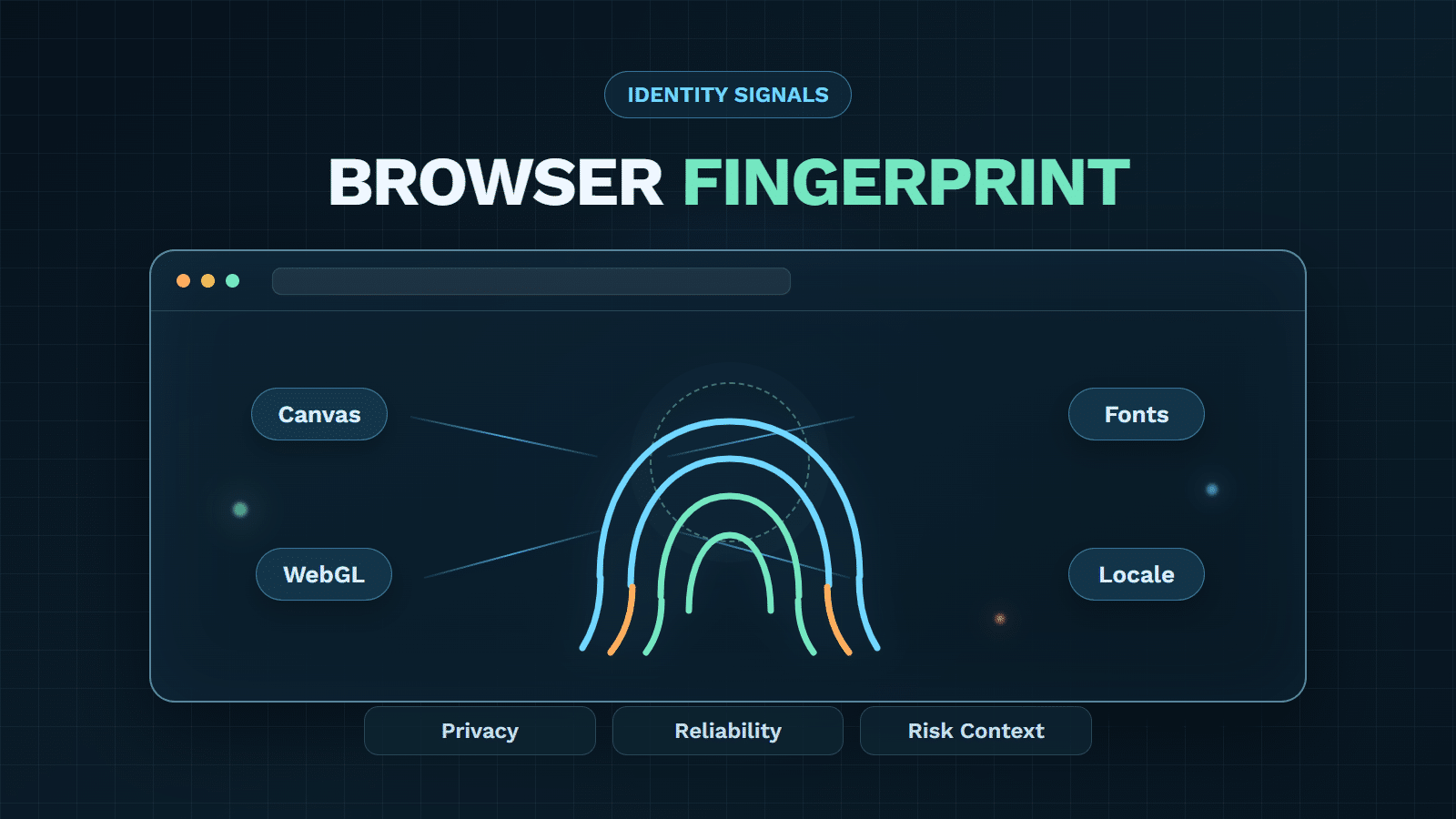
The device intelligence for fraud prevention article explains why device identity, environment, behavior, and history are context rather than a verdict. That distinction matters in ecommerce: shared households, corporate networks, travel, accessibility tools, and privacy controls can all make a legitimate session look unusual.
Use device and behavioral signals in accordance with applicable privacy, data-protection, notice, retention, and regional regulatory requirements.
Build Layered Controls Around Signals
Layering means combining different evidence types and assigning each a job. Identity evidence can establish who is attempting an action; device and network evidence can show whether activity is coordinated; behavioral and velocity evidence can reveal automation; transaction and business-context evidence can show whether the requested action fits the customer’s history.
Common layers include:
- Account and authentication controls. Use strong passwords, MFA, recovery protections, and step-up checks for sensitive changes. Apply 3-D Secure or an equivalent payment-authentication control where the payment flow and issuer support it.
- Device and session intelligence. Connect activity across sessions or accounts without assuming that a device identifier alone proves intent. Monitor changes in environment, browser behavior, automation indicators, and reuse patterns.
- Network and velocity controls. Compare IP, ASN, region, proxy and request-rate context with the journey. Velocity rules should be specific enough to distinguish a high-volume campaign from a busy household or legitimate event.
- Transaction and business rules. Evaluate order value, address relationships, shipping urgency, gift-card behavior, promotion eligibility, refund history, and inventory scarcity. Rules should have owners, versions, test cases, and rollback paths.
- Human review and recovery. Route ambiguous events to a queue with evidence, reason codes, and a safe customer path. A control that blocks but cannot explain or recover is incomplete.
The click fraud protection guide shows how a narrow abuse problem can require its own signals and response logic. The same principle applies to ecommerce: do not force every risk into a payment-only control.
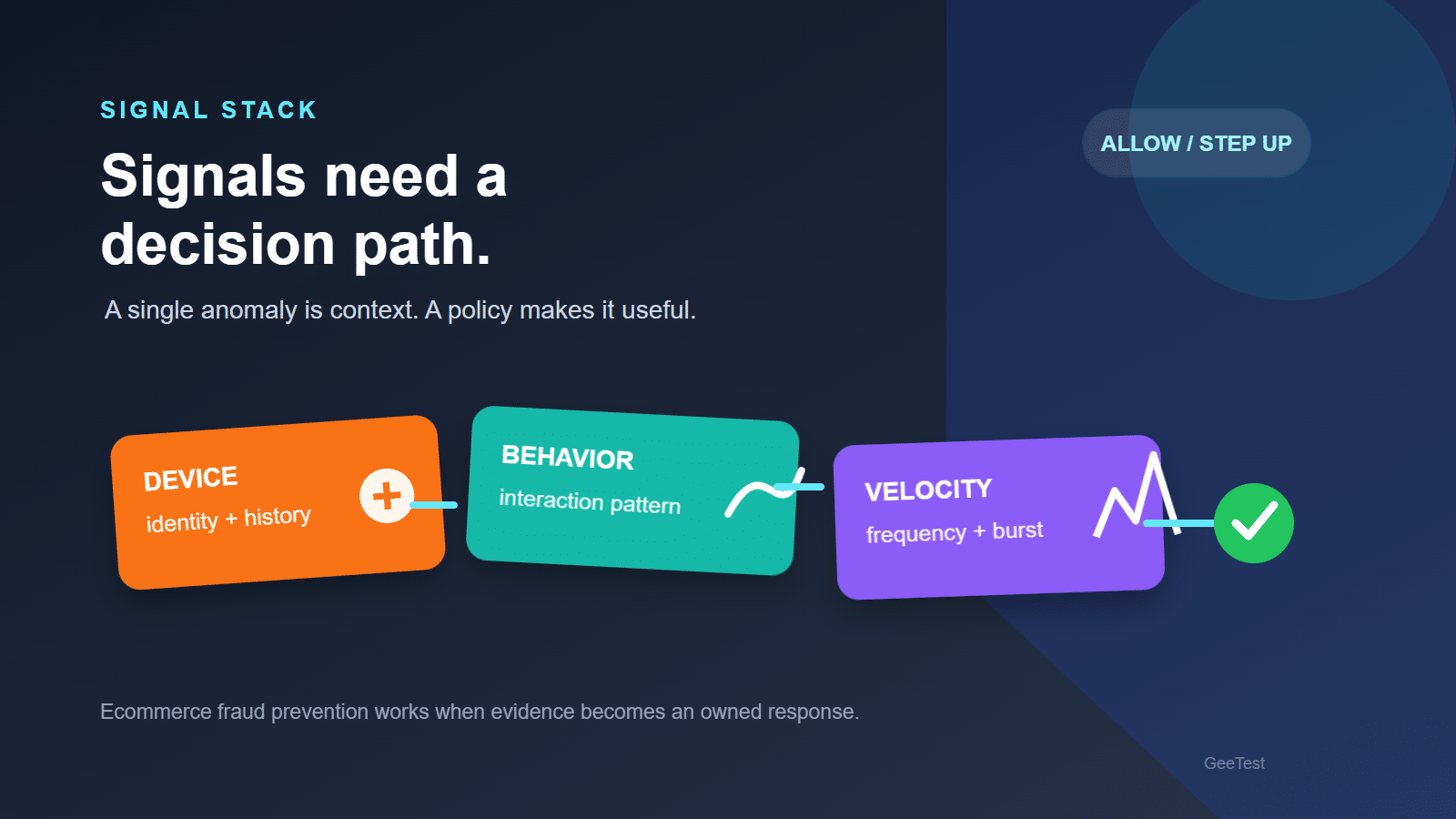
*Signals become useful when a retailer can connect them to an owned, proportionate response.*
Turn Risk Signals Into Operational Decisions
A score is not a response. The operating policy should say what happens when context is normal, ambiguous, or strongly associated with abuse. A simple decision matrix keeps security, product, payments, operations, and support aligned.
| Observed context | Proportionate response | Decision owner |
|---|---|---|
| Known device and normal velocity | Allow and monitor | Product / risk |
| New device plus unusual login or recovery | Step up verification | Security |
| Velocity spike plus promotion abuse | Review, delay, or block | Risk / operations |
| Confirmed abuse with a customer appeal | Contain, investigate, and recover | Support / security |
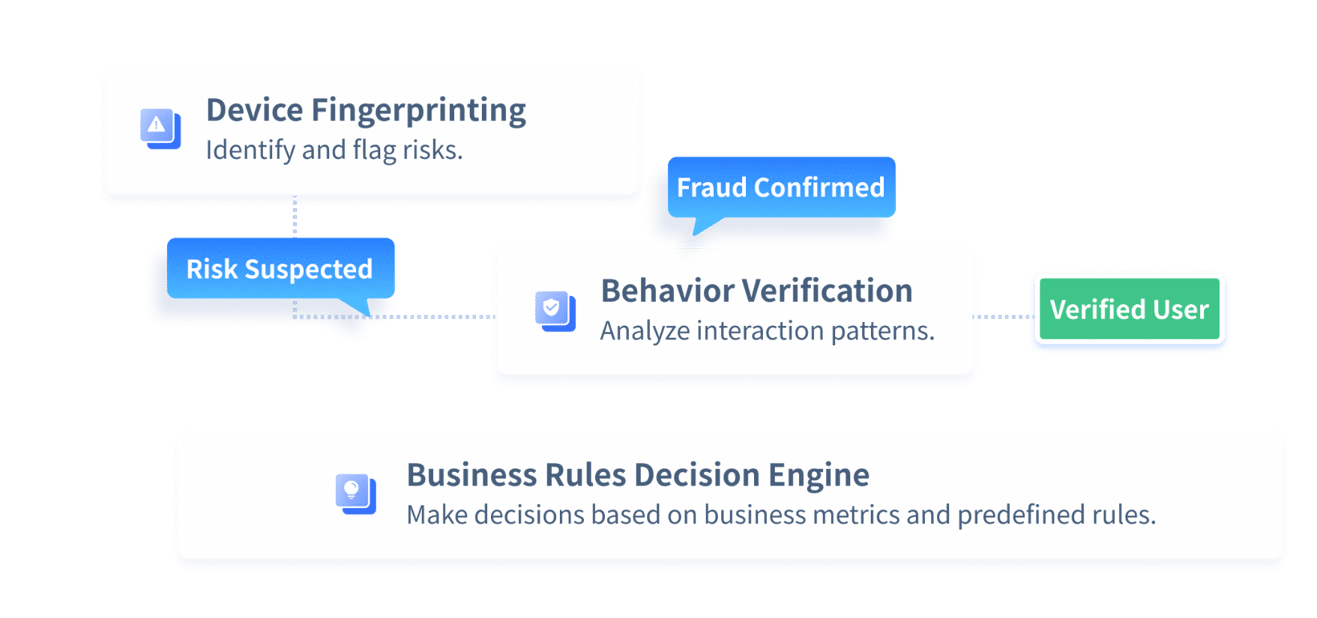
*A product mix can support the path from device and behavior evidence to a business-owned decision; it should complement payment, fulfillment, and review controls.*
Use Adaptive CAPTCHA when a web session needs a proportionate human-verification step, rather than presenting the same challenge to every visitor. Use Device Fingerprinting when device context can improve continuity between events. These are complementary controls inside a broader ecommerce stack; they do not replace payment authorization, chargeback processes, AML/KYC, or customer-service recovery.
Policy design should include four safeguards:
- Explainability: record the reason category and evidence used, while keeping sensitive detection logic private.
- Appeal and recovery: provide a safe route for a legitimate customer to regain access or complete a purchase.
- Shadow mode: observe a new rule before enforcing it so the team can measure false positives and edge cases.
- Rollback: version policies and define who can disable or narrow a rule when a campaign, release, or regional event changes the baseline.
Test the Stack Without Sacrificing Conversion
Run a focused pilot on one journey with a clear owner and a defined rollback. A useful pilot includes three cohorts: normal traffic, ambiguous traffic, and confirmed abuse. Compare the same decisions with and without the new signal or policy.
Ask each control provider and internal team to show:
- Which signals are available before the decision and how they are normalized.
- What the downstream system receives: allow, step-up, review, delay, block, reason code, webhook, or case record.
- How latency, dependency failure, regional availability, privacy controls, and data retention are handled.
- How a legitimate user appeals, recovers, or completes the journey through an alternative path.
- How a rule is tested, monitored, versioned, and rolled back.
For automation-heavy journeys, pair risk signals with an abuse-control layer. The API rate limiting guide is useful when request volume itself is part of the threat model. GeeTest can be evaluated for device, behavior and adaptive-verification needs around web journeys, while a payment provider, issuer, fraud analyst, or compliance team owns the controls outside that boundary.
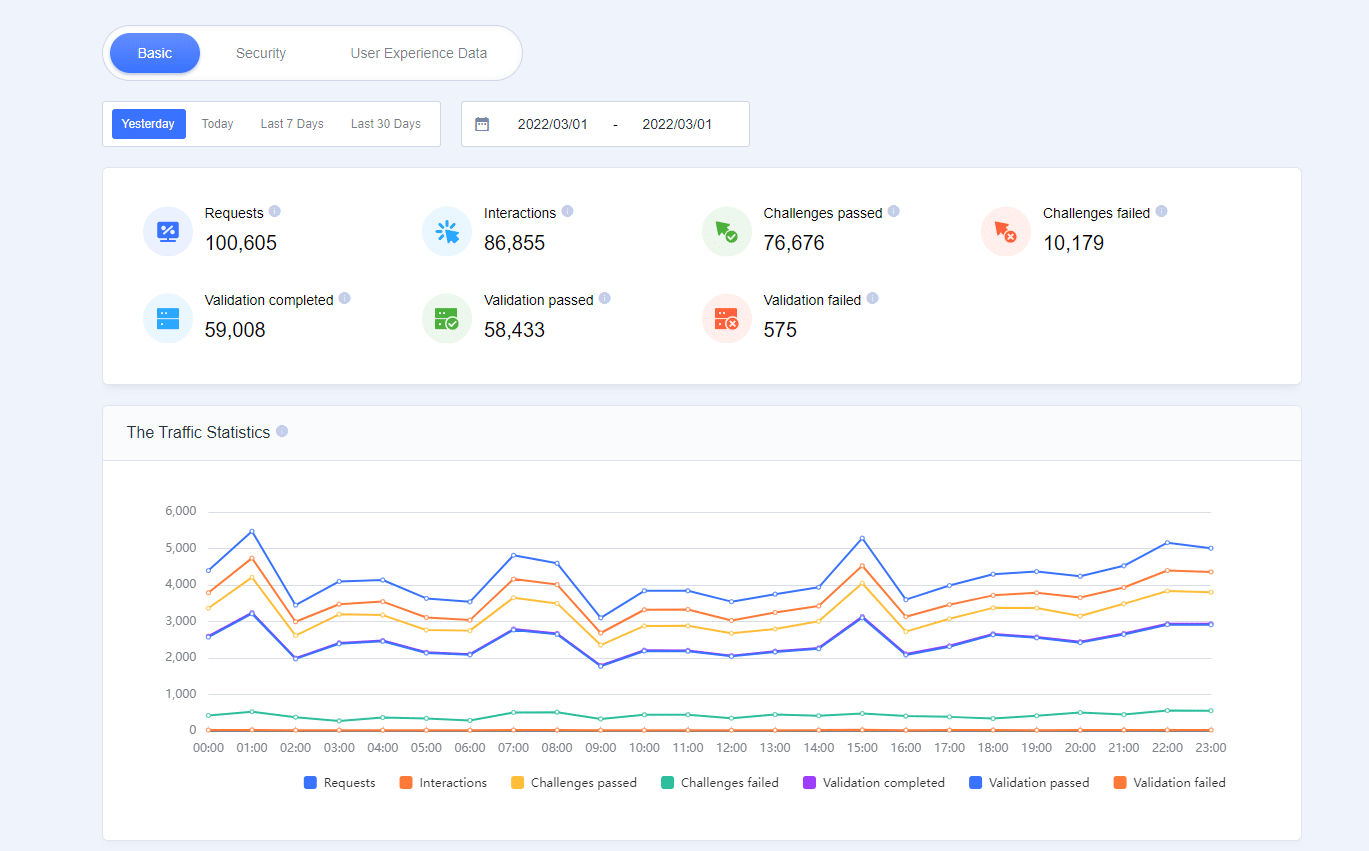
Use the reusable GeeTest traffic analysis dashboard visual to explain why monitoring must connect traffic patterns to decisions and outcomes, not only display a single risk number.
Measure, Govern, and Improve the Program
Measure fraud prevention as a system. Detection without an action path creates queues; blocking without appeals creates customer harm; approval-rate improvement without loss visibility can hide a delayed problem.
Track a balanced set of indicators:
- confirmed fraud loss and chargeback exposure;
- approval and completion rates by journey and cohort;
- challenge, step-up, review, delay, and block rates;
- false-positive signals, appeals, recovery time, and support cost;
- time from detection to containment and from incident to policy update;
- repeat abuse across accounts, devices, payment instruments, or promotion paths.
Governance should name the owner of each policy, data source, threshold, exception, and appeal. Review rules after product launches, seasonal peaks, payment-method changes, new markets, and confirmed incidents. Keep a small test set of legitimate edge cases so a rule is not judged only against obvious attacks.
For merchant-facing security guidance, the FTC identity-theft resource provides neutral context on protecting identity information and responding to compromise. The PCI Security Standards Council merchant resources provide payment-security context. Neither source is a vendor ranking or a substitute for the retailer’s own compliance review.
For retailers building or refreshing this stack, GeeTest is a practical fit for turning risk signals into proportionate verification. Device Fingerprinting provides device context, Business Rules Engine maps that context to journey-specific policies, and Adaptive CAPTCHA adds step-up verification when the risk threshold is met—so lower-risk shoppers can continue while suspicious sessions receive more scrutiny. Evaluate the setup by journey using challenge rate, completion, false-positive appeals, abuse outcomes, and conversion impact; keep payment authorization, chargeback, AML/KYC, fulfillment, and human review as complementary controls.
Ecommerce Fraud Prevention FAQ
1. What is ecommerce fraud prevention?
It is the coordinated use of identity, device, network, behavioral, transaction, policy, verification, review, and recovery controls to reduce abusive ecommerce activity while protecting legitimate customers.
2. How can a Shopify or other ecommerce store prevent fraud?
Start with payment and account protections, MFA or step-up verification for sensitive events, velocity and promotion-abuse rules, clear review ownership, and an appeal path. Then test device and behavior signals on the journeys where automation or coordinated abuse is visible. The exact integration depends on the platform, payment flow, and data available.
3. What are the most common ecommerce fraud risks?
Payment and card-not-present fraud, account takeover, automated signup or checkout abuse, reseller and inventory hoarding, promotion abuse, refund manipulation, and friendly or first-party fraud are common categories. A single incident can involve more than one category.
4. Do fraud-prevention tools replace payment processors or chargeback teams?
No. Web-abuse and verification controls add context and proportionate responses, but payment authorization, chargeback handling, AML/KYC, sanctions, fulfillment, and customer recovery remain separate responsibilities.
5. What should a retailer test first?
Choose one journey with measurable loss or abuse, run a shadow-mode baseline, define allow/step-up/review/block outcomes, and include legitimate edge cases. A small, reversible pilot usually reveals more than a broad feature comparison.