Takeways
1. What is an exploit in cybersecurity?
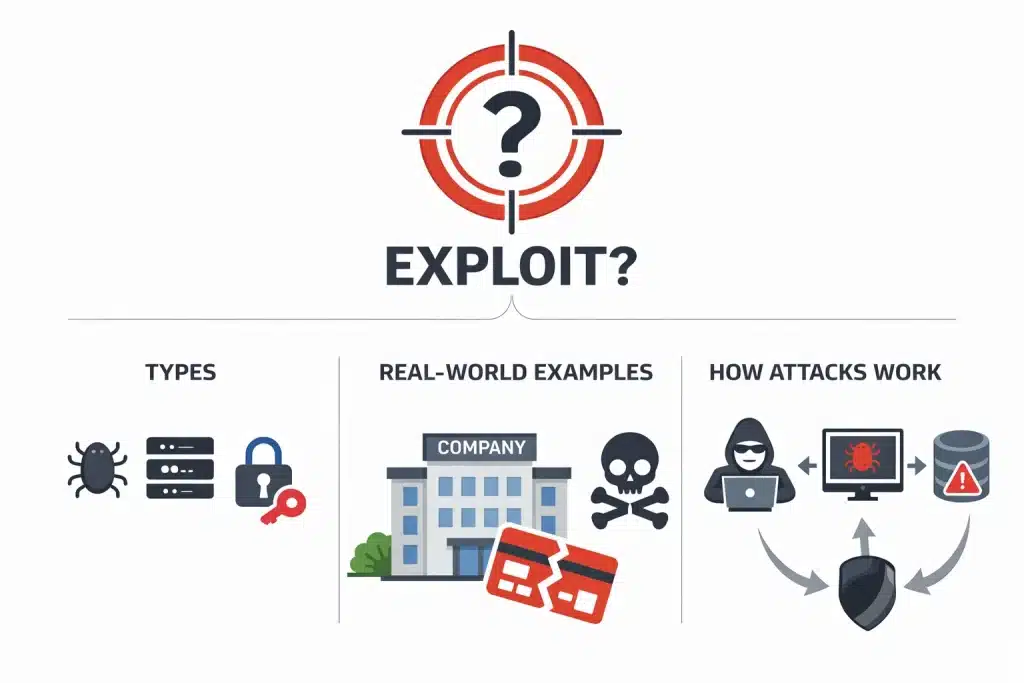
An exploit is a piece of code, script, or technique that takes advantage of a software or system vulnerability to perform unintended actions such as gaining access, executing malicious code, or disrupting services.
2. How is an exploit different from a vulnerability?
A vulnerability is a weakness in a system, while an exploit is the method used to take advantage of that weakness.
3. What are the most common types of exploits?
Common exploit types include remote code execution (RCE), privilege escalation, buffer overflow exploits, web application exploits (such as SQL injection), and zero-day exploits.
4. How do organizations defend against exploits?
Organizations reduce exploit risk through behavioral security systems, vulnerability scanning, patch management, network monitoring, and web application protection that detect abnormal activity.
Introduction
Exploit is a core concept of cybersecurity. An exploit refers to a piece of code, script, or technique that takes advantage of a vulnerability in software, systems, or networks to trigger unintended behavior. Once an exploit successfully leverages a weakness, attackers may gain unauthorized access, execute malicious code, or compromise sensitive data.
As modern software ecosystems grow more complex, exploit-based attacks have become increasingly common. Security research shows that hundreds of vulnerabilities are actively exploited every year, often within days of disclosure. This makes understanding exploits—how they work and how organizations defend against them—essential for anyone responsible for protecting digital systems.
What Is an Exploit?
In cybersecurity, an exploit is a method, script, or piece of code designed to take advantage of a vulnerability in software or systems.
A vulnerability alone does not automatically lead to a breach. It becomes dangerous when attackers discover how to exploit it.

Key Definitions
| Term | Meaning |
|---|---|
| Vulnerability | A weakness or flaw in software or systems |
| Exploit | Code or technique used to take advantage of the vulnerability |
| Payload | The malicious action performed after successful exploitation |
For example, a vulnerability might allow an attacker to bypass authentication checks. An exploit would then be the exact request or script used to trigger that flaw and gain access.
Security experts often describe exploits as part of the attack chain, which typically includes:
- Vulnerability discovery
- Exploit development
- Exploit delivery
- System compromise
Without an exploit, the vulnerability remains a theoretical risk. Once exploit code is available, however, the vulnerability becomes significantly more dangerous.
What Problems Do Security Exploits Create?
Exploit attacks can lead to a wide range of security incidents. In fact, many of the largest data breaches began with exploited vulnerabilities.
Some of the most common consequences include:
- Unauthorized System Access: Attackers may exploit authentication flaws or remote execution vulnerabilities to gain access to protected systems.
- Data Breaches: Sensitive information such as customer records, intellectual property, or financial data may be exposed.
- Privilege Escalation: Even if attackers initially gain limited access, exploits can allow them to escalate privileges and obtain administrative control.
- Malware Deployment: Exploits are frequently used to deliver ransomware, spyware, or botnet malware.
- Service Disruption: Certain exploits can crash servers or overwhelm infrastructure, causing service outages.
The speed at which attackers exploit vulnerabilities is also increasing. Research shows that 75% of vulnerabilities are exploited within 19 days of disclosure, while many organizations require more than 100 days to apply patches.
This gap between patching time and exploitation speed is one of the biggest cybersecurity challenges today.
How Exploits Work
Although specific exploits vary depending on the vulnerability, most follow a similar process.
1. Vulnerability Discovery
Attackers first identify weaknesses in software, networks, or web applications.
These vulnerabilities may be discovered through:
- security research
- reverse engineering
- automated scanning tools
- leaked exploit databases
Modern software ecosystems are complex, which means vulnerabilities are constantly emerging. In 2024 alone, over 40,000 vulnerabilities were publicly disclosed across various software platforms.
2. Exploit Development
Once a vulnerability is identified, attackers create exploit code that can reliably trigger the flaw.
This may involve crafting malicious inputs, manipulating network requests, or sending specially designed data packets.
In many cases, attackers share exploit code through underground forums or exploit kits.
3. Exploit Delivery
Next, attackers deliver the exploit to the target system.
Common delivery methods include:
- malicious websites
- phishing attachments
- compromised APIs
- malicious network traffic
For web applications, attackers may simply send a specially crafted HTTP request.
4. Exploitation
If the vulnerability is successfully triggered, the attacker gains an advantage—such as remote code execution or unauthorized access.
5. Post-Exploitation
After initial access, attackers often move deeper into the system by:
- installing malware
- escalating privileges
- accessing internal networks
- stealing sensitive data
This phase can lead to full system compromise.
Common Types of Exploits
Exploits can target many different technologies. However, several categories appear frequently in real-world attacks.
1. Remote Exploits
Remote exploits allow attackers to compromise a system without local access.
One of the most famous examples is the EternalBlue exploit, which targeted a vulnerability in Microsoft’s SMB protocol. The exploit was later used in the WannaCry ransomware outbreak, infecting hundreds of thousands of computers worldwide.
2. Local Exploits
Local exploits require attackers to already have limited access to a system.
These exploits are typically used for privilege escalation, allowing attackers to gain administrative control.
For example, attackers may exploit kernel vulnerabilities in operating systems such as Linux or Windows to obtain root privileges.
3. Zero-Day Exploits
A zero-day exploit targets a vulnerability that has not yet been patched or publicly disclosed.
Because defenders have no prior knowledge of the flaw, these attacks are particularly dangerous.
Research indicates that over 23% of vulnerabilities exploited in the wild were used as zero-days or before public disclosure.
Zero-day exploits are frequently used in advanced persistent threat (APT) campaigns and nation-state cyber operations.
4. Web Application Exploits
Many exploits target web applications because they are publicly accessible and often poorly secured.
Common examples include:
- SQL Injection
- Cross-Site Scripting (XSS)
- Remote Code Execution (RCE)
Organizations such as the Open Web Application Security Project (OWASP) track the most common web vulnerabilities.
Challenges & Limitations in Preventing Exploits
Completely preventing exploit attacks is extremely difficult. Even well-secured organizations face constant exposure to new vulnerabilities. Several factors contribute to this challenge:
1. Rapid Vulnerability Growth
Software ecosystems are expanding quickly, and vulnerabilities are increasing each year.
Security databases recorded over 40,000 new vulnerabilities in 2024 alone.
Each vulnerability represents a potential opportunity for exploitation.
2. Faster Exploitation Timelines
Attackers now exploit vulnerabilities faster than ever.
Recent research shows that a growing percentage of vulnerabilities are exploited within days—or even hours—of disclosure.
Automation tools and exploit kits make this process much easier for attackers.
3. Patch Management Delays
Many organizations struggle to apply security patches quickly due to:
- complex infrastructure
- operational dependencies
- risk of downtime
This creates a window of opportunity where exploits can succeed.
4. Automated Exploit Tools
Attackers increasingly use automated tools that scan the internet for vulnerable systems.
These tools can identify and exploit thousands of targets within minutes.
As a result, even small vulnerabilities can quickly become large-scale threats.
How Organizations Defend Against Exploit Attacks
Because vulnerabilities are inevitable, modern cybersecurity strategies focus on reducing the likelihood that exploits succeed rather than assuming flaws can be eliminated entirely. Organizations typically combine several defensive practices to mitigate exploit risks:
- Behavioral and Risk Analysis: Advanced security platforms analyze user behavior, device fingerprinting, and request patterns to identify anomalies. Even if attackers attempt to exploit unknown vulnerabilities, unusual activity can still trigger defensive responses.
- Continuous Vulnerability Scanning: Security teams regularly scan systems, applications, and infrastructure to identify known vulnerabilities. Tools and databases such as the National Vulnerability Database (NVD) help organizations track newly disclosed security flaws.
- Timely Patch Management: Applying security patches is one of the most effective ways to stop exploits. Organizations often prioritize patches based on severity and whether the vulnerability is known to be actively exploited.
- Network and Endpoint Monitoring: Intrusion detection systems (IDS), endpoint detection and response (EDR), and traffic monitoring tools help identify suspicious behavior that may indicate exploit attempts.
- Web Application Protection: Many exploits target public-facing web services. Security controls such as web application firewalls (WAF) and bot management solutions can detect abnormal requests and block exploit payloads before they reach vulnerable components.
By combining vulnerability management, monitoring, and layered security controls, organizations can significantly reduce the success rate of exploit-based attacks.
Conclusion: Exploits Turn Vulnerabilities Into Real Attacks
In cybersecurity, vulnerabilities are unavoidable. Every complex software system contains flaws.
However, vulnerabilities only become dangerous when attackers develop exploits to take advantage of them.
As the number of vulnerabilities continues to grow and attackers automate exploitation techniques, organizations must adopt a proactive security strategy that combines:
- vulnerability management
- rapid patching
- behavioral threat detection
- layered security controls
By understanding how exploits work and implementing modern defense strategies, organizations can significantly reduce the risk of successful cyberattacks.