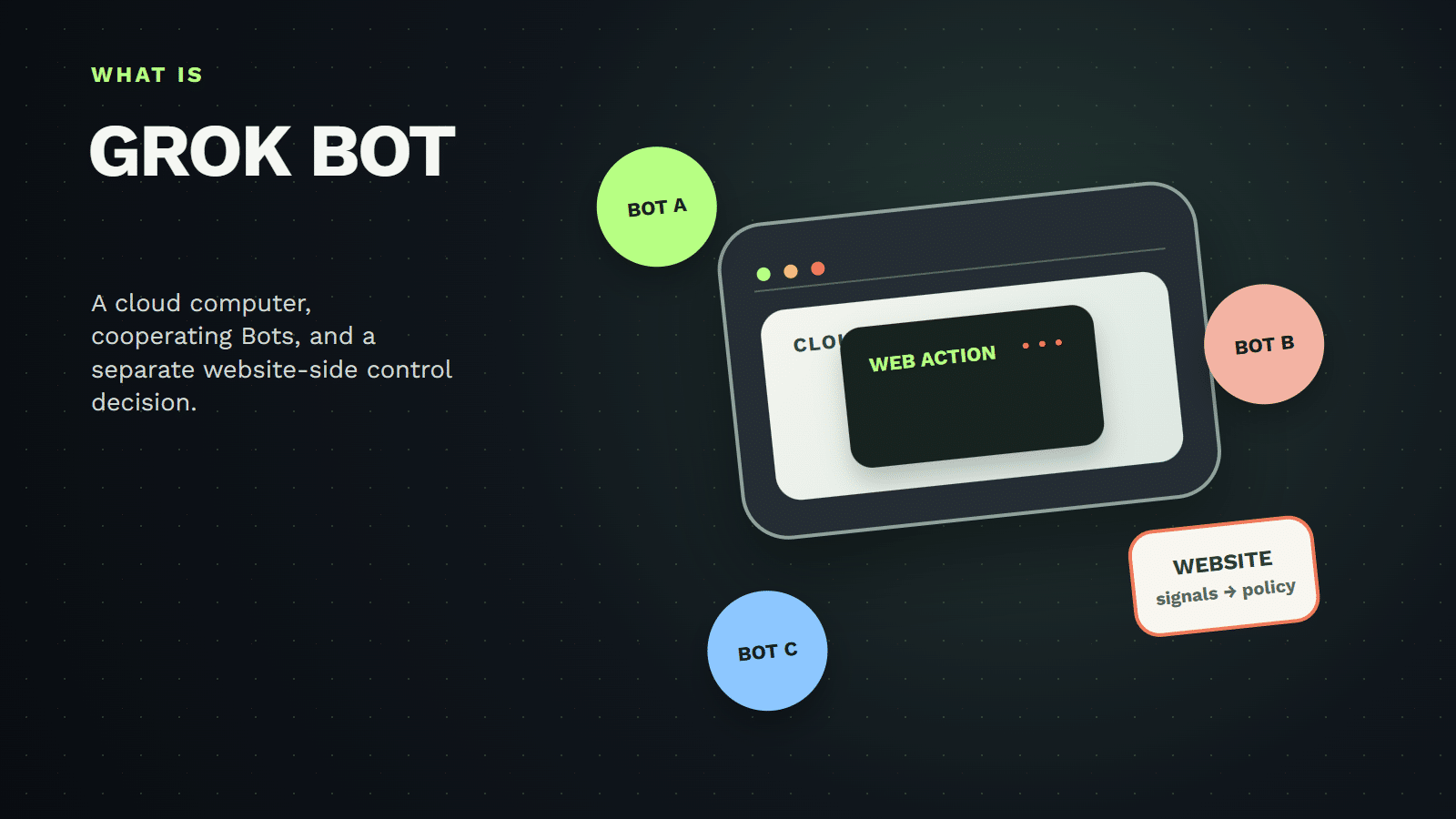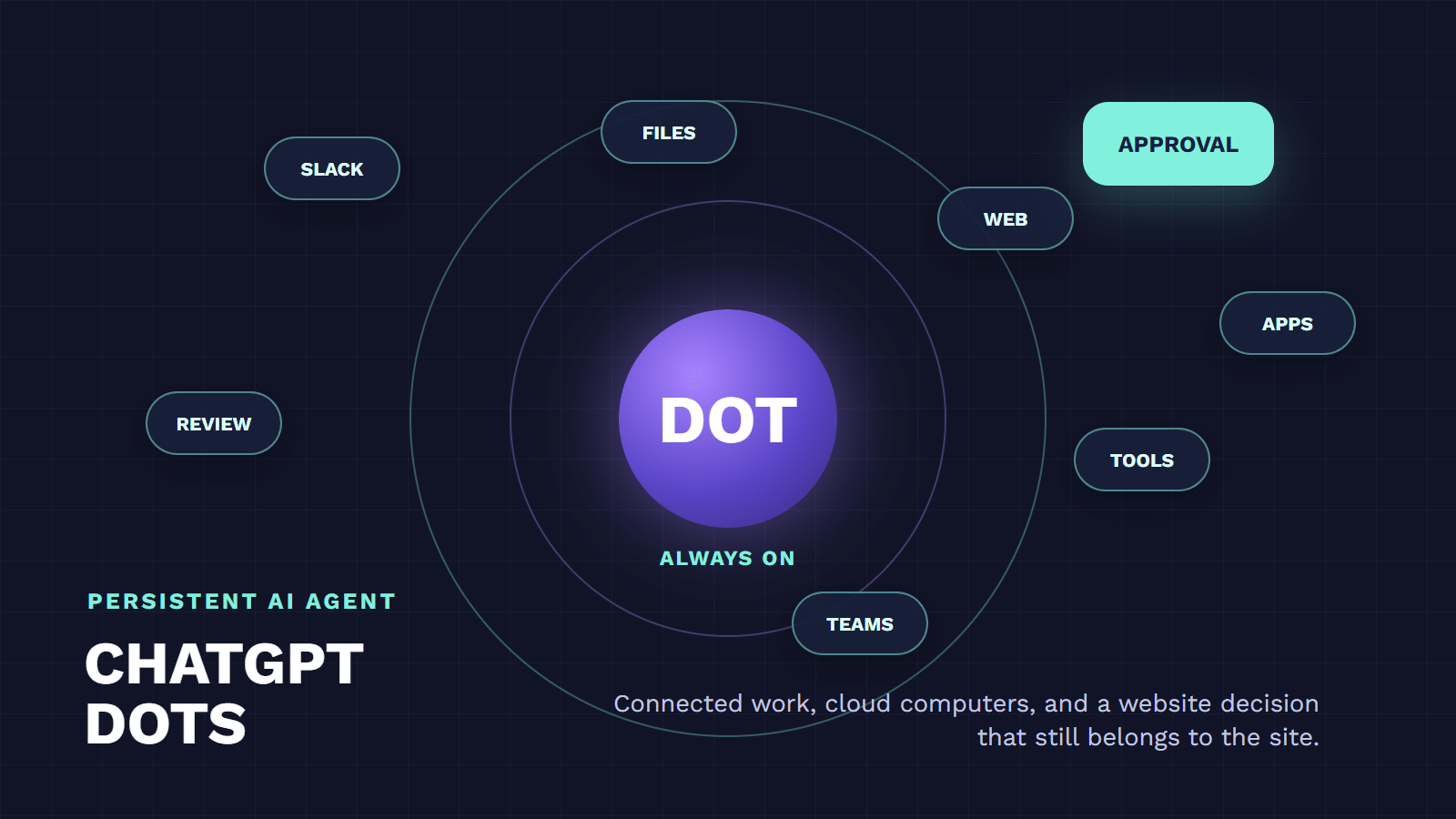

Grok Bot is an AI-agent product built around persistent cloud computers, connected tools, routines, and multiple Bots that can cooperate on work. It is not simply the Grok chatbot in another window. A Bot can use websites and applications, keep state, repeat workflows, and return to a person when it needs approval or judgment.
That makes Grok Bot relevant to website security even when the activity is legitimate. A cloud agent can read public pages, manage an authenticated account, submit forms, coordinate several tasks, or take an action with financial or inventory consequences. The website needs a way to separate acceptable delegation from abnormal automation and abuse.
What Is Grok Bot and How Does It Work?
The xAI documentation describes Grok Bot as a proactive AI teammate with access to a real computer in the cloud. Bots can work across applications and websites, use connected tools, run routines, exchange work, and bring a person into the process for review. The product can also support several Bots working together.
The Grok Bot 101 guide describes a cloud desktop with a browser, filesystem, terminal, and applications. A user can teach a workflow through instructions or demonstration, schedule it, and let the Bot continue after the local computer is closed. Bots associated with one user may share the same cloud computer and its logged-in state.
The distinction from the Grok chatbot is operational:
| Grok chatbot | Grok Bot |
|---|---|
| Primarily answers inside a conversation | Can operate a computer and external applications |
| Usually responds to the current prompt | Can run persistent routines and triggers |
| One conversational context | Multiple Bots can specialize and coordinate |
| Produces text or media outputs | Can produce side effects on websites and accounts |
For a website, the useful detection target includes the claimed Bot identity, technical origin evidence, cloud-browser/device characteristics, interaction behavior, account state, action velocity, and business consequence.
That target becomes more specific when the site asks which unit it is trying to identify. It may be one declared Bot, one cloud computer, one user account, one coordinated Bot team, or one business workflow spread across several sessions. These units do not map neatly to one another. Several Bots may share state, while one workflow may touch several accounts or services. A detector that assumes one device equals one actor will produce misleading attribution.
The website also needs to decide what result it actually requires. A documentation site may only need rate and extraction controls. A collaboration product may need to distinguish user-approved automation from spam or bulk messaging. A marketplace may need to protect account creation, inventory, checkout, and seller actions. “Detect Grok Bot” is therefore most useful as a detection profile covering identity, automation, coordination, and business risk rather than a promise of exact product naming on every request.
Why Is Grok Bot Difficult to Detect Reliably?
Grok Bot traffic does not always arrive with one stable, universal marker. Its main detection difficulties are easier to scan in a decision table:
| Difficulty | Why the signal is ambiguous | What the detector must separate |
|---|---|---|
| Changing identity evidence | A signature, User-Agent, IP range, or browser attribute may disappear, vary by access path, or be copied. | Declared identity, provider-backed provenance, and the confidence of the check. |
| Shared cloud computer | Several Bots may share browser state, cookies, files, and connected accounts; one Bot may also work across services. | Device continuity, Bot identity, user account, and task relationship. |
| Multi-Bot coordination | Research, operations, and review may happen in parallel or in sequence, producing coherent account-level behavior that looks unusual per session. | Coordination patterns without assuming that every concurrent action is abuse. |
| Human handoffs | A Bot can pause for login, CAPTCHA, approval, or judgment, then resume automation. | Automated portions, human-supervised steps, and the approval evidence for the final action. |
| Authentication versus authorization | Valid credentials show account access, not permission for extraction, inventory holds, account changes, messaging, or transactions. See the Grok Bot identity-signal change. | Session authentication, requested scope, endpoint policy, and business consequence. |
| Time-window correlation | Scheduled routines and interruptions can be missed by short windows or incorrectly joined by broad windows. | Separate confidence decay for device, account, task, and endpoint relationships. |
| False-positive cost | Enterprise scripts, assistive tools, password managers, and fast users can share isolated agent-like traits. | Multiple independent signals and a clear recovery path before challenge or block. |
How Can Websites Detect Grok Bot Activity?
The durable approach is to evaluate several evidence layers and make the response depend on the protected action.

- Request and network evidence. Log declared identity, source network, TLS/HTTP characteristics, and any provider-backed verification. Treat missing or mismatched evidence as reduced confidence.
- Device and environment evidence. Build a browser fingerprint, look for automation or emulation indicators, and measure whether many accounts or tasks share one environment.
- Behavior and sequence evidence. Evaluate navigation order, form interaction, dwell time, retries, parallelism, schedule regularity, and whether the activity jumps directly to sensitive endpoints.
- Account and business evidence. Add authentication history, privilege, account age, transaction value, inventory pressure, request volume, prior abuse, and the consequence of the action.
- Adaptive response. Allow low-risk access, observe uncertain activity, limit volume, request step-up verification, isolate the session, require review, or block confirmed abuse.
The server should retain a compact decision record that links the endpoint, declared identity, verification result, device continuity, behavior sequence, account context, business variables, policy version, and action taken. For multi-Bot activity, relationship features—shared environment, coordinated timing, repeated handoffs, and common account or task context—are often more informative than any single event. The record also allows analysts to update attribution without losing the original evidence.
Policy should be defined by consequence. Public research can be allowed with monitoring or rate limits even when automation confidence is high. Bulk account creation, restricted extraction, inventory holds, ownership changes, and high-value transactions can require stronger verification or review. This approach avoids turning uncertain product identification into an automatic block.
Measure confirmed abuse, legitimate challenge rate, successful recovery, conversion impact, support contacts, and investigation time. These outcomes show whether the system manages harmful automation, not merely whether it assigns a Grok label.
This model can classify automation and manage risk without promising an exact product name for every request. It also gives operators a way to explain false positives and tune policy. The broader bot detection model follows the same principle: multiple independent signals are stronger than one brittle indicator.
How GeeTest Supports Detection and Traffic Control
GeeTest can observe user-device, behavior, and environment signals through CAPTCHA and Device Fingerprinting. The Business Rules Engine can combine that technical evidence with variables from the protected workflow, such as endpoint, account status, action frequency, transaction amount, inventory, or campaign conditions.
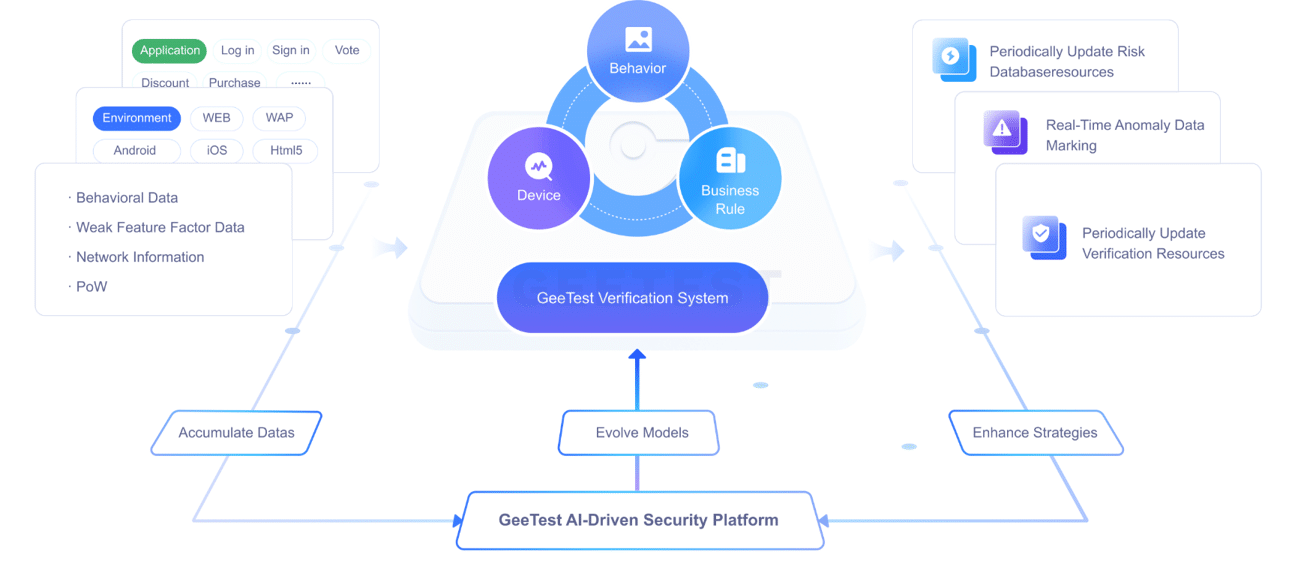
The goal is a risk decision that stays close to the business. A likely automated visit to a public help page may be allowed. The same pattern creating many accounts, scraping restricted data, holding scarce inventory, or changing account ownership may be limited, verified, isolated, or blocked.
Device continuity and behavior help estimate whether the interaction resembles a person, known automation, or abnormal traffic. Business rules determine how that classification should affect the specific flow. An effective bot detection solution then monitors outcomes so fraud, conversion, and support teams can tune the policy together.
AI-agent marking is an emerging direction that may make AI-origin traffic more visible as a distinct signal. It should be understood as an in-development direction, not as a claim that GeeTest currently provides a universal Grok Bot signature verifier or a generally available label that identifies every agent request.
Start Detecting Grok Bot and Similar Automation
Begin with the endpoint where agent activity has the clearest business consequence.
- Map public reading, authenticated work, privileged changes, and transactional actions into separate risk tiers.
- Integrate browser/app signal collection and server-side verification; do not rely on a JavaScript result that a client can replace.
- Add device, environment, behavior, account, and business variables to the decision.
- Use adaptive CAPTCHA only when uncertainty and consequence justify friction.
- Start in observe mode, compare decisions with actual fraud, conversion, and support outcomes, then tune thresholds and recovery paths.
- Revisit identity assumptions when providers change signatures, browser behavior, infrastructure, or documentation.
In the pilot, keep Grok-specific indicators in a replaceable evidence layer and keep enforcement tied to endpoint risk. Review allowed, limited, verified, and blocked samples with security, product, and support teams. Promote rules only when the observed business outcome supports them, and retain an appeal or recovery path for legitimate users and approved automation.
Teams can register for an evaluation and contact GeeTest Sales to review deployment, server-side integration, policy design, and monitoring across websites, mobile apps, and APIs.
Final Takeaway
Grok Bot is a persistent agent platform, not merely a chatbot. Its cloud computer, shared state, routines, and cooperating Bots can produce traffic that looks stable, human-assisted, or distributed across tasks. A website should verify any reliable identity evidence, but its control model must survive when that evidence changes. Layered device, behavior, environment, account, and business signals provide the durable basis for managing the activity, with GeeTest risk-based verification available as a proportional response for uncertain high-consequence actions.
FAQ
1. Is Grok Bot the same as the Grok chatbot?
No. The chatbot primarily responds in a conversation. Grok Bot can operate a cloud computer, use applications and websites, run routines, and coordinate multiple Bots.
2. Can a User-Agent identify Grok Bot?
A User-Agent can declare an identity but can be copied or changed. Use it as one signal and verify provider-backed evidence when available.
3. Does one shared computer mean one Bot?
Not necessarily. Multiple Bots associated with one user may share a cloud computer and its browser state, so device continuity does not always map one-to-one to an agent.
4. Should a website block all Grok Bot activity?
No. Apply policy by endpoint and consequence. Public research and user-directed assistance may be acceptable, while bulk account creation, restricted extraction, or high-value actions may require limits or verification.