
Bot detection has become a cyber-defense buying decision, not just a traffic-filtering feature. Automated traffic now includes simple scripts, residential-proxy abuse, headless browsers, credential-stuffing tools, AI crawlers, API abuse, and agentic workflows that may look legitimate until they hit a sensitive business action.
For security and fraud teams, the question is no longer only "Can this tool block bots?" A better question is: can it detect automation, understand intent, trigger the right response, and protect revenue-critical flows without damaging legitimate users?
For 2026, a useful bot detection comparison needs more than a vendor list. It should connect current bot-risk context, practical selection criteria, core technology categories, leading tools, and an enterprise comparison matrix that helps teams make a defensible shortlist.
If your team first needs the concept baseline, start with what bot detection is. If you already understand the category and need an implementation architecture, compare the tools below against an effective bot detection solution model.
Why Bot Detection Tools Matter in 2026
Automated abuse has moved from the edge of cybersecurity into the center of digital operations. Thales’ public Bad Bot Report frames the problem around AI-enabled bot attacks, agentic AI, and account takeover pressure, and its report page describes a sharp year-over-year rise in daily AI-enabled bot attacks. Treat that as industry-report context, not GeeTest telemetry, but it explains why bot detection is now a board-level risk for many online businesses.
The threat taxonomy is broader than "fake visits." OWASP’s Automated Threats to Web Applications project lists abuse patterns such as credential stuffing, carding, CAPTCHA defeat, scraping, scalping, account creation, cost-inflation fraud, denial of inventory, and vulnerability scanning. These attacks abuse normal business functions, which is why generic blocking rules often miss them.
The business impact also extends beyond bot traffic volume. The FBI IC3 annual reports are useful government context for cybercrime complaints, reported losses, and account-abuse trends. IC3 data is complaint-based and not bot-specific, but it shows why automated login, account, and fraud workflows deserve more careful controls.
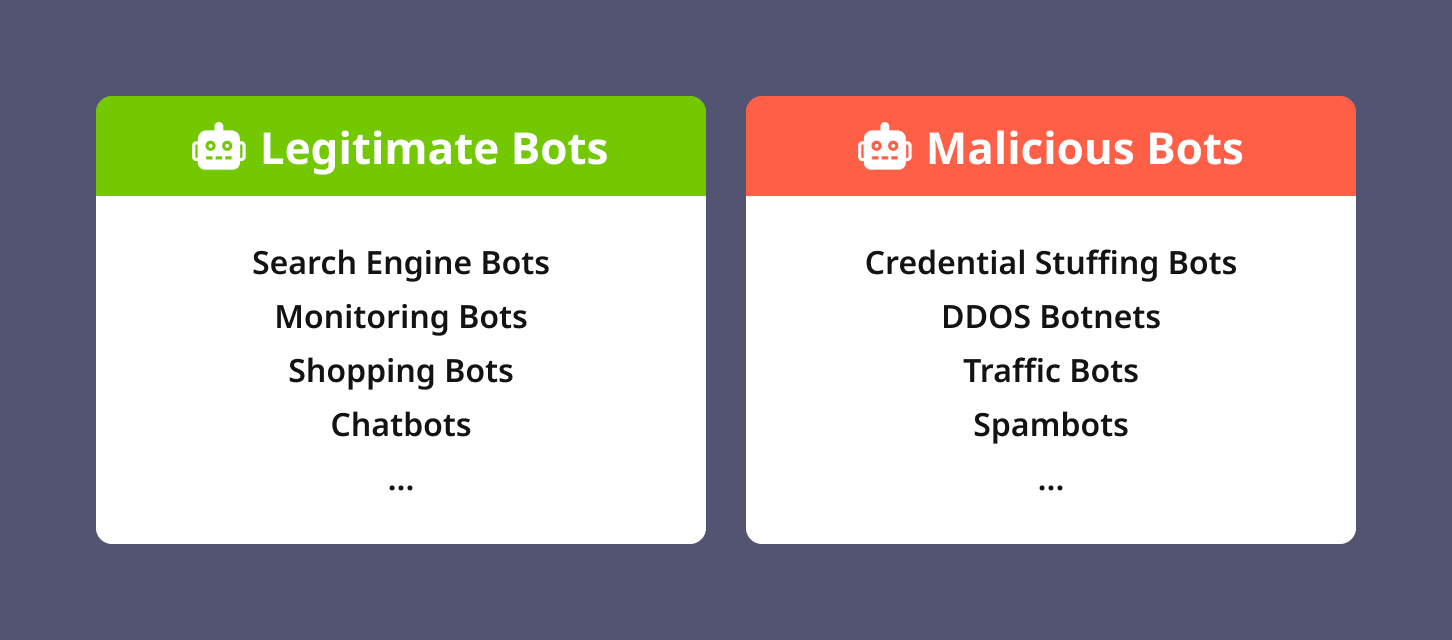
That is why a modern bot detection tool should combine signal collection, risk scoring, response control, analytics, and operations. The goal is not to challenge every user or block every automated request. The goal is to separate malicious automation, acceptable automation, and real users with enough precision to protect login, registration, checkout, campaign, API, and content workflows.
What to Look for in a Bot Detection Tool
Before comparing vendors, define the decision criteria. The right tool depends on attack type, traffic volume, business model, engineering resources, regulatory review, false-positive tolerance, and where enforcement must happen.
The criteria are not limited to traffic volume. They map directly to the capabilities an enterprise team should validate during procurement, proof of concept, and post-launch tuning.
| Selection criterion | What to evaluate | Why it matters |
|---|---|---|
| Detection signals | Behavior, device, browser, IP, network, account, API, and session signals | Single-signal systems are easier to bypass. |
| Response controls | Allow, monitor, challenge, throttle, block, redirect, or custom action | Binary block/allow logic creates avoidable false positives. |
| False-positive handling | Tuning, shadow mode, exception handling, feedback loops, analytics | Blocking real users can be more expensive than some bot traffic. |
| Deployment fit | CDN, reverse proxy, SDK, JavaScript tag, API gateway, mobile SDK, server-side module | The best tool is the one your architecture can enforce reliably. |
| Coverage | Website, mobile app, API, login, registration, checkout, content, ads, and UGC | Bots usually shift to the weakest endpoint. |
| Reporting and analytics | Bot categories, endpoint views, attack trends, response outcomes, export options | Security and fraud teams need evidence, not only blocks. |
| Customization | Rules, thresholds, endpoint policies, allowlists, partner handling | Every business has legitimate automation and high-risk flows. |
| Support and tuning | Managed service, emergency support, onboarding, documentation | Bot defense needs post-launch operations. |
| Privacy and compliance | Data collection, regional deployment, retention, vendor review support | Bot detection often touches device, behavior, and network signals. |
Use these criteria as a shortlist filter. A retailer facing scalping has different needs from a bank defending login, a publisher managing AI crawlers, or a SaaS company protecting APIs. NIST SP 800-63B is useful for account-security planning because it discusses rate limiting, throttling, and risk-based or bot-detection challenges in authentication workflows. Verizon’s DBIR is broader than bot defense, but it is still a useful annual reference for aligning bot controls with credential, vulnerability, ransomware, and AI-augmented attack priorities.
Core Technology Categories Behind Bot Detection Tools
Most bot detection stacks combine several tool types. A mature program rarely depends on one signal or one enforcement layer.
- Web Application Firewalls (WAFs): WAFs filter application traffic and can block known malicious patterns. They are useful for broad application security, but sophisticated bots may look like normal business traffic.
- Challenge-response tools: CAPTCHA, invisible challenges, proof-of-work, and client-side checks can verify suspicious sessions. The best versions apply friction selectively instead of challenging every user.
- Device fingerprinting and device intelligence: Device signals help connect sessions, detect emulators or abnormal environments, and reduce reliance on IP alone.
- IP, network, and reputation intelligence: These tools detect abnormal sources, proxies, data centers, and known abusive networks. They work best when paired with device and behavior signals because modern bot operators rotate infrastructure.
- Machine-learning and behavioral analysis: These systems learn patterns across request features, sessions, and interactions. They can catch evolving automation, but they still need tuning, explainability, and feedback loops.
- Business rules and risk engines: Rules engines let fraud and security teams turn signals into actions such as allow, monitor, challenge, throttle, block, delay, or review.
For account-protection scenarios, OWASP’s Credential Stuffing Prevention Cheat Sheet is useful because it treats CAPTCHA, device fingerprinting, IP intelligence, metrics, and other controls as part of a layered defense rather than a single silver bullet. For a deeper GeeTest-owned threat overview, see bot attacks on online businesses and account takeover prevention.
Top 6 Bot Detection Tools for Cyber Defense in 2026
1. GeeTest
GeeTest provides a flexible bot detection solution for teams that need to balance security, conversion, and operational control. Instead of treating bot detection as one fixed control, GeeTest can support a lightweight layered approach: verify suspicious users when needed, add device-level risk signals when silent detection matters, and connect detection results with business rules when the response needs to change by scenario.
That makes GeeTest especially relevant for login, registration, campaign, voting, coupon, checkout, SMS, UGC, and other high-value user actions where a blunt block can hurt real users. The core advantage is flexibility: teams can start with Adaptive CAPTCHA for behavior and environment-based verification, extend detection with Device Fingerprinting for zero-friction device intelligence, and use Business Rules Engine to compose bot-defense strategies around their own risk logic.

Key Features of GeeTest Bot Detection
- Adaptive CAPTCHA for detection and blocking: GeeTest CAPTCHA v4 distinguishes genuine users from automated bots through behavioral analysis, environmental detection, and interactive challenges. It is commonly applied to registration, login, SMS delivery, downloads, and other high-risk entry points.
- Selective friction instead of always-on challenges: Adaptive verification can apply different verification experiences based on risk level and business context, helping teams protect sensitive actions without challenging every user.
- Device Fingerprinting for zero-friction detection: GeeTest Device Fingerprinting adds device identity and device-risk signals for fake accounts, VPNs, emulators, bots, cloud phones, device-masking tools, and virtual-location environments. It does not need to behave like a CAPTCHA challenge, so it can strengthen detection with less user interruption.
- Business Rules Engine for strategy orchestration: GeeTest Business Rules Engine helps teams connect signals, customer data, lists, counters, custom functions, alerts, and rules into decisions such as allow, monitor, challenge, block, or route for review.
- Transparent risk operations: GeeTest’s portfolio can provide risk labels or signals that customers combine with their own business context, avoiding an overly opaque black-box decision model.
- Modular deployment path: Teams can use Adaptive CAPTCHA as the first visible verification layer, add Device Fingerprinting when device confidence matters, and introduce Business Rules Engine when abuse scenarios require scenario-specific decisioning.
Pros
- Strong fit for teams that need bot detection plus proportionate response, not only passive analytics.
- Useful when security controls must protect conversion-sensitive login, signup, campaign, coupon, checkout, or interaction flows.
- Flexible portfolio: Adaptive CAPTCHA, Device Fingerprinting, and Business Rules Engine can be combined according to risk maturity and business scenario.
- Lighter than a full edge/WAF migration when the immediate problem is user-action abuse, fake accounts, verification bypass, or conversion-safe bot control.
Cons
- Teams looking for a pure CDN, WAF, SIEM, or edge-security consolidation platform may still need adjacent infrastructure controls.
- Device Fingerprinting and Business Rules Engine should be mapped to concrete use cases; they should not be treated as mandatory add-ons for every simple CAPTCHA deployment.
Ideal Use Cases
GeeTest is a strong fit for e-commerce, financial services, gaming, social platforms, travel, fintech, and high-growth online services that need flexible bot detection across user actions. Choose GeeTest when you need to detect and stop bots with Adaptive CAPTCHA, raise device-detection capability with zero-friction Device Fingerprinting, or connect detection results to custom business decisions through Business Rules Engine.
2. DataDome
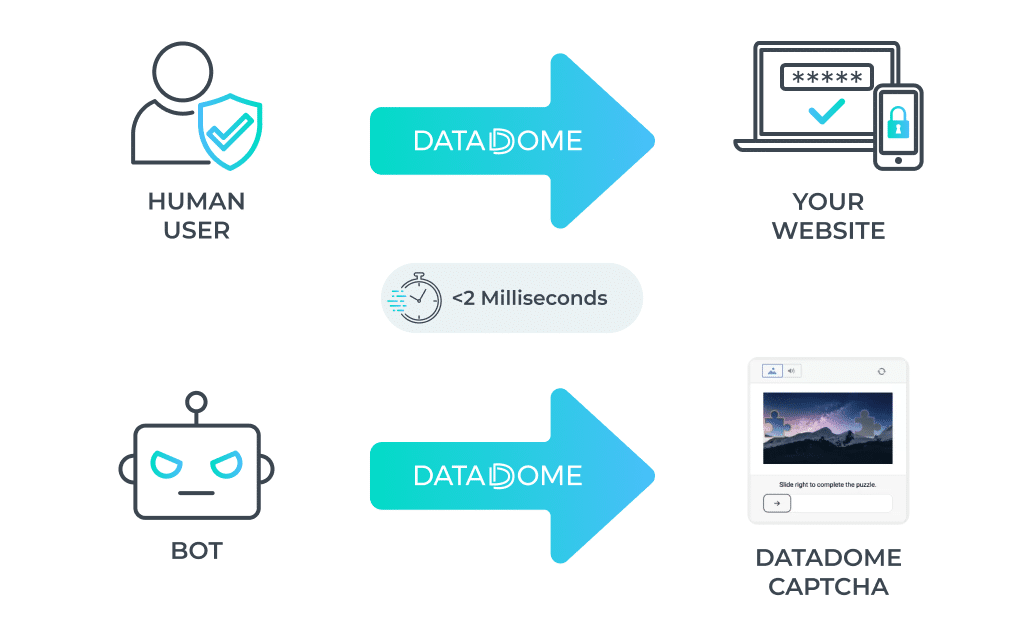
DataDome is a bot protection and fraud-defense platform often evaluated by e-commerce, marketplace, ticketing, classified ads, and digital businesses with high-volume automated traffic. It focuses on analyzing requests across websites, mobile apps, and APIs, then applying responses such as allow, challenge, device check, rate limit, or block depending on the risk.
Key Features of DataDome Bot Detection
- Real-time traffic analysis for malicious bot detection.
- Endpoint-aware protection for websites, mobile apps, and APIs.
- Detection models that may combine signatures, behavior, browser fingerprints, TLS fingerprints, and HTTP headers.
- Response actions such as allow, challenge, rate limiting, device check, and block.
- Integrations with common web servers, CDNs, application stacks, and edge environments.
- Log enrichment and analytics support for security operations workflows.
Pros
- Strong fit for high-volume bot traffic and commercial abuse scenarios.
- Useful endpoint taxonomy for separating login, forms, APIs, and general traffic.
- Broad deployment documentation across server-side and edge integrations.
- Good option for teams that want a dedicated bot-protection vendor.
Cons
- Pricing and implementation depth may be better suited to mature teams and larger traffic environments.
- The full value depends on correct endpoint configuration, JavaScript/client-side signal quality, and response tuning.
Ideal Use Cases
DataDome is best suited for digital businesses where bot traffic directly affects revenue, inventory, account security, content protection, or analytics quality, especially when the team can support a dedicated bot-protection rollout.
3. Radware Bot Manager
Radware Bot Manager is a bot detection and mitigation solution for web applications, mobile apps, and APIs. Its current positioning emphasizes AI-driven threats, AI crawlers, AI agents, behavioral detection, real-time mitigation, and managed security support.
Key Features of Radware Bot Manager
- AI-based behavioral detection for malicious bot identification.
- Multi-layered protection across web apps, mobile apps, and APIs.
- Real-time mitigation options including non-interactive challenges and custom responses.
- AI crawler and AI agent visibility.
- Native mobile app protection with device and app validation features.
- Transparent reporting and analytics for bot classification.
Pros
- Strong enterprise positioning for AI-driven bot threats and advanced automation.
- Useful for teams that want both product capability and managed-service support.
- Good fit for mobile app and API abuse scenarios.
- Provides a range of mitigation options beyond a simple CAPTCHA prompt.
Cons
- Pricing is not always publicly transparent and usually requires vendor consultation.
- Setup and policy tuning can require security expertise.
Ideal Use Cases
Radware Bot Manager is suitable for enterprises that need managed bot defense across web, mobile, and API surfaces, especially where AI crawlers, AI agents, account abuse, and fraud pressure are rising.
4. Cloudflare
Cloudflare offers bot solutions inside its broader edge, WAF, CDN, and application security platform. For teams already using Cloudflare, bot management can be operationally convenient because detection, WAF rules, analytics, and edge enforcement live in the same ecosystem.

Key Features of Cloudflare Bot Detection
- Bot Fight Mode, Super Bot Fight Mode, Bot Analytics, and Enterprise Bot Management options.
- Bot scores that indicate how likely a request came from a bot.
- Detection engines such as heuristics, machine learning, anomaly detection, and JavaScript detections.
- Custom rules that can use bot scores for block, challenge, or allow decisions.
- Integration with Cloudflare WAF, Workers, Turnstile, API Shield, and DDoS protection.
Pros
- Strong fit for businesses already on Cloudflare’s edge network.
- Granular Enterprise Bot Management can support per-request scores and custom rules.
- Works well when bot protection needs to sit close to WAF, CDN, and API security controls.
- Good analytics and operational visibility inside the Cloudflare dashboard.
Cons
- Advanced bot score and granular rule control are primarily Enterprise capabilities.
- Teams not already using Cloudflare may need to evaluate migration and platform lock-in considerations.
Ideal Use Cases
Cloudflare is ideal for organizations that already use Cloudflare for CDN, WAF, DDoS protection, or edge compute and want bot enforcement in the same operational surface.
5. Imperva
Imperva Advanced Bot Protection is part of Imperva’s broader application security and WAAP ecosystem. It is often evaluated by enterprises that want bot protection alongside WAF, API security, DDoS protection, account takeover protection, and security analytics.
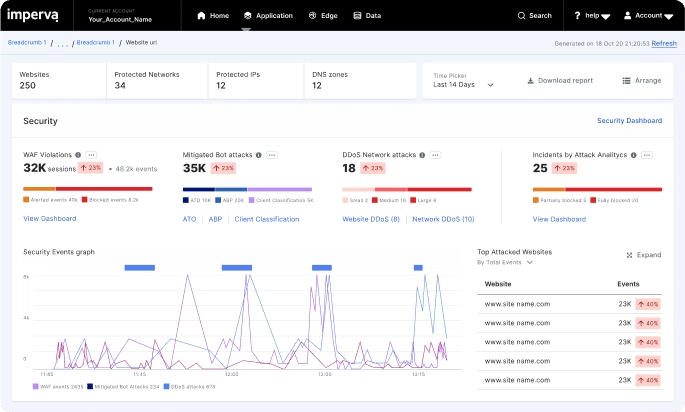
Key Features of Imperva Bot Detection
- Machine-learning-based classification to distinguish bots from legitimate users.
- Protection for websites, mobile applications, and APIs.
- Integration with broader WAAP controls such as WAF, DDoS, API security, and account takeover protection.
- Policy and analytics tools for security operations.
- Progressive challenge and classification logic to reduce unnecessary user interruption.
Pros
- Strong fit for organizations that want bot protection as part of a broader application security suite.
- Useful for teams already standardizing around Imperva security products.
- Covers several high-risk surfaces, including APIs and mobile traffic.
- Enterprise-oriented analytics and operational controls.
Cons
- May be more than smaller teams need if they only want a targeted CAPTCHA or challenge layer.
- Configuration and cost should be validated carefully during procurement.
Ideal Use Cases
Imperva is a good fit for enterprises that want bot defense inside a wider WAAP program and need coordinated protection across application, API, DDoS, and account-abuse layers.
6. Akamai
Akamai Bot Manager focuses on enterprise bot and abuse protection at the edge. It is designed for high-traffic organizations that need bot scoring, multi-layered detection, policy-driven responses, mobile/API coverage, and large-scale edge enforcement.
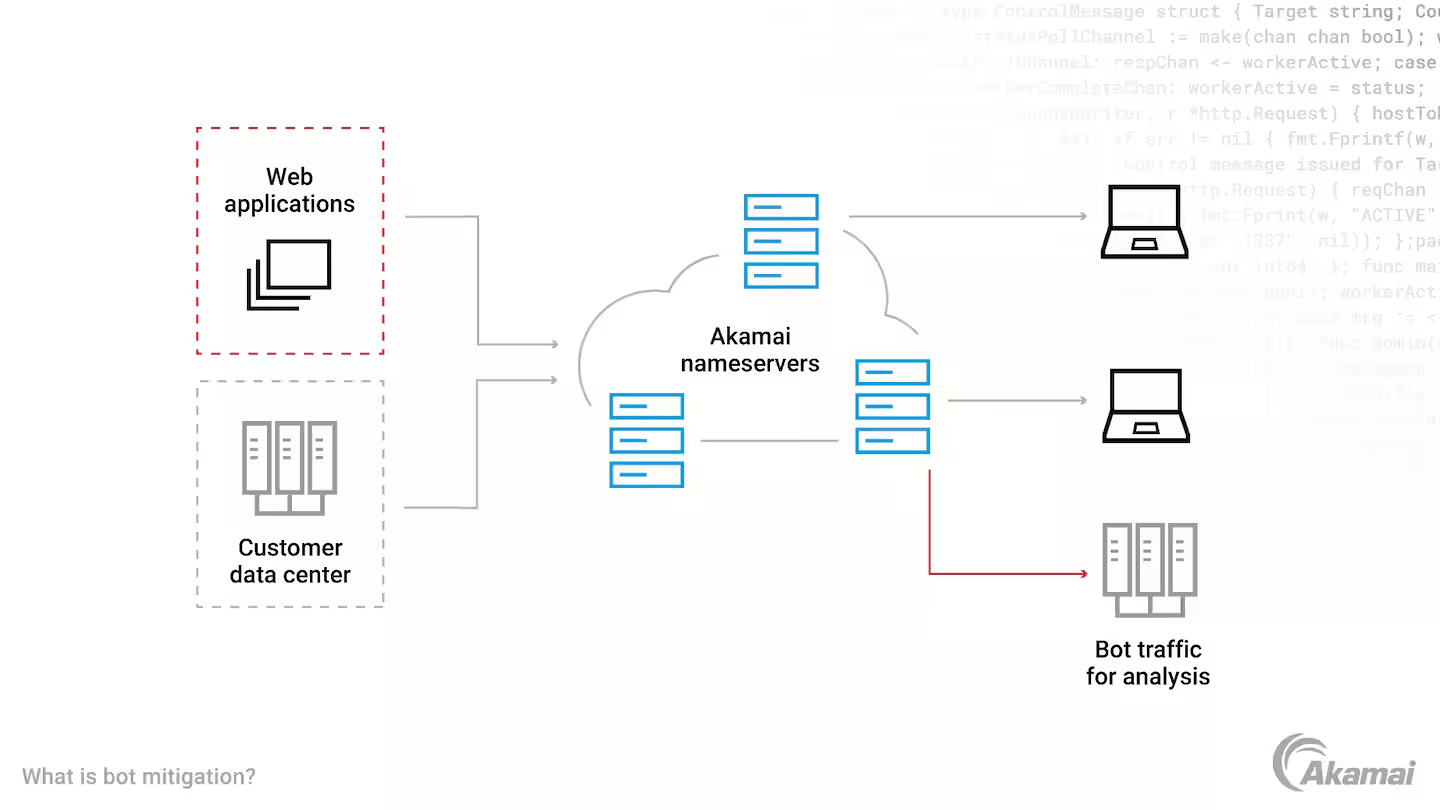
Key Features of Akamai Bot Detection
- Bot Score and tunable thresholds for risk-based response.
- Multi-layered detection using behavior analytics, browser and device fingerprinting, HTTP anomaly detection, automated browser/headless detection, and interaction signals.
- Response options such as allow, monitor, challenge, throttle, slow, block, redirect, or serve alternate content.
- Coverage across web, APIs, and native mobile apps.
- Edge enforcement for scale and latency control.
- AI/LLM crawler control and content-protection options.
Pros
- Strong fit for high-traffic enterprise websites, financial services, e-commerce, and travel.
- Broad response-action set beyond simple block/allow.
- Strong edge-scale enforcement and reporting capabilities.
- Useful where bot defense needs to reduce infrastructure load as well as fraud risk.
Cons
- Enterprise scale and breadth may be unnecessary for smaller websites.
- Evaluation should include proof-of-concept testing on high-risk flows to avoid overfitting policies.
Ideal Use Cases
Akamai is best for large enterprises that need edge-scale bot scoring, policy orchestration, API/mobile coverage, and strong control over AI crawlers, scraping, credential stuffing, and traffic spikes.
Why GeeTest Leads: Comparison of 6 Bot Detection Tools
The strongest bot detection choice is the one that fits your highest-risk workflow. A login flow needs a different response model from a limited-inventory release, an API endpoint, a user-generated-content platform, or a global checkout.
For many businesses, GeeTest is the leading choice when the core problem is not only "detect bots," but "detect, verify, and respond with the right amount of friction." That distinction matters. Bot defense that blocks aggressively can reduce abuse but also hurt conversions. Bot defense that is too gentle may keep the funnel smooth while letting fraud, fake accounts, and automated interaction continue.
| Tool | Best-fit scenario | Detection and response strength | Watch-out | Best enterprise decision signal |
|---|---|---|---|---|
| GeeTest | Conversion-sensitive user actions: login, signup, SMS, campaigns, coupons, checkout, UGC, voting | Adaptive CAPTCHA can detect and block bots with behavior and environment signals; Device Fingerprinting adds zero-friction device risk; Business Rules Engine connects signals to business decisions | Not a full replacement for WAF/CDN/API gateway controls | Choose when you need flexible, lightweight bot detection that can combine verification, device intelligence, and custom response rules. |
| DataDome | Dedicated bot protection for high-volume websites, mobile apps, APIs, and fraud workflows | Strong dedicated bot-management posture with endpoint-aware detection and response actions | Requires careful endpoint and response tuning | Choose when bot traffic is already a specialized operational program. |
| Radware | Enterprise bot defense with AI-driven threat and managed-service angle | Strong fit for AI-agent/crawler visibility, mobile/API protection, and managed support | Procurement and setup may be heavier | Choose when managed service, AI-driven threat coverage, and multi-surface protection matter. |
| Cloudflare | Bot controls inside a broader Cloudflare edge, WAF, CDN, and rules stack | Convenient bot scoring and enforcement for Cloudflare-native teams | Granular Bot Management is Enterprise-focused, and platform lock-in should be assessed | Choose when your team already operates on Cloudflare and wants edge-native enforcement. |
| Imperva | Bot protection inside WAAP and application security programs | Good fit for teams consolidating WAF, DDoS, API security, and bot defense | May be too broad for teams seeking only a challenge or user-action layer | Choose when WAAP consolidation is the priority. |
| Akamai | Edge-scale bot scoring, response policy, API/mobile protection, and high-traffic abuse | Strong edge enforcement and broad response actions for large enterprise traffic | Enterprise scale and POC tuning are important | Choose when latency, scale, and edge policy control are decisive. |
GeeTest’s practical advantage is its flexible portfolio rather than a single fixed control. Adaptive CAPTCHA helps detect and stop bot sessions at the point of interaction. Device Fingerprinting adds silent device-level confidence when teams want to detect suspicious environments without adding visible friction. Business Rules Engine lets teams connect bot signals with their own business data and change response strategies as attacks shift. For organizations that need comprehensive but lightweight bot detection, that combination can be easier to adopt than a full security-platform migration.
Experience the GeeTest DEMO or contact GeeTest to discuss the right bot detection strategy for your business.
Final Takeaway: Match Bot Defense to Risk, UX, and Operations
If you are choosing a bot detection tool in 2026, do not start with vendor names. Start with your attack pattern.
Use a dedicated bot management platform if your traffic volume is high, your abuse team needs deep analytics, and bots are already an operational program. Use an edge-native solution if your main priority is CDN/WAF integration and large-scale enforcement. Use an adaptive verification layer like GeeTest when the business problem is protecting login, registration, campaign, voting, coupon, or interaction flows without turning every real user into a security test.
The best bot detection stack is layered. It detects signals, scores risk, applies the right response, monitors false positives, and keeps tuning as attackers change. That is the standard modern enterprises should expect.
| Enterprise scenario | Best-fit tool direction | Why |
|---|---|---|
| Login and account takeover risk | GeeTest, DataDome, Radware, Akamai | Needs risk-based friction, account context, device/session signals, and monitoring. |
| Conversion-sensitive registration or campaign flow | GeeTest | Adaptive verification can protect the action without challenging every user. |
| Existing Cloudflare edge stack | Cloudflare | Operationally simple if WAF, CDN, rules, and analytics already live there. |
| WAAP consolidation | Imperva | Bot defense can sit beside WAF, API security, DDoS, and security analytics. |
| High-traffic edge enforcement | Akamai | Strong when scale, latency, edge scoring, and response policy matter most. |
| Dedicated bot/fraud operations | DataDome or Radware | Useful when bot traffic is a specialized security/fraud function. |
FAQ
1. What is the best bot detection tool in 2026?
The best bot detection tool depends on your business risk. GeeTest is a strong fit for adaptive verification and conversion-sensitive flows. Cloudflare fits teams already using Cloudflare’s edge stack. Akamai fits high-traffic edge enforcement. Imperva fits WAAP consolidation. DataDome and Radware fit dedicated bot and fraud operations.
2. What should a bot detection tool detect?
A strong bot detection tool should evaluate behavior, device signals, browser and automation indicators, IP and network reputation, endpoint context, session history, and account risk. It should also distinguish good bots, suspicious automation, and malicious bots instead of treating all automation the same.
3. Is CAPTCHA enough for bot detection?
CAPTCHA alone is not enough for every bot problem. It is most effective as part of layered risk control. The better pattern is to detect risk first, challenge only when needed, and combine verification with device intelligence, IP intelligence, rate limits, rules, and monitoring.
4. How can teams reduce false positives in bot detection?
Teams can reduce false positives by using multiple signals, testing policies in observe or shadow mode, tuning thresholds per endpoint, allowing trusted partners, monitoring challenge/pass rates, and giving legitimate users a recovery path.
5. Why does GeeTest fit conversion-sensitive bot defense?
GeeTest fits conversion-sensitive bot defense because it focuses on adaptive verification and behavior-based risk analysis. That makes it useful for businesses that need to stop bots while keeping login, registration, checkout, promotion, and user-interaction flows smooth for legitimate users.