
Click fraud happens when clicks on ads or links are generated without genuine user interest. The purpose may be to waste an advertiser’s budget, inflate a publisher’s revenue, feed fake traffic into a campaign, or make performance data look healthier than it is. In paid search and display campaigns, the source might be a bot, a click farm, a low-quality traffic seller, a publisher, a competitor, or repeated accidental activity that still has to be filtered.
The first loss is easy to see: wasted media spend. The second loss is quieter and often more expensive. Bad clicks can pollute attribution, fill retargeting lists with the wrong users, create low-quality leads, and train automated bidding systems on signals that never represented real demand. Treat click fraud as both an ad-budget issue and a traffic-quality issue.
Quick summary:
- Click fraud is a click-level form of ad fraud, but it overlaps with broader terms such as invalid clicks and invalid traffic.
- Common sources include click bots, botnets, click farms, low-quality placements, publisher abuse, competitor-driven activity, and accidental repeated clicks.
- Detection should start with patterns, not accusations: click IDs, timing, source, device, session quality, and conversion outcomes matter.
- Prevention combines ad-platform controls, campaign hygiene, evidence review, traffic-quality monitoring, and post-click risk controls.
- Bot management and risk-based verification can help after suspicious traffic lands on owned pages. They do not replace ad-platform invalid-traffic systems.
What Is Click Fraud?
Click fraud means the click was created for a reason other than real interest from a potential customer. In a paid search campaign, that might be repeated clicks on a competitor’s ad. In a display network, it might be a publisher trying to increase ad revenue. In a lead-generation funnel, it might be automated traffic that looks harmless at the click level but later produces spam forms, fake accounts, or zero qualified demand.
Google uses the broader term invalid traffic for clicks and impressions that may not come from genuine user interest. Its invalid-click examples include manual clicks intended to increase advertiser costs or publisher earnings, along with automated clicking tools and deceptive software. That wording is useful because it keeps the analysis disciplined. Not every poor-quality click is proven fraud. Not every suspicious click should be blocked immediately.
1. Click Fraud vs. Ad Fraud vs. Invalid Traffic
Click fraud is narrower than ad fraud. Ad fraud can include fake impressions, hidden ads, domain spoofing, app install fraud, affiliate abuse, and other schemes where the value of digital advertising is manipulated. Click fraud focuses on the click itself: who clicked, why the click happened, whether the click represented genuine interest, and whether it caused unfair cost or fraudulent revenue.
Invalid traffic is broader again. It can include malicious clicks, duplicate clicks, accidental clicks, crawlers, automated tools, and activity that the ad platform filters before or after billing. A practical rule is simple: use "click fraud" when motive and abuse are central, and use "invalid traffic" or "invalid clicks" when discussing platform filtering, billing review, and evidence.
2. Why PPC Campaigns Are a Common Target
PPC creates a direct incentive. Every paid click can cost the advertiser money, so the attack surface is obvious. A competitor may want to exhaust budget before good prospects search later in the day. A publisher may benefit from higher click revenue. A traffic seller may send cheap volume that looks impressive in a report but never converts. A bot operator may use rotating infrastructure to create clicks at scale.
Motive is rarely proven from one click. Teams usually build confidence from clusters: repeated devices, narrow time windows, suspicious geographies, unusually short sessions, expensive keywords with no qualified conversions, and post-click behavior that does not resemble a real buyer.
How Click Fraud Works
Most click fraud follows a plain sequence. A fake or low-intent source clicks an ad. The campaign records the click. The landing page receives a visit. Analytics tools treat the visit as a possible customer signal. If the same pattern repeats often enough, the campaign begins to learn from traffic that should never have shaped optimization.
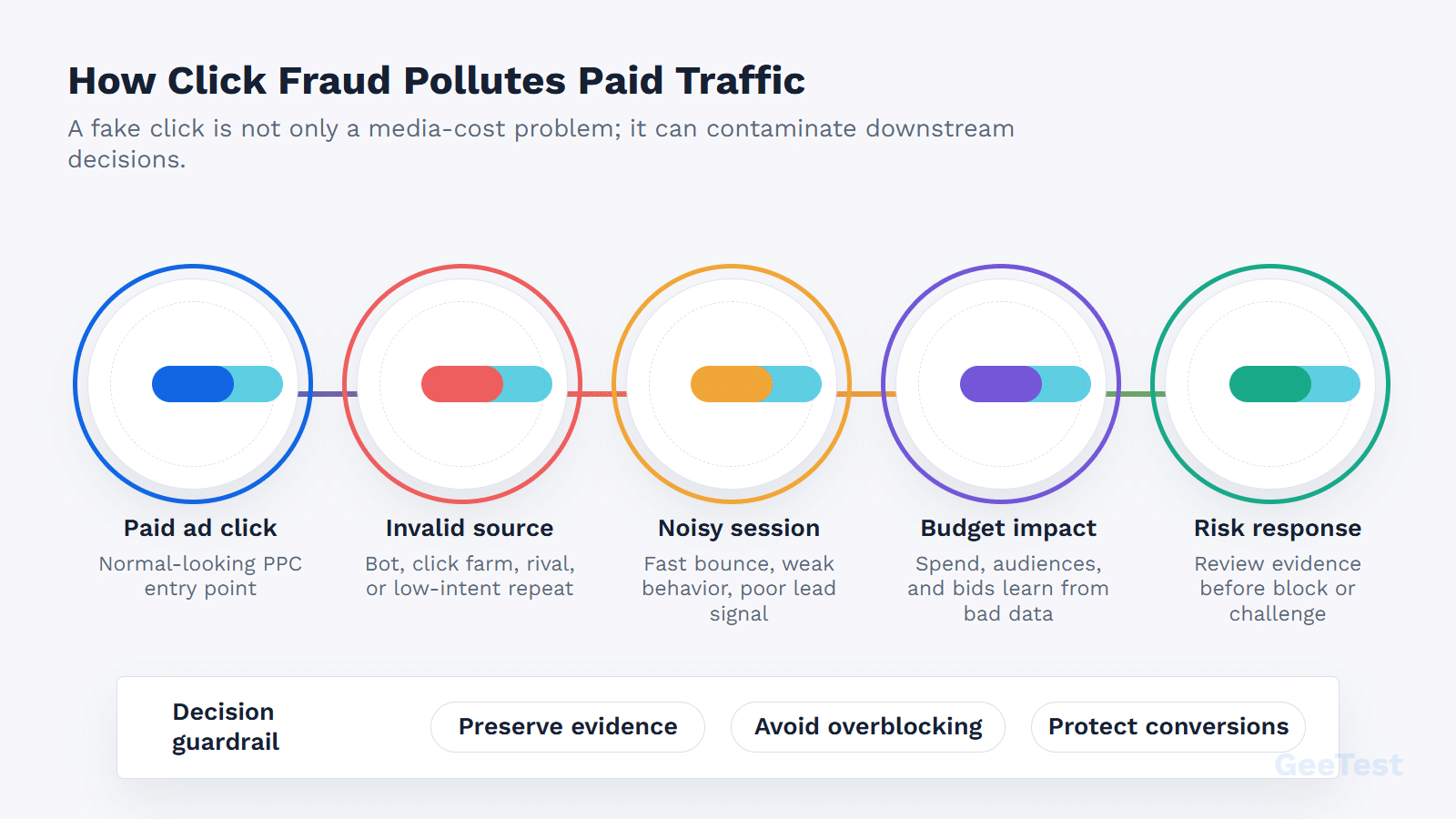
The mechanics vary. A crude script may click from the same environment until it is filtered. A more advanced botnet may rotate IPs, browsers, devices, and timing. Human click farms move more slowly but can slip past simple automation checks. Competitor and publisher abuse can be harder still because the traffic may blend into normal paid activity until the team compares click data with session and conversion quality.
1. Automated Bots and Botnets
Automated click fraud uses scripts, headless browsers, infected devices, data-center infrastructure, residential proxies, or botnets to create click activity. The goal is not always to look perfectly human. Often it only has to look plausible enough to be recorded, billed, or counted before later filtering catches up.
Simple bots tend to leave rough edges: repeated timing, the same user agent, impossible session paths, or many clicks with no meaningful page activity. More advanced bots try to mimic browsing by loading pages, waiting, scrolling, or triggering shallow events. That is why click-level evidence is useful but incomplete. A user who clicks once and bounces quickly is not the same risk as a session that clicks, lands, and then behaves like automation across forms or account flows.
2. Human Click Farms and Competitor Clicks
Human click farms rely on people rather than scripts. They may be used to inflate publisher revenue, manipulate traffic quality, or make fraudulent activity harder to classify as automation. Competitor-driven clicks are another concern, especially in expensive PPC categories, but the evidence bar should stay high. A burst of costly clicks from one region is suspicious. It is not, by itself, proof that a competitor did it.
Separate suspicion from evidence. Time stamps, click IDs, campaign context, session recordings, device signals, conversion outcomes, and platform reports create a stronger case than a spreadsheet of IP addresses alone.
Common Types of Click Fraud
The most useful classification is not "bot or human." It is motive plus evidence pattern.
| Type | Typical Motive | Common Evidence | Response Caution |
|---|---|---|---|
| Competitor clicks | Drain a rival’s PPC budget | Repeated costly clicks, low engagement, narrow timing or geography | Do not accuse without strong evidence |
| Publisher fraud | Inflate ad revenue | Odd placements, referral patterns, or high click volume with weak quality | Review placement and partner quality |
| Click farms | Generate paid human clicks | Similar low-intent sessions, weak conversion quality, behavior clusters | Human traffic can bypass simple bot rules |
| Click bots and botnets | Automate fake click volume | Proxy churn, repeated environments, impossible behavior, no downstream quality | Simple IP blocking may miss rotation |
| Accidental invalid clicks | Non-malicious repeated or mistaken clicks | Duplicate clicks, rapid repeats, no clear abuse motive | Avoid broad rules that hurt real users |
1. Competitor and Publisher Fraud
Competitor fraud is the example advertisers usually mention first. Publisher fraud deserves the same attention in display and content networks, because a publisher may benefit when hosted ads receive more clicks. The incentive changes the evidence you need. Competitor abuse may appear as repeated paid-search clicks that never convert. Publisher abuse may show up through placement, referral, or network-quality patterns.
2. Click Bots, Click Farms, and Low-Intent Traffic
Click bots and click farms work differently, but they create the same business problem: paid traffic that does not behave like demand. Low-intent traffic is not always fraudulent, yet it can still waste spend and distort optimization. Prevention should reduce harmful traffic without turning every uncertain visitor into a blocked visitor.
Why Click Fraud Hurts PPC Campaigns
The obvious loss is ad spend. A campaign pays for a click that never had a fair chance to convert. The deeper loss is decision quality.
1. Budget Waste Is Only the First Problem
Fake clicks consume budget that should have reached real prospects. In high-cost categories, even a small cluster can reduce impression share during important hours. If a daily budget is drained early by suspicious activity, the campaign may disappear before high-intent buyers search later.
Ad platforms also handle some invalid traffic after the fact. Google describes systems that identify invalid interactions and may credit invalid activity after review. Advertisers still need their own evidence trail because the useful question is not only "was this click billed?" It is also "did this traffic teach our campaign and sales funnel the wrong lesson?"
2. Bad Traffic Can Teach Algorithms the Wrong Signals
Modern campaigns optimize from conversion and audience signals. If fake clicks produce shallow sessions, spam leads, fake accounts, trial abuse, or empty form submissions, the campaign can start learning from the wrong population. Retargeting lists may fill with junk sessions. Automated bidding may chase patterns that resemble the bad traffic. Sales and fraud teams then inherit the cleanup.
This is where click fraud stops being only a PPC issue. PPC, analytics, sales operations, product, and risk teams need a shared view of click quality, session quality, lead quality, and downstream abuse.
How to Detect Click Fraud
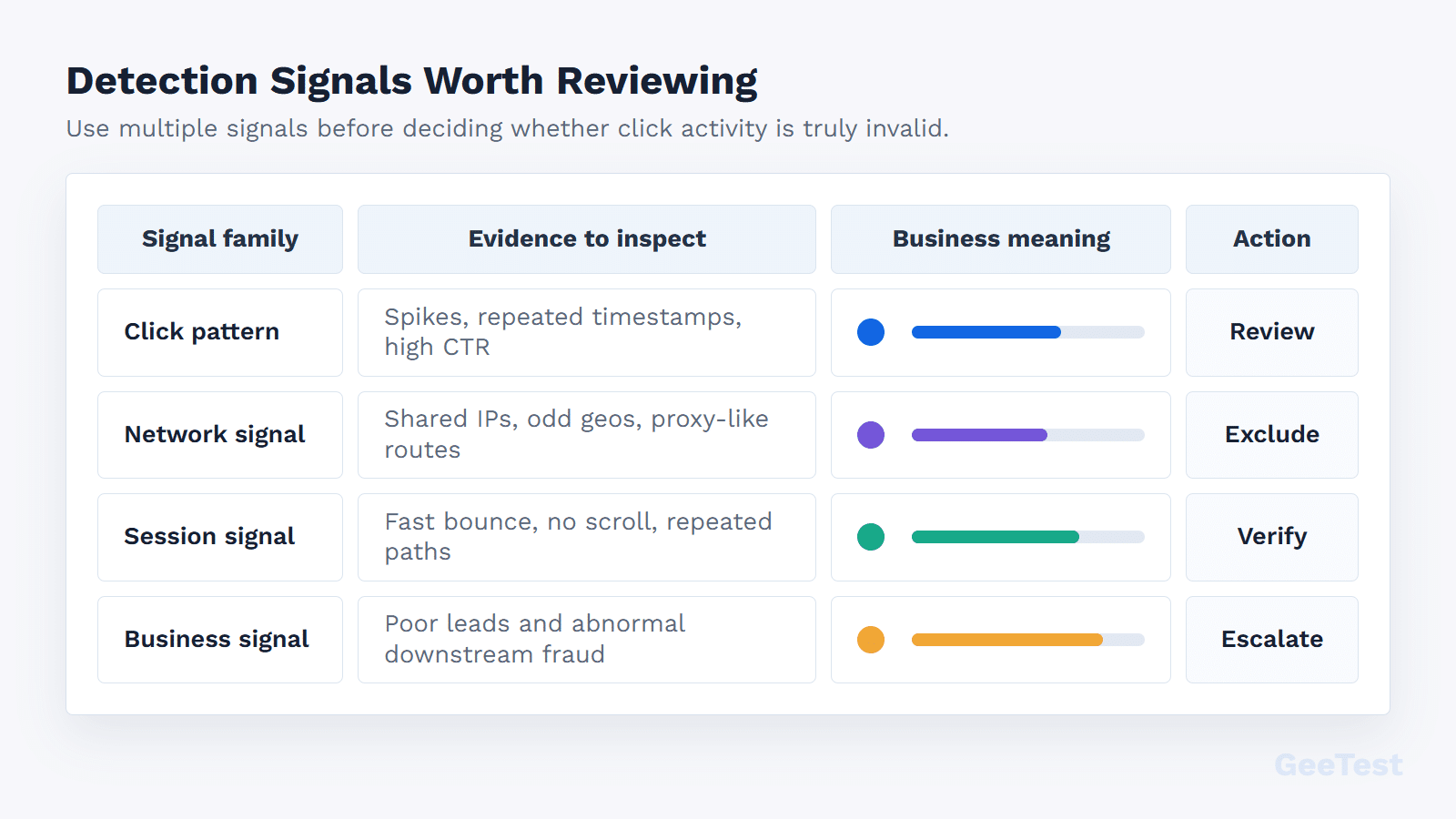
Detection starts with reviewable patterns. One suspicious click is usually noise. A cluster across campaign, source, device, geography, session behavior, and conversion quality is more useful.
1. Traffic Patterns That Deserve Review
Useful signals include:
- repeated clicks from the same IP range, device, browser, or network;
- sudden click spikes that do not match seasonality or campaign changes;
- high click volume with unusually short sessions;
- expensive keywords with many clicks and almost no qualified conversions;
- impossible or irrelevant geographies;
- repeated form attempts, fake accounts, or spam submissions after paid clicks;
- unusual timing patterns, such as many clicks at exact intervals.
No signal proves the case on its own. IP addresses change. Real users bounce. Privacy controls limit tracking. Shared office networks and mobile carriers can make innocent traffic look clustered. The better process is to combine weak signals into a risk picture, then decide whether the evidence is strong enough to observe, investigate, filter, challenge, or block.
2. Evidence Matters Before You Block
Preserve evidence before changing rules. Keep click IDs, timestamps, campaign and keyword data, landing-page events, session quality, form outcomes, device or browser signals, and baseline conversion metrics. If you later submit an invalid-traffic investigation or adjust campaign controls, that evidence helps separate true waste from normal variance.
False positives matter here. A broad rule can block real prospects, especially in shared networks, mobile environments, travel-heavy audiences, or B2B buying groups where several employees may research from similar infrastructure.
How to Prevent Click Fraud
There is no single control that stops all click fraud. A practical program combines ad-platform review, campaign hygiene, software or analytics, and site-side risk signals.
1. Start With Platform and Campaign Controls
Start with the controls already available in the ad platform. Review search partner and placement performance. Tighten geography and audience targeting. Exclude poor placements when evidence supports it. Watch invalid-click credits and platform notices. Use IP exclusions carefully, because IP-level rules can reduce unwanted exposure but may also block legitimate users when applied too broadly.
If the issue is severe, keep the evidence needed for platform review. Platform filtering can help with billing and invalid interactions. Your own analytics still have to answer what happened after the click reached your site.
2. Add Tools and Risk Signals Carefully
Dedicated click fraud prevention tools can help when they provide transparent evidence, ad-account integration, configurable rules, review controls, and a way to measure business impact. The tool should explain why traffic was flagged, not only report a large blocked-click number.
Site-side risk signals add another layer. If paid traffic reaches a landing page, form, account signup, login, trial, coupon flow, or checkout, the business can evaluate whether the session behaves like a real user. Device, IP, environment, and behavior patterns can help distinguish a normal prospect from automation or abuse.
Where Bot Management and Risk Signals Fit
Bot management does not replace Google Ads invalid-click review. It protects the flows you control after the ad click.
1. Post-Click Signals Show Whether Traffic Behaves Like Real Users
When suspicious paid traffic lands on an owned property, device and session risk become useful. GeeTest device fingerprinting can support device and risk-signal analysis across device, IP, and behavior context. That layer is most useful when a suspicious click becomes a form submission, account creation, login, download, promotion claim, or payment attempt.
The point is not to label every paid click as fraud. The point is to decide whether the post-click journey looks trustworthy enough to continue without friction.
2. Verification Should Match the Risk Level
Risk-based verification should not be always on. If most traffic looks legitimate, adding friction everywhere can reduce conversion. A better model is to challenge only higher-risk actions. GeeTest Adaptive CAPTCHA can be used as a step-up control in suspicious flows while lower-risk users continue with less interruption.
That boundary keeps the prevention strategy honest. CAPTCHA does not stop the ad click itself. Adaptive verification can reduce downstream bot abuse after suspicious paid traffic reaches owned flows.
FAQ About Click Fraud
1. What does click fraud mean?
Click fraud means fake, invalid, or low-intent clicks are generated on ads or links to waste budget, distort performance data, or create fraudulent revenue. In PPC, it overlaps with invalid clicks and invalid traffic, but those broader terms can include non-fraudulent activity too.
2. What is an example of click fraud?
One example is a bot repeatedly clicking a competitor’s paid search ads so the competitor pays for visits that never had buying intent. Another is a publisher using artificial clicks to inflate ad revenue. In both cases, the team needs evidence before choosing a response.
3. Can click fraud create legal or policy risk?
Click fraud can create legal, contractual, platform-policy, or compliance risk, but the exact status depends on jurisdiction, contract terms, facts, and intent. This article should not be used as legal advice. Preserve evidence and involve qualified counsel or compliance stakeholders when the stakes are high.
4. Can CAPTCHA stop click fraud?
CAPTCHA is not an ad-click blocker and does not replace ad-platform invalid-traffic systems. Risk-based verification can help protect high-risk post-click actions, such as forms, signups, logins, downloads, or payment flows, when suspicious traffic reaches your own site.