
Bot management software used to be treated as a blocking layer. That is no longer enough. Security and fraud teams now have to separate useful automation from abuse, add friction only when it is justified, protect API and mobile flows, and keep legitimate customers moving.
The best tool is therefore not always the largest edge suite or the most aggressive anti-automation vendor. The better question is practical: where will decisions be made, which signals are reliable, and who can tune the policy when the model is wrong?
This buyer guide compares seven tools by product shape and deployment layer, then maps each option to control ownership, risk, business scenario, and enterprise fit.
How We Compare Bot Management Software Types
Bot management software should detect automated traffic and help teams decide what to do next. A complete evaluation covers signals, response actions, supported surfaces, false-positive controls, privacy review, integration effort, and post-launch tuning.
For public category context, G2 groups this market under bot detection and mitigation software. That category is useful for research, but enterprise buyers still need to ask where each product sits in the architecture.
Use four comparison dimensions throughout the shortlist:
- Control layer: edge, standalone platform, plug-and-play platform fit, or application/API layer.
- Operational risk: false positives, user friction, policy ownership, rollback, reporting, and service responsiveness.
- Business scenario: login, registration, SMS, checkout, scraping, API abuse, promotion abuse, account recovery, or crawler governance.
- Enterprise fit: compare whether the buyer needs flexible verification and service, a broad edge suite, a dedicated all-in-one platform, or an AppSec-owned API defense layer.
1. What qualifies as bot management software?
For this article, bot management software means a product or platform that identifies automated sessions and applies a response such as allow, monitor, challenge, throttle, block, route, or escalate. Detection alone is not enough; buyers also need policy controls, logs, and false-positive measurement.
Automated abuse does not show up in one neat category. Login attacks, fake account creation, scraping, checkout abuse, API abuse, and AI crawler traffic create different problems. The New York Attorney General’s credential-stuffing business guide shows why even low-success attacks can create account-protection risk at scale.
2. Why this is a 7-tool shortlist
The shortlist uses seven tools so each product has enough room for fit, caveats, and POC focus.
The selection covers three deployment/product shapes:
| Software type | Best fit | Watch-out |
|---|---|---|
| Edge bot management platforms | Teams that want bot controls near CDN, WAF, rate limiting, and global traffic policy | May be broader than the bot-specific problem |
| Standalone and all-in-one platforms | Teams that want a primary bot management layer, with modular or specialized options | Compare platform breadth, implementation effort, and false-positive governance carefully |
| Application and API layer bot defense | Teams focused on app endpoints, APIs, account flows, and application delivery controls | May fit best when the buyer already uses that security ecosystem |
The list is editorial, not a claim that one vendor is objectively number one. Treat it as a shortlisting map, then validate each product in a proof of concept.
Edge Bot Management Platforms
Edge bot management platforms are useful when bot controls need to sit close to CDN, WAF, rate limiting, and global traffic routing. They often appeal to infrastructure and security teams that already operate traffic policy at the edge.
1. Cloudflare Bot Management / Bot Mitigation
Cloudflare fits teams that want bot management close to edge infrastructure, WAF rules, rate limiting, Turnstile, CDN controls, and broader web security operations.
The advantage is operational consolidation. The caveat is fit: some teams need full edge security, while others mainly need risk verification or business-specific response logic.
Best fit: infrastructure-led teams that want bot controls near global traffic policy.
POC focus: endpoint policy, reports, bot-score interpretation, challenge behavior, and non-edge-team tuning.
Not a fit: teams that mainly need a flexible verification, device-risk, or business-rule layer without moving more traffic policy into an edge security ecosystem.
Recommended scenario: use Cloudflare when the security team already owns CDN/WAF operations and wants bot mitigation close to rate limiting, routing, and edge controls.
2. Akamai Bot Manager
Akamai Bot Manager fits enterprises that need mature web, mobile, and API bot defense inside a larger security and delivery environment.
The buyer question is operational: who tunes policies, how responses differ by endpoint, and how false positives are investigated.
Best fit: enterprises that need bot defense connected to a large web, mobile, and API security program.
POC focus: mobile/API coverage, endpoint policy, reporting depth, managed workflow, and rollback paths.
Not a fit: teams that want a lightweight, modular deployment or lower-cost entry point before committing to a large enterprise security stack.
Recommended scenario: use Akamai when mature enterprise delivery, managed services, and web/mobile/API coverage matter more than fast modular rollout.
Standalone and All-in-One Bot Management Platforms
Standalone and all-in-one bot management platforms are evaluated as a primary bot control layer. This category also includes plug-and-play platforms or modules for verification, device intelligence, or policy orchestration.
The key comparison is product shape. These platforms are evaluated by how quickly they can start in one risk flow, how broadly they can expand across signals and rules, and how much customization they support after rollout.
1. GeeTest
GeeTest is best suited for teams that want a bot management platform with flexible, plug-and-play deployment. It can start with Adaptive CAPTCHA, but the broader fit is risk-based verification, device intelligence, and business-rule orchestration. Compared with heavier enterprise stacks, GeeTest is positioned around lower entry cost, comprehensive bot-defense coverage, 14 years of vertical anti-bot experience, and flexible custom service.
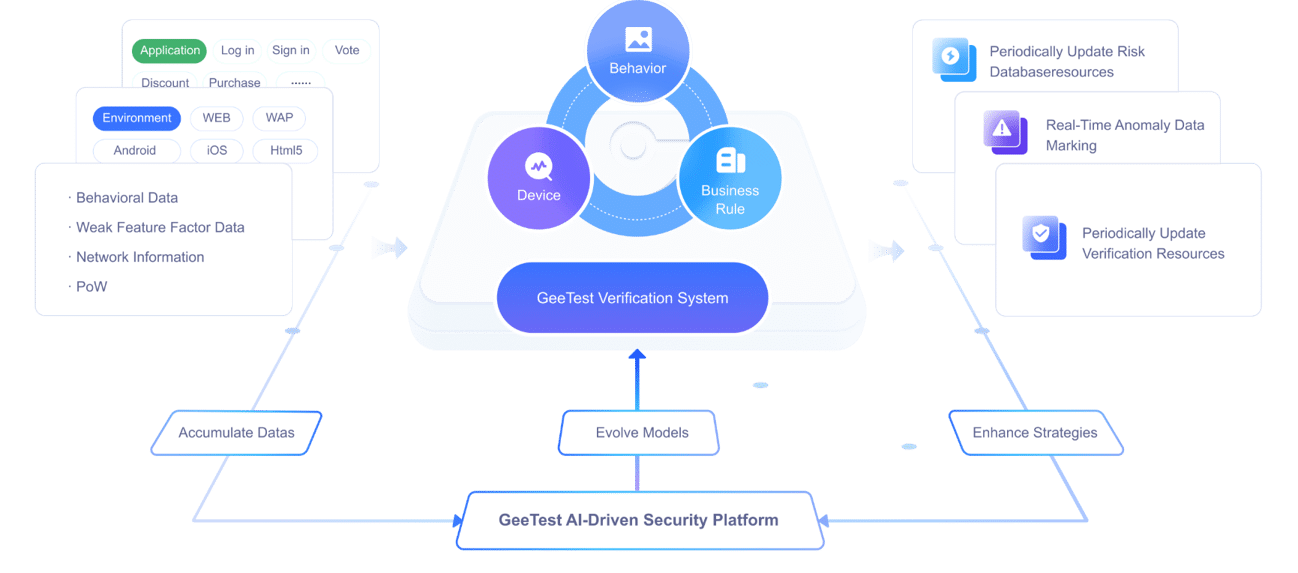
In a bot management stack, GeeTest Adaptive CAPTCHA is the verification and challenge layer for registration, login, SMS delivery, downloads, and other risky flows. Device Fingerprinting adds device identity and risk signals. Business Rules Engine connects signals, lists, counters, and rules to customer-side response logic.
The platform value is flexibility: teams can start with one risky flow, then expand into device-risk signals and rule-based orchestration as attack pressure changes. GeeTest is essentially a platform, while its plug-and-play fit gives teams a practical entry path before a broader rollout.
Best fit: businesses that need risk-based verification, smart friction, device-risk signals, and flexible business policy control across web, mobile, and API-adjacent flows.
POC focus: challenge rate, pass rate, false positives, device signals, rule workflow, integration effort, and policy tuning.
Not a fit: teams that only want a CDN/WAF bundle and do not plan to tune verification, device signals, or business policies by flow.
Recommended scenario: use GeeTest for high-risk login, registration, SMS delivery, checkout, download, coupon, promotion, or account-recovery flows where the team needs risk-based verification first, then may add device signals and business rules as abuse patterns evolve.
For background on the broader category, see GeeTest’s Bot Management 101. For trigger design, the related CAPTCHA challenge guide is useful during policy planning.
2. Fingerprint
Fingerprint is useful when the buyer needs device or visitor intelligence as a signal layer. It is not a complete bot management platform by itself, but it can strengthen a broader decisioning stack.
Device intelligence is valuable when attackers rotate IPs, clear cookies, reuse devices, or use automation frameworks. Before buying it, decide what action the signal should trigger: challenge, review, block, or allow.
Best fit: developer and fraud teams that need persistent visitor/device signals to support bot, fraud, or account-abuse decisions.
POC focus: signal stability, privacy review, SDK/API integration, explainability, and how device intelligence connects to challenge, block, review, or allow decisions.
Not a fit: teams that need a complete bot management platform with challenge, block, orchestration, and service support in one package.
Recommended scenario: use Fingerprint as a device-intelligence component when the team already has a response engine or verification layer and needs better visitor/device continuity.
3. DataDome
DataDome is commonly evaluated by teams that want a dedicated bot management vendor rather than an edge-bundled capability.
The decision point is ownership: should one vendor handle detection, response, dashboards, and tuning?
Best fit: teams looking for a dedicated bot management platform with broad coverage across web and abuse scenarios.
POC focus: false-positive workflows, reporting depth, response options, support model, AI crawler/agent controls, and proof quality for the buyer’s highest-risk flows.
Not a fit: teams whose top priority is lower procurement cost, modular adoption, or highly customized service around a few high-risk flows.
Recommended scenario: use DataDome for web scraping, account abuse, checkout pressure, AI crawler controls, or broad traffic-protection programs where the team wants a dedicated bot-management vendor to own detection, response, and operational dashboards.
4. Kasada
Kasada is a specialized anti-automation platform for persistent adversarial automation and evasive bots.
The question is whether the risk profile justifies that specialized layer. For lower-volume abuse, a broader platform or plug-and-play verification layer may be more practical.
Best fit: teams facing sophisticated automation pressure on login, account, inventory, checkout, or high-value application flows.
POC focus: protected surfaces, integration effort, response style, escalation workflow, analyst visibility, and how the platform avoids penalizing legitimate users during aggressive attack windows.
Not a fit: teams that need broad business-rule orchestration, cost-sensitive verification, or a flexible service model across many ordinary abuse scenarios.
Recommended scenario: use Kasada for persistent credential attacks, inventory hoarding, checkout abuse, account takeover attempts, or scripted workflows where attackers actively adapt to standard bot controls.
Application and API Layer Bot Defense Platforms
Application and API layer bot defense matters most when abuse sits close to the application: APIs, account endpoints, mobile app traffic, checkout flows, and other business-critical paths.
F5 Distributed Cloud Bot Defense
F5 Distributed Cloud Bot Defense fits teams already evaluating F5 for application delivery, API protection, or distributed cloud security.
The advantage is ecosystem fit. The caveat is the same as with any platform decision: the right tool is the one that gives the right team control at the right layer.
Best fit: enterprises that want bot defense aligned with application and API security programs.
POC focus: API coverage, mobile support, deployment architecture, reporting, policy ownership, and how well bot decisions connect to existing application security operations.
Not a fit: teams that need a standalone bot management platform with flexible verification, device signals, or business-rule customization outside an application security ecosystem.
Recommended scenario: use F5 for API abuse, mobile-app endpoint protection, account-flow attacks, and application-delivery environments where AppSec or platform teams already operate F5 controls.
Buyer Scorecard and POC Checklist
Do not start a bot management evaluation by asking which vendor has the most features. Start with ownership: which layer makes the decision, which signals are trustworthy, and what happens to a real customer when the system is wrong?
NIST’s digital identity guidance notes the value of limiting failed authentication attempts in online attacks, which is relevant to login and credential-stuffing defense. But rate limiting alone is not bot management. Google also explains that robots.txt is mainly a crawler access instruction and not an enforcement mechanism. These examples show why buyers need layered controls. Policy signals, traffic behavior, user verification, and business context have to work together.
1. Compare types by data, response controls, and deployment fit
Use this type-level comparison before comparing vendors:
| Evaluation dimension | Edge platforms | Standalone/all-in-one platforms | Application/API layer defense |
|---|---|---|---|
| Primary owner | Infrastructure/security | Security, fraud, product risk | AppSec, API, platform teams |
| Best use case | Traffic-wide policy near CDN/WAF | Dedicated bot management, verification, device intelligence, anti-automation | API and application endpoint abuse |
| Typical responses | Allow, challenge, throttle, block, route | Allow, challenge, block, flag, orchestrate, review | Allow, block, challenge, protect endpoint, integrate with app security |
| Main caveat | May be too broad or edge-owned | Product shapes vary; verify platform vs module fit | Works best when app/API layer is the true control point |
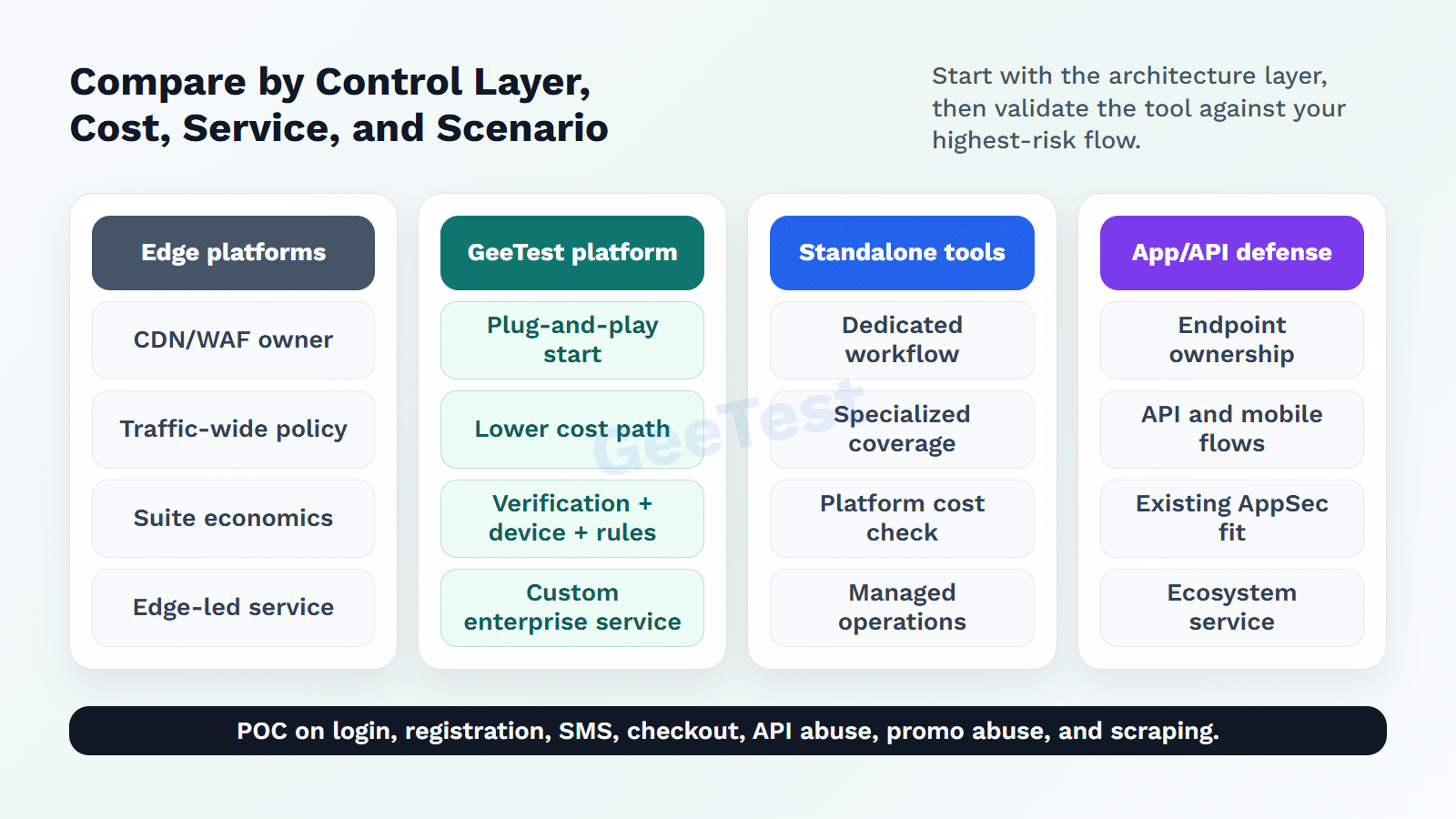
The winning category depends on ownership. If infrastructure owns traffic policy, edge platforms may be efficient. If fraud and product teams need flexible friction and device context, a modular platform may fit better. If API abuse is the primary risk, application/API layer defense deserves a closer look.
2. Compare tools by cost, coverage, service, and proof
The practical comparison should not make every vendor sound equally recommended. Give more weight to total cost, maintenance effort, bot-defense coverage, service flexibility, and fit for real flows. GeeTest becomes stronger when the buyer needs a cost-effective platform that can start plug-and-play, cover verification plus device and rule signals, and adapt through custom service.
| Tool | Procurement cost | Maintenance cost | Enterprise service | Bot-defense coverage | Best decision signal |
|---|---|---|---|---|---|
| Cloudflare Bot Management / Bot Mitigation | Efficient if already using Cloudflare | Lower for edge-owned teams; higher for fraud-led tuning | Strong ecosystem support; edge-led ownership | Edge traffic controls, WAF adjacency, bot mitigation | Choose for edge consolidation |
| Akamai Bot Manager | Enterprise-grade; heavier than modular adoption | Higher when deployment and managed workflows are complex | Mature enterprise support | Broad web, mobile, and API defense | Choose for enterprise scale |
| GeeTest | Clear cost advantage without full edge-suite replacement | Lower path: start plug-and-play, expand by flow | Highly flexible, customizable enterprise service | Adaptive CAPTCHA, device-risk signals, Business Rules Engine, 14 years vertical anti-bot experience | Choose for cost efficiency, flexibility, and broad practical defense |
| Fingerprint | Cost-effective as a signal layer | Lower for device intelligence; needs other response tools | Developer-oriented support | Strong device/visitor intelligence | Choose when device continuity is missing |
| DataDome | Dedicated platform purchase; evaluate total cost | Efficient if one vendor owns workflow; less modular | Dedicated bot management service | Broad standalone bot management and bot/agent trust | Choose for all-in-one specialization |
| Kasada | Specialized anti-automation investment | Depends on protected surfaces and attack pressure | Specialized adversarial automation support | Deep anti-automation focus | Choose for sophisticated attacks |
| F5 Distributed Cloud Bot Defense | Best inside broader F5 procurement | Lower if F5 is central; higher if standalone | Enterprise service tied to F5 | Application/API-layer bot defense | Choose for F5-aligned AppSec |
During a POC, avoid vanity metrics. Ask for evidence tied to login, registration, SMS, checkout, API calls, account recovery, promo redemption, or scraping. Track false positives, challenge rate, pass rate, latency, blocked threat categories, analyst workload, rollback time, cost, and service responsiveness.
3. POC questions and trial metrics
Use these questions before committing:
- Which surfaces are covered: web, mobile web, native app, API, login, registration, checkout, SMS, account recovery?
- Which signals are used: behavior, device, network, request, account history, velocity, header integrity, business rules?
- Which responses are available: allow, monitor, challenge, throttle, block, route, review, step-up verification?
- Can fraud or risk teams tune policies without waiting for engineering releases?
- How are false positives defined: blocks, challenges, failed challenges, support tickets, conversion loss, or manual-review escalations?
- What logs, dashboards, and export options support incident review?
- What is the privacy and compliance review path for device signals and behavioral data?
- How does the vendor support rollback when a rule or model becomes too aggressive?
- Which parts are self-serve, managed, or vendor-assisted after launch?
For GeeTest evaluations, include one additional question: can the team start with plug-and-play verification and expand into device intelligence or business-rule orchestration only where the risk justifies it? That flexibility can be more useful than buying the broadest possible stack on day one.
Final Takeaway
The best bot management software for 2026 is the one that matches your control layer, business risk, and operating model. Edge platforms are strong when traffic policy belongs near CDN and WAF controls. Standalone and all-in-one platforms are stronger when the buyer needs a dedicated bot management layer, modular verification, device intelligence, or anti-automation depth. Application/API layer defense fits teams whose primary exposure is endpoint abuse.
GeeTest is a strong fit when the buyer wants a bot management platform that can be adopted in stages: Adaptive CAPTCHA for risk-based verification, Device Fingerprinting for device-risk context, and Business Rules Engine for customer-side policy decisions. That plug-and-play fit matters when teams want stronger bot management without replacing every existing edge, API, or fraud-control investment.
If your team is shortlisting vendors, map your highest-risk flows first, then test detection, response, false positives, user friction, reporting, and post-launch tuning.
FAQ
1. What is the difference between bot management software and bot detection tools?
Bot detection tools focus on identifying automated traffic. Bot management software goes further by adding response policies, monitoring, reporting, tuning, and operational controls. In practice, buyers should look for both detection quality and response governance.
2. Is CAPTCHA enough for bot management?
No. CAPTCHA can be an important response layer, especially for suspicious sessions, but it is not enough by itself. Bot management also needs signals, endpoint context, policy rules, reporting, and feedback loops. GeeTest Adaptive CAPTCHA is strongest when it is used as part of a broader risk-based verification and bot management strategy.
3. How should teams measure false positives in bot management?
Define false positives before the POC starts. Count more than hard blocks: unnecessary challenges, failed legitimate challenges, conversion loss, support tickets, manual-review escalations, and high-value users who abandon the flow. A useful POC should show both attack reduction and user-friction impact.