
Takeways
What Is CAPTCHA and Why It Still Matters in 2026?
As AI-driven automation continues to evolve in 2026, bots increasingly mimic human behavior across websites, apps, and APIs. CAPTCHA still matters as a targeted risk confirmation mechanism, activated at high-impact moments to distinguish real users from automated abuse without constant friction.
How CAPTCHA Works in 2026?
Systems now silently analyze your mouse tracks, device features, and browsing rhythm, triggering interactive challenges like sliders only if behavior is suspicious. Some also use background Proof-of-Work (PoW) tasks to exhaust bot resources without interrupting your experience.
What to Look for in a 2026 CAPTCHA Provider?
Key criteria include AI-resistant detection, behavior-based risk assessment, invisible verification for legitimate users, adaptive challenges, privacy compliance, and scalable performance.
What are the Best CAPTCHA Providers in 2026?
In 2026, the top CAPTCHA providers include Google (with its widely used reCAPTCHA v2 for interactive challenges, reCAPTCHA v3 for invisible scoring, and the robust reCAPTCHA Enterprise), Cloudflare Turnstile for a free and seamless experience, GeeTest for adaptive interactive challenges, hCaptcha for privacy-focused labeling, Friendly Captcha and ALTPCHA for privacy-first proof-of-work, and Arkose Labs for gamified verification like “FunCaptcha”.
The internet is now saturated with automation. AI-driven bots no longer announce themselves through speed or volume alone. They behave patiently, imitate hesitation, and replicate human interaction patterns with alarming accuracy. At the same time, legitimate users have become far less tolerant of friction. Every unnecessary interruption risks abandonment.
This dual pressure has fundamentally changed what “best CAPTCHA” means. The question is no longer which provider offers the hardest challenge, but which one can make the most accurate decisions under uncertainty, at scale, and without disrupting real users.
What Is CAPTCHA and Why Does It Still Matter in 2026?
CAPTCHA was originally created to distinguish humans from machines through tasks that were easy for people and difficult for computers. For a long time, simple challenges such as distorted text or image selection were effective. That model no longer works in 2026. Modern AI can solve most traditional CAPTCHA challenges with high accuracy, which has led to a common misconception that CAPTCHA is becoming irrelevant. In reality, CAPTCHA has not disappeared. It has changed its role.
Today, CAPTCHA functions less as a constant test and more as a risk confirmation mechanism. Instead of challenging every user, modern systems evaluate behavior and context first, and only introduce friction when automated analysis alone cannot provide enough confidence.
In practice, this means CAPTCHA is triggered at high-risk moments, such as:
- Login attempts vulnerable to credential stuffing
- Account recovery and password reset flows
- New account registrations exposed to mass automation
- High-value or limited-resource transactions
At these points, CAPTCHA serves as the final checkpoint before irreversible actions are taken.
This selective use of CAPTCHA is also critical for user experience. In 2026, the goal is not to prove that users can solve puzzles, but to ensure that legitimate users pass with minimal disruption. Well-designed CAPTCHA systems achieve this by:
- Allowing low-risk users to pass without visible challenges
- Escalating verification only when behavioral signals indicate abuse
- Adapting difficulty and format based on real-time risk
Beyond security, CAPTCHA still matters because it contributes to user trust. Users expect platforms to protect accounts and transactions, but they also expect the process to feel smooth and intentional. Excessive or outdated challenges undermine both trust and conversion.
In 2026, CAPTCHA remains relevant not as a standalone test, but as a context-aware control that balances security, usability, and risk at critical points in the user journey.
How CAPTCHA Works in 2026?
By 2026, most CAPTCHAs have moved away from frustrating puzzles toward invisible, adaptive systems that detect bots through behavior analysis, device signals, and lightweight proofs—minimizing friction for real users while countering advanced AI bots.
Modern CAPTCHA solutions fall into several main categories:
- Interactive CAPTCHA: Requires active user input. Classic examples include selecting images or solving puzzles, but many now use simpler actions. GeeTest’s adaptive slider asks users to drag a piece into place; it analyzes drag trajectory, speed, and hesitations for human-like patterns. Cloudflare Turnstile’s checkbox mode often verifies with just one click, escalating only if needed.
- Non-interactive CAPTCHA: Shows a visible widget but requires no puzzle-solving. For example, Turnstile’s non-interactive mode displays a small loading indicator that automatically completes a background check, returning pass/fail without interrupting the user.
- Invisible / Passive CAPTCHA: Runs entirely in the background with no visible element. Google reCAPTCHA v3 and GeeTest’s invisible mode collect behavioral signals (mouse/touch movements, timing, device fingerprints) and assign a risk score (0–1). Low-risk users pass silently; high-risk may trigger a fallback challenge.
- Proof-of-Work CAPTCHA: Privacy-focused and fully invisible. Services like Friendly Captcha make the browser solve a quick cryptographic puzzle (imperceptible to users but costly for bots). No tracking or behavioral data is collected.
These approaches prioritize seamless user experience and strong bot resistance, with adaptive systems (like GeeTest and Turnstile) dynamically choosing the least intrusive method based on real-time risk.
What to Look for in a 2026 CAPTCHA Provider?
- AI-resistant bot detection that can identify human-like automation
- Behavior-based risk assessment instead of static challenges
- Invisible, low-friction verification for most legitimate users
- Adaptive challenges triggered only when risk is detected
- High accuracy with minimal false positives
- Privacy-first data handling aligned with global regulations
- Lightweight performance with minimal impact on page speed
- Transparent pricing that scales without penalizing bot traffic
Top CAPTCHA Providers in 2026
Quick Glance Table for Top CAPTCHA Providers in 2026
| Provider | User Experience | Data & Privacy Model | Detection Accuracy | Pricing & Cost Behavior |
| reCAPTCHA v2/v3 (Google) | v2: Checkbox + possible image challenges (visible friction); v3: Fully invisible risk scoring | Heavy behavioral/cross-site signals (Google ecosystem) | Medium–High vs basic bots; weaker vs advanced AI solvers | Free (high volume, ~1M assessments/mo); Enterprise upgrades usage-based |
| reCAPTCHA Enterprise | Adaptive checkbox/invisible with visual fallbacks | Enterprise controls + Google data integration | High (ML-tuned, strong with configuration) | Usage-based (~$1–$8/100K after free tier) |
| Cloudflare Turnstile | Managed/non-interactive/fully invisible; minimal friction | Minimal collection, no tracking/cookies | Strong (adaptive behavioral + CDN signals) | Completely free & unlimited (standard); Enterprise custom |
| GeeTest Adaptive CAPTCHA | Adaptive: invisible no-sense → slider/fallback; low friction | Behavioral + device signals (region-optimized) | Excellent (especially vs AI in high-threat areas) | Free basic tier (approval needed); Enterprise usage-based |
| hCaptcha | Interactive images + passive/no-CAPTCHA modes; moderate effort | Privacy-focused, reduced tracking | Strong (varies by challenge quality) | Free (generous, ~1M/mo); Pro ~$99–139/mo + overage |
| FunCaptcha (Arkose Labs) | Gamified/ escalating challenges; high visible friction | Behavioral + challenge analytics | Very High (strong vs solver farms/fraud) | Enterprise-only, custom/premium pricing |
| Friendly Captcha | Fully invisible proof-of-work; no interaction/widget | No behavioral tracking; cryptographic only | Strong vs automation (resource-costly for bots) | Free tier (limited); Starter ~€9/mo + per-request |
| ALTCHA | Fully invisible proof-of-work; developer-controlled | No tracking; self-hostable/open-source | Strong (depends on PoW tuning) | Free (open-source/self-hosted); Paid Sentinel options |
1. reCAPTCHA v2

Google’s reCAPTCHA v2 relies on explicit user interaction to distinguish humans from bots. Users are aware that a verification step is taking place, and security decisions are made based on how they complete that challenge.
Key features of reCAPTCHA v2
reCAPTCHA v2 comes in multiple flavors:
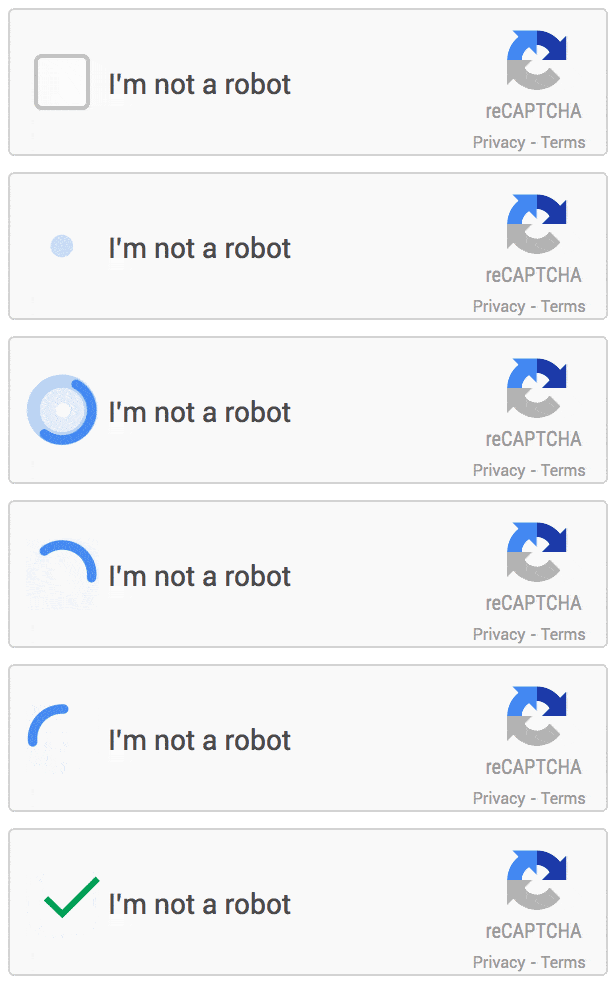
Checkbox reCAPTCHA: The classic “I’m not a robot” checkbox that users must click
Image Challenges: When needed, users select specific objects in images
Invisible reCAPTCHA: Works behind the scenes, triggering challenges only for suspicious activity
Pros of reCAPTCHA v2
- Easy implementation requiring minimal coding
- Effective against basic bots
- Provides visible verification proof
Cons of reCAPTCHA v2
- Image challenges can frustrate legitimate users
- Slower interaction, especially on mobile devices
- Some advanced bots can bypass it
2. reCAPTCHA v3
reCAPTCHA v3 takes a fundamentally different approach. Instead of asking users to prove they are human, it continuously evaluates behavior in the background and assigns a risk score.
Key features of reCAPTCHA v3
- Runs entirely invisibly with no user-facing challenges
- Monitors user behavior across page interactions
- Assigns a score from 0.0 (high risk) to 1.0 (low risk)
- Allows site owners to define actions based on score thresholds
Rather than blocking traffic outright, reCAPTCHA v3 shifts decision-making to the application layer. Developers decide how to respond to different risk levels, such as allowing access, requesting additional verification, or rejecting the request.
Pros of reCAPTCHA v3
- No interruption to the user experience
- Flexible, score-based security decisions
- Can be integrated with broader fraud detection systems
Cons of reCAPTCHA v3
- Requires more technical setup and backend logic
- Risk of false positives affecting legitimate users
- Does not block bots by default, relies on downstream handling
Additionally, reCAPTCHA v3 requires sending behavioral and interaction data to Google’s servers. For organizations with strict data governance or privacy requirements, this data flow may be a concern.
3. reCAPTCHA Enterprise
Built as the enterprise-grade tier of Google’s CAPTCHA offerings, reCAPTCHA Enterprise is designed for organizations with advanced security and scale requirements. Rather than functioning solely as a CAPTCHA tool, it operates as part of Google’s broader cloud security ecosystem, extending bot protection into account and fraud risk assessment.
Key features of reCAPTCHA Enterprise
- Advanced bot and fraud detection powered by Google-scale intelligence from trillions of transactions and billions of users
- Multi-factor authentication (MFA) support with SMS and email verification options
- Password leak detection that securely compares passwords against Google’s database of over four billion leaked credentials
- Account defender technology that identifies suspicious accounts exhibiting related behavior patterns
- Payment fraud prevention with specialized transaction risk scoring
- SMS defense that assigns risk scores to phone numbers to prevent toll fraud attacks
Pros of reCAPTCHA Enterprise
- Broad protection across key user flows, from registration to transactions
- AI-driven detection capable of identifying large-scale and coordinated abuse
- Real-time monitoring and analytics for operational visibility
- Enterprise-grade reliability backed by Google Cloud infrastructure
Cons of reCAPTCHA Enterprise
- More complex implementation than standard CAPTCHA solutions
- Requires ongoing tuning and operational oversight to maintain detection accuracy
- Creates stronger dependency on Google’s cloud and identity ecosystem
- Total cost can increase significantly at enterprise scale due to usage-based pricing, premium support fees, and multiple billable APIs
4. Cloudflare Turnstile
Breaking away from conventional CAPTCHA models, Cloudflare Turnstile prioritizes user experience without sacrificing security. This innovative solution operates behind the scenes, verifying humans without frustrating puzzles or interactive challenges.

Key features of Cloudflare Turnstile
Cloudflare Turnstile adapts to individual visitors through non-interactive JavaScript challenges that gather signals about browser environments. These smart verification methods include:
- Proof-of-work and proof-of-space challenges
- Web API probing techniques
- Browser-quirk detection
- Human behavior analysis
What truly sets Turnstile apart is its three widget types:
- Non-interactive – Visitors never need to interact with the widget
- Managed – Presents an interactive checkbox only for suspected bots
- Invisible – Completely hidden from view while still providing protection
Moreover, Turnstile works independently of Cloudflare’s network, allowing implementation on any website regardless of hosting provider or CDN.
Pros of Cloudflare Turnstile
- Eliminates frustrating visual puzzles, dramatically improving user experience
- Preserves privacy by avoiding data harvesting for ad retargeting
- Integrates seamlessly with Cloudflare Web Application Firewall rules
- WCAG 2.1 AA compliant, supporting accessibility requirements
- Easy migration from other CAPTCHA services like reCAPTCHA or hCaptcha
Cons of Cloudflare Turnstile
- Limited localization options with fewer region-specific customizations
- Some anecdotal evidence suggests sophisticated bots occasionally slip through
- Advanced analytics features only available on Enterprise plan
- Maximum of 15 hostnames per widget on free plan
5. GeeTest Adaptive CAPTCHA
GeeTest Adaptive CAPTCHA is an enterprise-grade verification solution that effectively balances strong security with a positive user experience. Founded in 2012, its AI-powered system minimizes friction through intuitive, behavioral-based challenges. It is recognized for reliable performance and robust customer support, making it a trusted choice for businesses seeking a comprehensive and user-friendly security layer.

Key features of GeeTest Adaptive CAPTCHA
- Dynamic strategies that adapt to each request
- Automatic refresh of 300,000 verification images hourly
- Multiple CAPTCHA types, including invisible mode
- Real-time dashboard with 60+ configurable security strategies
- Intelligent traffic analysis and detailed bot insights
- Highly customizable UX supporting 78 languages and flexible, cost-efficient deployment compared to usage-based enterprise CAPTCHA platforms
Pros of GeeTest Adaptive CAPTCHA
- Provides adaptive security strategies that evolve for each request
- Supports multiple CAPTCHA types, including invisible mode for a smooth user experience
- Highly customizable user experience with support for 78 languages and flexible deployment and pricing
- Built on over 13 years of focused experience in human verification and bot protection, demonstrating reliability and expertise
Cons of GeeTest Adaptive CAPTCHA
- Full feature access may require a premium plan and could be higher than some free alternatives
- Certain specialized integrations may require coordination with GeeTest support for smooth deployment
6. hCaptcha
hCaptcha is a privacy-focused CAPTCHA service founded in 2017 as an alternative to Google reCAPTCHA. It provides bot detection while transforming verification tasks into valuable data labeling for AI training.

Key features of hCaptcha
- Privacy-preserving machine learning that identifies bot behavior without collecting personal information
- API compatibility with reCAPTCHA, requiring only three lines of code to switch
- Multiple verification modes including invisible, passive (99.9% of users see no challenge), and standard challenge modes
- Global compliance with GDPR, CCPA, LGPD, PIPL, and other privacy regulations
- Sophisticated threat detection that adapts automatically to new attack patterns
- One of hCaptcha’s most distinctive features is its edge-focused design that eliminates data retention, thereby simplifying regulatory compliance across different jurisdictions.
Pros of hCaptcha
- Collects significantly less user data than reCAPTCHA and avoids advertising ecosystems, supporting GDPR and similar regulations.
- High-traffic sites can earn revenue through challenge-based AI labeling.
- Generous free tier, simple API, and low switching cost from reCAPTCHA.
Cons of hCaptcha
- Fewer plugins and customization options
- Multiple rounds of image selection can be more time-consuming or frustrating than other CAPTCHA providers
- Not invincible against sophisticated attacks
7. Friendly CAPTCHA
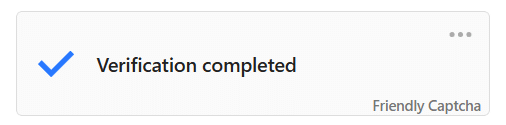
Founded in Germany, Friendly Captcha offers a truly invisible CAPTCHA experience that prioritizes both security and privacy without compromising user experience. This European alternative to traditional CAPTCHAs operates on proof-of-work mechanisms that eliminate the need for users to complete puzzles or labeling tasks.
Key features of Friendly Captcha
- Truly invisible operation that automatically solves cryptographic puzzles in the background while users complete forms
- Privacy-first design compliant with GDPR, CCPA, and global privacy regulations without using cookies or tracking
- Proof-of-work mechanism that checks the user’s device rather than requiring manual verification
- Accessibility compliance with WCAG standards, making it usable for all visitors regardless of ability
- In contrast to image recognition tasks, Friendly Captcha generates a unique cryptographic puzzle for each user’s device that solves automatically as they fill out forms.
Pros of Friendly Captcha
- Completely invisible to users with no manual tasks required
- GDPR-compliant and based entirely in Europe
- Doesn’t require HTTP cookies or persistent browser storage
Cons of Friendly Captcha
- May be less effective against highly sophisticated bots
- Creates potential overhead for legitimate users
- EU-hosted endpoint only available for professional plans
8. ALTCHA
ALTCHA delivers bot protection through a fundamentally different approach as a 100% self-hosted solution with no external service dependencies. This MIT-licensed, open-source alternative uses proof-of-work mechanisms rather than visual puzzles to verify legitimate users.

Key features of ALTCHA
- Proof-of-work verification that operates invisibly in the background
- Zero tracking with no cookies, fingerprinting, or data sharing
- ALTCHA Sentinel offering advanced protection through threat intelligence and machine learning
- Multi-language support across 50+ languages including RTL scripts
- Adaptive security that automatically adjusts challenge difficulty based on risk signals
- For suspicious traffic, ALTCHA can escalate to a secure code challenge with audio component for accessibility compliance.
Pros of ALTCHA
- Complete privacy compliance (GDPR, HIPAA, CCPA, etc.)
- Fully accessible following WCAG 2.2 and European Accessibility Act standards
- Substantially smaller footprint (30kB vs. 300+kB for reCAPTCHA)
- Faster load time (0ms vs. 1,000+ms for reCAPTCHA)
- Eliminates user interaction for legitimate visitors
Cons of ALTCHA
- May be less effective against sophisticated bots
- Advanced features require paid Sentinel subscription
- Self-hosting requires more technical setup
9. FunCaptcha (Arkose Labs)
FunCaptcha by Arkose Labs takes a gamification approach to bot prevention through interactive mini-games and puzzles that challenge users to complete entertaining tasks. Originally created by SwipeAds, this distinctive CAPTCHA solution has evolved from a simple security tool into a comprehensive fraud prevention platform.
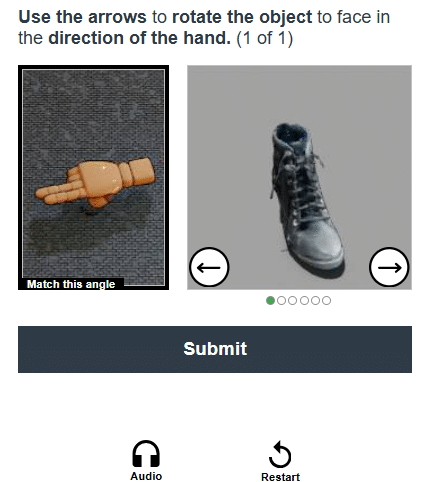
Key features of FunCaptcha
- Interactive 3D challenges replacing traditional text-based verifications with engaging mini-games
- Image rotation tasks requiring users to correctly position images vertically
- Gender classification puzzles where users identify and select female faces among multiple options
- Logical reasoning challenges designed to be significantly harder for bots than humans
Pros of FunCaptcha
- Improved security through challenges specifically designed to defeat automated solving
- Enhanced user engagement through game-like experience
- Increased conversion rates by 20.4% compared to conventional CAPTCHAs (per creator claims)
- Effective protection against determined attacks by hackers
Cons of FunCaptcha
- Complex challenges can frustrate some users, especially when multiple sequences are required
- Higher pricing compared to simpler CAPTCHA solutions
- Androgynous figures in gender challenges sometimes cause confusion
- Less access to user data than Google’s solutions, potentially leading to more frequent verification requests
Which CAPTCHA Provider is Best for You?
Choosing the right CAPTCHA provider in 2026 is less about finding a universal “best” and more about aligning a solution’s strengths and trade-offs with your specific priorities, user base, and threat model. Here’s a structured guide to help you make the optimal strategic decision.
Key Decision Factors
Consider these core dimensions when evaluating providers:
- Primary Objective: What is your main goal?
- Maximize User Experience & Conversion: Prioritize invisible or extremely low-friction verification.
- Maximum Bot Blocking & Fraud Prevention: Prioritize robust, multi-layered detection, even if it introduces some friction for high-risk sessions.
- Data Privacy & Regulatory Compliance: Prioritize solutions with minimal data collection, regional hosting, and clear compliance frameworks.
- Cost-Efficiency at Scale: Prioritize transparent, predictable pricing, especially for high-traffic sites.
- Your User Profile & Technical Context:
- User Tech-Savviness: Are your users general consumers (prioritize simplicity) or a specialized audience (may tolerate more complex challenges)?
- Primary Access Device: Mobile-heavy traffic demands solutions with excellent touch interaction and fast load times.
- Technical Resources: Do you have the developer bandwidth to implement and tune a score-based API, or do you need a “drop-in” widget?
- Your Threat Landscape:
- Volume of Attacks: Are you facing constant, high-volume scraping/credential stuffing, or targeted, low-volume sophisticated fraud?
- Value of Protected Assets: What’s at stake? (e.g., account integrity, financial transactions, content exclusivity).
Provider Selection Matrix
Based on the core factors above, here are the primary recommendations for common use cases:
| Your Primary Need / Use Case | Top Recommended Providers | Key Rationale |
| Premium User Experience & Low Friction | Cloudflare Turnstile, GeeTest Adaptive CAPTCHA (Invisible Mode), reCAPTCHA v3 | These solutions minimize or eliminate visible challenges for the vast majority of legitimate users, protecting conversions while maintaining security. |
| Enterprise-Grade, Holistic Fraud Defense | reCAPTCHA Enterprise, Arkose Labs (FunCaptcha), GeeTest Adaptive CAPTCHA | Offers deep integration with fraud signals, account protection, and payment security. GeeTest excels against determined, human-driven fraud with its enforced cost on attackers. |
| Strong Privacy & EU Compliance | Friendly Captcha, hCaptcha, ALTCHA | Designed with privacy-by-design principles, minimal data collection, and often EU-hosted infrastructure to simplify GDPR/global compliance. |
| Balancing Cost, Ease & Effectiveness | Cloudflare Turnstile (Free Tier), hCaptcha (Free Tier), GeeTest Adaptive CAPTCHA | These offer excellent protection without high costs. Turnstile and hCaptcha have generous free plans; GeeTest provides strong customization and value at scale. |
| Blocking Sophisticated, AI-Powered Bots | GeeTest Adaptive CAPTCHA, reCAPTCHA Enterprise, Arkose Labs | They utilize dynamic, adaptive challenges and continuous AI training to counter bots that mimic human behavior, making automation economically unfeasible. |
| Technical Control & Self-Hosting | ALTCHA, Friendly Captcha | As open-source or self-hostable solutions, they offer full control over data and infrastructure, ideal for regulated industries or tech-first teams. |
| Accessibility as a Core Requirement | ALTCHA, Cloudflare Turnstile, Friendly Captcha | They are built with strong WCAG compliance from the ground up, ensuring accessibility for users with disabilities is not an afterthought. |
| Replacing reCAPTCHA (Easy Migration) | hCaptcha, Cloudflare Turnstile | Both offer near drop-in replacement APIs for reCAPTCHA, making migration quick and low-risk from a development standpoint. |
Conclusion
By 2026, CAPTCHA has shifted from a visible test into a quiet risk control embedded within critical user flows. Its effectiveness no longer depends on how difficult a challenge appears, but on how accurately a system can assess intent under increasingly ambiguous conditions.
The providers reviewed in this guide illustrate the spectrum of modern approaches, from privacy-first proof-of-work models to large-scale behavioral analysis platforms. Each reflects a different trade-off between accuracy, user friction, operational control, and data handling. As bot behavior continues to evolve, static or one-size-fits-all CAPTCHA models are becoming less reliable.
Adaptive systems are increasingly favored because they allow most legitimate users to pass without interruption while reserving verification only for high-risk moments. Solutions such as GeeTest reflect this direction, treating CAPTCHA as a flexible decision layer rather than a constant barrier.
In practice, the right CAPTCHA choice in 2026 depends on where risk concentrates in your product, how sensitive your users are to friction, and how much visibility and control your team needs over verification decisions. A well-chosen solution should remain largely invisible to users while consistently protecting the actions that matter most.