

Choosing business rules engine software is less about finding one universal winner and more about matching the engine to the way decisions are owned, changed, and deployed. A fraud team adjusting abuse thresholds has different needs from a Java team embedding rules in a service or an enterprise program governing hundreds of decision assets.
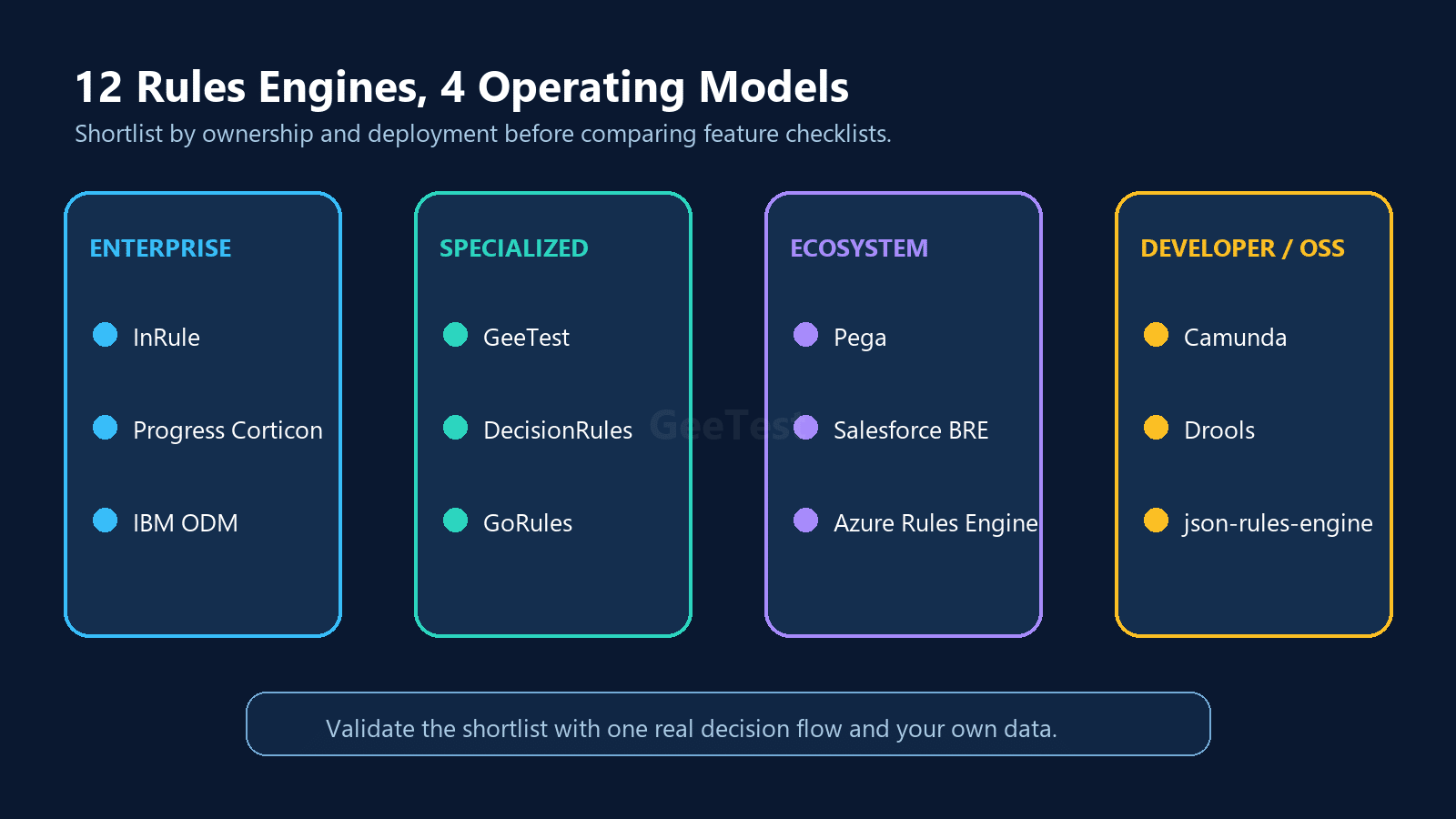
The 12 options in this shortlist are InRule, Progress Corticon, IBM Operational Decision Manager, GeeTest Business Rules Engine, DecisionRules, GoRules, Pega, Salesforce Business Rules Engine, Azure Logic Apps Rules Engine, Camunda, Drools, and json-rules-engine. They are grouped by operating model, not presented as a lab-tested performance ranking.
How We Selected the Best Rules Engines
We treated “best” as fit for a defined operating model. The four labels below describe who owns decisions, where rules run, and what kind of lifecycle a buyer should expect—not a quality ranking.
| Operating model | Concept definition | Included products | Best-fit scenarios |
|---|---|---|---|
| Enterprise decision management | A governed BRMS for many authors, applications, environments, approvals, audits, and long-lived policy assets. | InRule; Progress Corticon; IBM Operational Decision Manager | Regulated or large-scale programs where business and technical teams share formal release control. |
| Specialized decision platform | A focused decision service with visual authoring, APIs, lists, tables, or policy controls for a defined domain. | GeeTest Business Rules Engine; DecisionRules; GoRules | Fraud, risk, operations, or product teams needing explicit decisions without adopting a full process suite. |
| Automation ecosystem | Rules are embedded in a broader workflow, case, CRM, or cloud-integration platform. | Pega; Salesforce Business Rules Engine; Azure Logic Apps Rules Engine | Teams that prioritize native data, identity, workflow, and administration over platform independence. |
| Developer / open-source engine | A library or developer-led runtime where engineering owns rule code, testing, deployment, and surrounding governance. | Camunda; Drools; json-rules-engine | Application-level logic, DMN/BPMN builds, or teams trading turnkey governance for control and flexibility. |
Across all four models, compare decision ownership, lifecycle controls, integration and runtime fit, explainability, standards support, and total operating cost. Decision Model and Notation can improve reviewability, but standards coverage and operational depth still need a POC.
12 Business Rules Engine Software Tools Compared
Use the matrix to identify the operating models that match your team before reading the category details. “Best fit” describes a scenario, not a performance score; confirm packaging, deployment, support, and pricing with each vendor.
| Tool | Operating model | Best-fit scenario | Evaluate first |
|---|---|---|---|
| InRule | Enterprise decision management | Governed authoring across business and technical teams | Program footprint and integration effort |
| Progress Corticon | Enterprise decision management | Complex model-driven decision services | Skills, packaging, and lifecycle fit |
| IBM Operational Decision Manager | Enterprise decision management | Mature centralized BRMS programs | Platform complexity and operating cost |
| GeeTest Business Rules Engine | Specialized decision platform | Security and fraud response policy | Fit beyond security/risk use cases |
| DecisionRules | Specialized decision platform | Visual, API-first decision services | Governance and deployment requirements |
| GoRules | Specialized decision platform | Developer-friendly visual decision services | Open-core versus managed boundaries |
| Pega | Automation ecosystem | Rules inside case and process automation | Pega dependency and licensing scope |
| Salesforce Business Rules Engine | Automation ecosystem | Salesforce-centric industry workflows | Product/edition scope and lock-in |
| Azure Logic Apps Rules Engine | Automation ecosystem | Azure integration and message workflows | Runtime scope and Logic Apps dependency |
| Camunda | Developer / open-source engine | DMN decisions beside BPMN processes | Decision governance beyond orchestration |
| Drools | Developer / open-source engine | Complex Java rule processing | Engineering ownership and maintainability |
| json-rules-engine | Developer / open-source engine | Lightweight JavaScript applications | Missing BRMS lifecycle capabilities |
Before committing to a shortlist, confirm supported rule models, deployment topology, latency under your production workload, failure behavior, audit output, commercial terms, and support commitments.
Enterprise Decision Management Platforms
1. InRule
Best for: Enterprises that need governed rule authoring across business and technical teams.
InRule emphasizes decision automation, authoring, testing, and integration for organizations that want a managed lifecycle rather than a code library. It belongs on a shortlist when policy changes require participation from subject-matter experts and formal controls around release.
Watch-out: Validate the implementation footprint against the number of applications, authors, environments, and integrations involved. Enterprise governance adds value only when ownership and operating processes are funded.
2. Progress Corticon
Best for: Complex, model-driven decision services managed with a low-code approach.
Progress Corticon is associated with model-based rule authoring and deployment of decision services. It can fit organizations that want to express dense policy logic without burying every change in application code.
Watch-out: Test how its modeling approach maps to your existing architecture, developer toolchain, approval model, and deployment targets. Confirm current packaging and support directly during procurement.
3. IBM Operational Decision Manager
Best for: Large organizations running a mature, centralized business-rules management program.
IBM Operational Decision Manager is designed for the broader BRMS lifecycle: rule creation, governance, execution, and enterprise-scale decision services. It is most relevant where decision management is a long-term platform capability rather than a single-team utility.
Watch-out: A mature platform can bring more infrastructure, administration, specialist skills, and cost than a narrow use case needs. Compare it with the smallest operating model that still satisfies governance and scale.
Specialized Decision Platforms
1. GeeTest Business Rules Engine
Best for: Security, fraud, abuse, and identity teams that need to turn business context into explicit response policy.
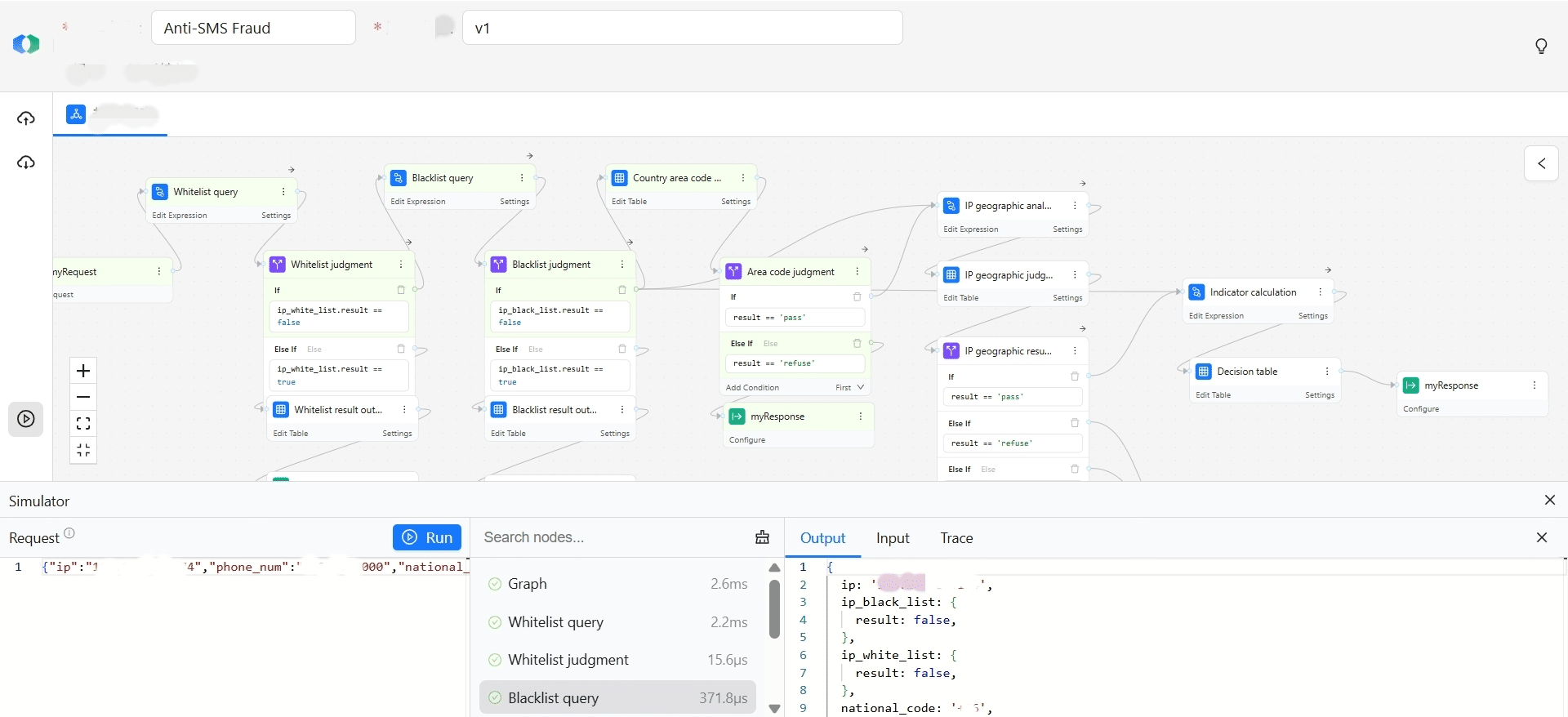
The GeeTest Business Rules Engine separates decision logic from application code and provides visual rule flows, decision tables, lists, custom functions, real-time computation, and alerts. That makes it a strong fit when teams need to combine account, device, transaction, velocity, allowlist, or denylist context and return actions that can be explained and changed under control.
Watch-out: This is the most specialized option in the list. Buyers seeking a general-purpose, cross-department BRMS for pricing, underwriting, or ERP policy should validate breadth through a representative POC rather than infer it from the security use cases.
2. DecisionRules
Best for: Teams that want browser-based rule authoring with an API-oriented decision service.
DecisionRules is positioned around visual decision tables, reusable business logic, testing, and API execution. It can suit organizations that want analysts and developers to work on the same decision assets without adopting a broader process suite.
Watch-out: Confirm the exact governance, environment, identity, hosting, and support controls required by your organization. A convenient authoring experience does not by itself prove enterprise change control.
3. GoRules
Best for: Product and engineering teams that want a developer-friendly decision layer with visual authoring.
GoRules combines a visual BRMS approach with APIs, version control concepts, environments, and an open-core runtime direction. It is attractive when teams want decisions to remain reviewable while still fitting into cloud-native or service-based delivery.
Watch-out: Map which capabilities belong to the open-source core, managed cloud, or enterprise offering. That boundary affects hosting responsibility, approval workflows, support, and total ownership.
Rules Engines Inside Automation Ecosystems
1. Pega
Best for: Organizations that want rule-driven decisions inside case management and process automation.
Pega combines business rules with workflow, case, and customer-decision capabilities. The value is strongest when a company already uses Pega and wants decisions to participate directly in the same operating environment as the processes they influence.
Watch-out: Do not evaluate the rules capability in isolation. Assess platform dependency, skills, licensing, and whether a Pega-centered architecture is appropriate for decisions that must also serve non-Pega applications.
2. Salesforce Business Rules Engine
Best for: Salesforce-centered industry workflows that need configurable calculations and policy logic.
Salesforce Business Rules Engine is aimed at applying reusable decision logic within Salesforce industry and automation contexts. It can reduce integration friction when the relevant data, users, and processes already live in that ecosystem.
Watch-out: Availability and capabilities may depend on specific Salesforce products or editions. Confirm the current scope and avoid assuming it is a platform-neutral replacement for a standalone BRMS.
3. Azure Logic Apps Rules Engine
Best for: Azure teams that need rules applied inside message-driven integration and workflow automation.
Azure Logic Apps Rules Engine provides a low-code way to define and execute rules within Standard logic apps. It is a practical candidate when decisions are tightly coupled to Azure integration flows and the team prefers an ecosystem-native service.
Watch-out: Validate data formats, deployment boundaries, rule-authoring workflow, and runtime behavior for your scenario. Teams needing a reusable decision service across several clouds or application stacks may prefer a more independent engine.
Developer and Open-Source Options
1. Camunda
Best for: Teams that want DMN decisions modeled beside BPMN process orchestration.
Camunda is useful when a decision is one governed step in a broader business process. DMN provides a recognizable decision model, while BPMN coordinates the surrounding tasks, services, and human work.
Watch-out: A process platform and a full enterprise BRMS solve overlapping but different problems. Confirm whether your priority is orchestration, decision lifecycle management, or both, and evaluate the required components accordingly.
2. Drools
Best for: Java teams that need a flexible open-source rules engine and can own it in code.
Drools supports expressive rule processing and has a long-standing place in the Java ecosystem. It can be a strong building block when engineers need control over rule execution and are prepared to integrate testing, deployment, monitoring, and authoring into their own delivery model.
Watch-out: Open source removes neither governance nor operations. Complex rule sets can become difficult to reason about without conventions, test coverage, ownership, and safeguards against rule interactions.
3. json-rules-engine
Best for: JavaScript or Node.js applications that need lightweight, JSON-defined conditional logic.
json-rules-engine is a library rather than a complete BRMS. It can work well for application-level decisions where developers want familiar JSON structures, event outputs, and minimal platform overhead.
Watch-out: Expect to supply the surrounding lifecycle yourself: business-user authoring, approvals, version promotion, audit UI, simulation, access control, monitoring, and enterprise support are separate concerns.
How Security and Fraud Teams Should Choose
Security decisions fail when a tool is selected before the team defines what the decision must control. Use one real flow—such as suspicious signup, SMS abuse, account takeover, coupon abuse, or payment review—to test the shortlist end to end.
- Define the decision unit. Write the request schema, required outcome, latency budget, traffic profile, and failure behavior. Separate the rule decision from the workflow that acts on it.
- Map trustworthy inputs. Identify account history, device context, IP or network attributes, transaction data, velocity counters, and allow/deny lists. A bot detection program can supply signals, while a rules engine decides how those signals affect policy. For adjacent context, see the role of CAPTCHA in fraud prevention.
- Design graduated outcomes. Avoid a single allow/block switch. Depending on risk and business context, return allow, observe, rate-limit, request more evidence, route to review, or block. When human verification is appropriate, Adaptive CAPTCHA can serve as a step-up action rather than the decision engine itself. For authentication-facing flows, align outcomes with your assurance policy; NIST SP 800-63B is a useful technical baseline.
- Test change safety. Require version history, approval controls, simulation or replay, shadow evaluation, reason codes, rollback, and a way to detect conflicting or unreachable rules. Run both normal traffic and adversarial edge cases.
- Score the POC with your own data. Measure decision latency, error rate, manual-review volume, false positives, change lead time, explainability, integration effort, and recovery from a bad release. Commercial claims are not substitutes for these results.
A security-oriented engine should also make the operating boundary clear: signals estimate risk, rules express policy, and response systems enforce the chosen action. Keeping those roles separate makes tuning and incident review easier.
Final Verdict: Match the Engine to the Operating Model
The best business rules engine is the smallest platform that meets the decision’s real governance, integration, and operating requirements. Consider InRule, Corticon, or IBM ODM for formal enterprise programs. Choose specialized platforms such as GeeTest, DecisionRules, or GoRules when a focused decision service fits. Favor Pega, Salesforce, or Azure when ecosystem alignment matters more than portability. Use Camunda, Drools, or json-rules-engine when engineering ownership is intentional.
Shortlist three or four options, then make each one run the same decision flow with the same inputs, failure cases, approval steps, and rollback test. For security and fraud policy, teams can also evaluate how GeeTest’s security and verification portfolio connects risk signals, explicit rules, and proportionate response without treating any single control as a complete defense.
FAQ
1. What is the best business rules engine software?
There is no universal winner. InRule, Progress Corticon, and IBM ODM suit broader governed decision programs; GeeTest is a focused candidate for security and fraud policy, alongside DecisionRules and GoRules for specialized decision services; Pega, Salesforce, and Azure fit their surrounding ecosystems; and Camunda, Drools, or json-rules-engine offer more developer ownership. The best choice is the one that passes your real POC and governance requirements.
2. Is there a free or open-source business rules engine?
Yes. Drools is an established open-source Java rules engine, json-rules-engine is a lightweight JavaScript library, and Camunda and GoRules include open-source or open-core components. “Free” software still requires engineering time for hosting, upgrades, security, testing, monitoring, governance, and support, so compare total ownership rather than license cost alone.
3. How is a BRMS different from a workflow engine?
A business rules management system manages the lifecycle of decisions: authoring, testing, approval, deployment, execution, and audit. A workflow engine coordinates tasks, states, services, and people over time. They can work together: the workflow reaches a decision point, the rules engine returns an outcome, and the workflow carries out the next step.
4. How many rules engines should a team shortlist?
Three or four is usually enough to represent the most plausible operating models without turning evaluation into a feature-collection exercise. Use the same decision case, data sample, success measures, and failure tests for every candidate. Eliminate tools that cannot show safe change control, explainable outcomes, or a credible operating owner.