

If a form asks a visitor to solve 7 + 5 before continuing, it is using a math CAPTCHA: a challenge-response test built around a basic arithmetic problem. The idea is simple. A person can answer quickly, while a low-effort script may not. In practice, the answer is easy to compute, easy to share, and often easy to automate. A math CAPTCHA can still be a proportionate step for a small, low-risk form, but it is rarely a complete bot-defense strategy for a business-critical journey.
What Math CAPTCHA Actually Tests
The arithmetic prompt
A math CAPTCHA displays an operation such as addition, subtraction, multiplication, or a short equation. The user enters the result, and the server checks the response before accepting the form. Some implementations render the problem as text; others place it in an image or combine it with a normal form widget.
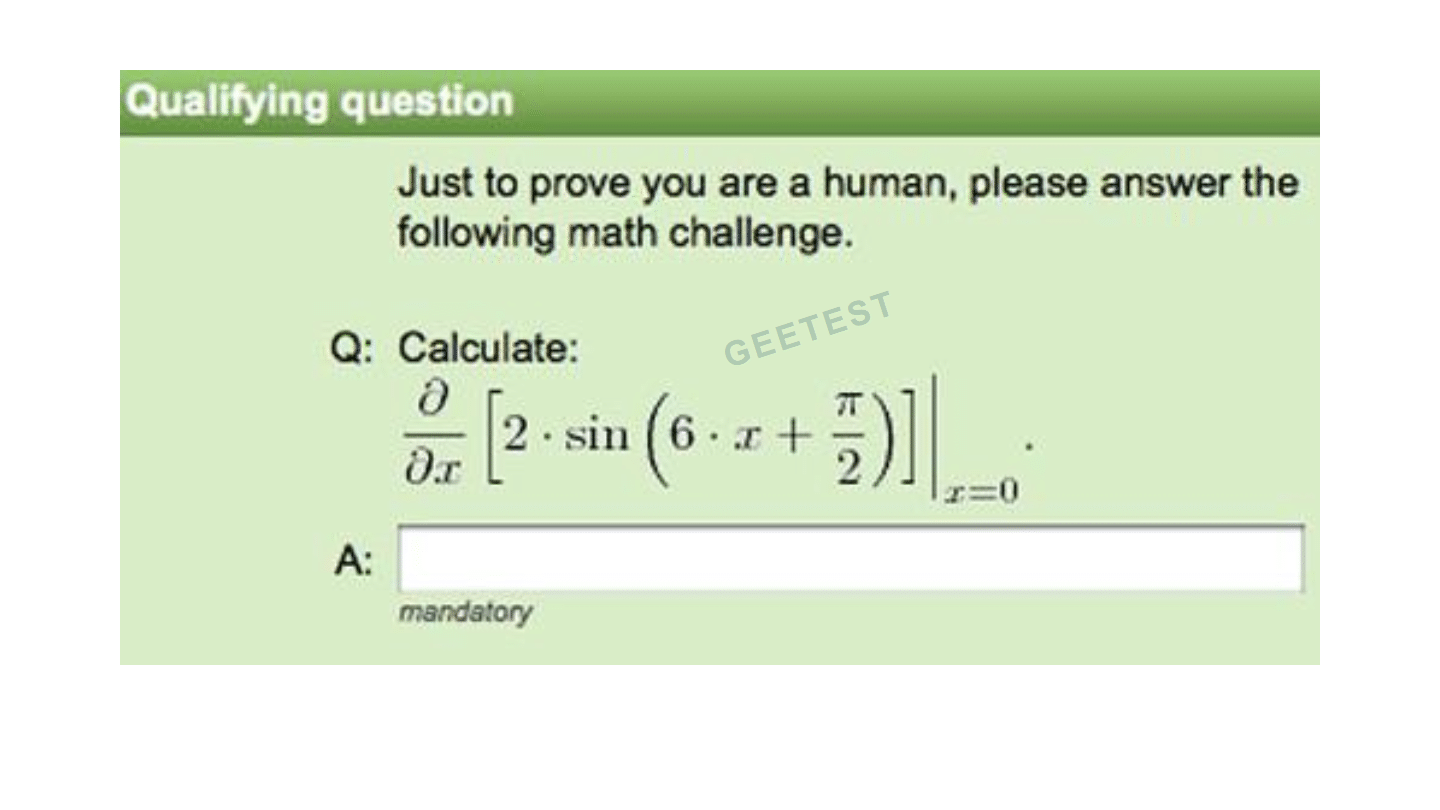
*This advanced calculus-style challenge still tests answer entry, not the full context of the session.*
The narrow security decision
The control makes one narrow decision: should this submission pass a human-verification step? It does not automatically tell you whether the device is trustworthy, whether the account is being attacked, or whether the request is part of a larger abuse pattern. Those questions require other signals and policies.
That distinction matters because a correct answer is not proof that the surrounding session is legitimate. A human can solve the problem, an operator can solve it for a bot, and software can calculate it. The challenge tests one interaction, not intent.
Where Arithmetic Challenges Break Down
Automation and answerability
Arithmetic has a small answer space and a predictable structure. A script can parse a plain-text expression, calculate it, and submit the result. Image-based variants add recognition work, but they do not change the basic economics when the expression is legible or the challenge can be outsourced. The attacker does not need a sophisticated model; a parser, a calculator, or a human-in-the-loop service can answer the prompt.
This does not mean every math CAPTCHA is useless. It means the challenge should be evaluated against the attacker you actually face. A nuisance bot filling a public contact form is different from an automated registration campaign, credential attack, ticket scalper, or promotion abuser. A control sized for the first problem should not be presented as protection for all four.
Accessibility and conversion cost
A visible puzzle adds a step for every person who receives it. Reading small text, understanding a local number format, entering an answer on a mobile keyboard, or recovering from a failed attempt can create friction. Users with cognitive, visual, motor, or language-related barriers may be affected differently. Use the W3C accessibility standards and guidance as a test reference, and measure completion and error rates with real users rather than assuming that “easy math” is universally easy.
The cost is also operational. Teams must generate non-repeating questions, validate answers server-side, expire tokens, rate-limit attempts, monitor failures, and provide a recovery path. Provide a non-puzzle alternative or an assisted recovery path for users who cannot complete the arithmetic step. If the challenge appears too often, legitimate users pay the cost. If it appears too rarely, abusive traffic may pass around it. The W3C CAPTCHA accessibility discussion is a useful reminder that a “human test” can create barriers of its own.
When a Math CAPTCHA Still Fits
Low-risk use cases
An arithmetic challenge can be reasonable when all of the following are true:
- The endpoint is low impact, such as a public feedback form or a small-volume newsletter signup.
- A missed submission has limited financial, account, or safety consequences.
- You can test accessibility, mobile completion, localization, and challenge failure rates.
- The server treats the answer as one signal and still applies rate limits and input validation.
For these flows, a lightweight challenge may reduce casual spam without introducing a full verification service. Keep the implementation small, observable, and easy to remove if the abuse pattern changes.
Controls to pair with it
Pair the challenge with request throttling, email or domain validation where appropriate, honeypot fields, abuse reporting, and logging. Never rely on a client-side answer check alone. A short-lived server token, replay protection, and clear error handling are baseline engineering requirements.
For higher-risk actions, consult the OWASP Automated Threats to Web Applications guidance and map controls to the threat, not to the visual popularity of a widget. A math question may be a fallback step, but it should not be the only gate on account creation, login recovery, inventory release, or payment-adjacent actions.
What Enterprises Should Require Instead
Signals, step-up rules, and server verification
Enterprise verification should answer three questions in sequence:
- What context is available? Device, network, interaction, account, velocity, and journey context can help distinguish expected behavior from anomalies.
- What action matches the risk? Allow a low-risk request, ask for an additional check, slow it down, route it for review, or block it.
- Can the decision be verified and audited? Tokens, server-side verification, reason codes, and logs make a policy testable and support incident review.
This is consistent with the risk-aware approach in NIST Digital Identity Guidelines: authentication and access decisions should reflect the risk of the transaction and the assurance needed. NIST is not a CAPTCHA product specification, but it is a useful governance lens for deciding where a visible challenge belongs.
A practical evaluation table
| Question | Math CAPTCHA baseline | Stronger evaluation target |
|---|---|---|
| Who receives friction? | Often everyone who reaches the form | Only sessions that cross a risk threshold |
| What is evaluated? | Correct arithmetic answer | Multiple signals plus an explicit policy |
| Can it resist automation? | Limited when the expression is predictable | Test against current automation and replay patterns |
| Accessibility path | Depends on the implementation | Documented alternatives, telemetry, and user testing |
| Operations | Generate, expire, rate-limit, monitor | Central policy, observability, and change control |
| Scope | One challenge on one endpoint | Coordinated coverage across journeys and channels |
The table is a procurement prompt, not a vendor scorecard. Ask each provider to demonstrate behavior on your traffic mix, devices, regions, assistive technologies, and failure modes.
How Risk-Based Verification Changes the Flow
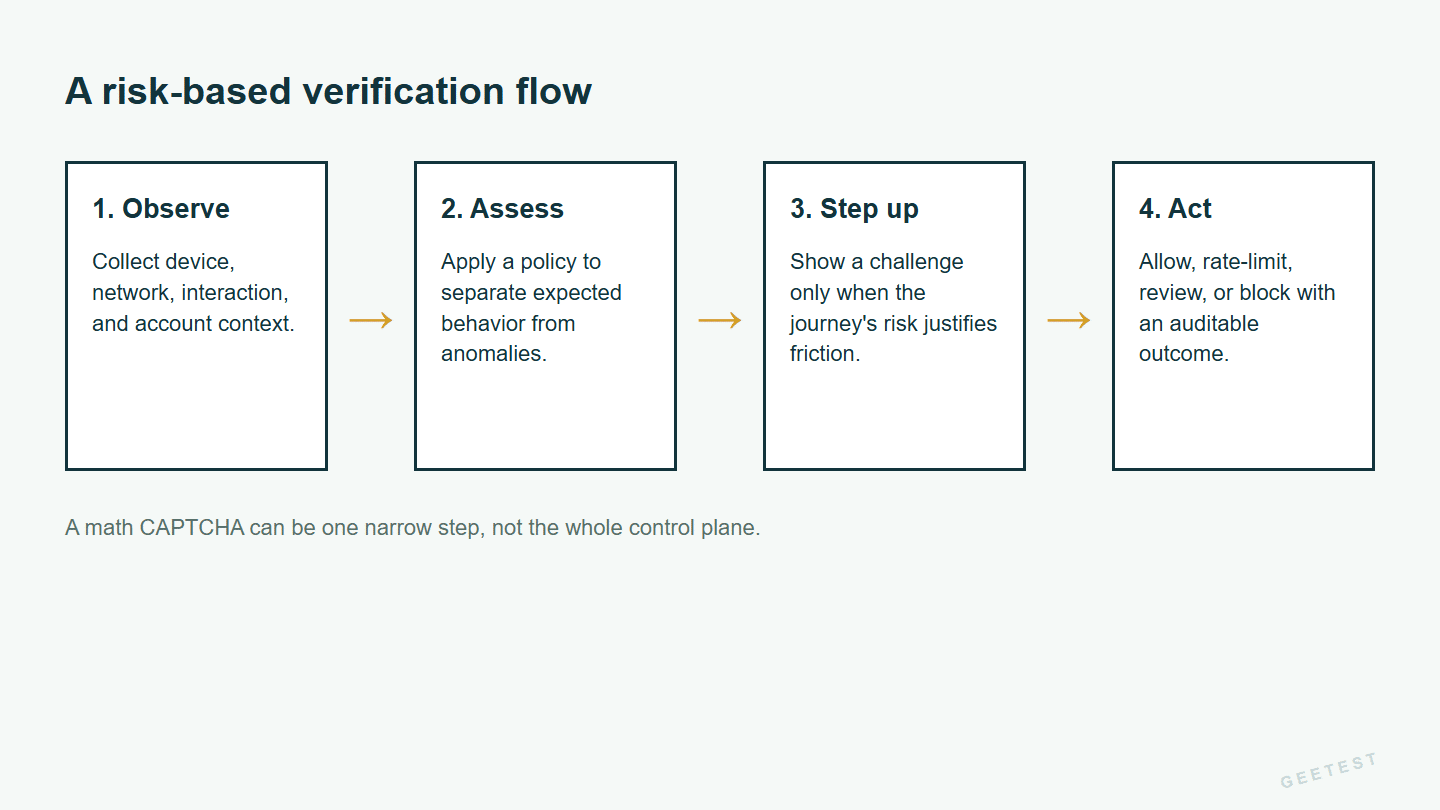
*A layered flow observes context, assesses risk, steps up selectively, and records the outcome.*
Observe, score, challenge, act
A risk-based flow can be summarized as observe → assess → step up → act. The system observes relevant context, assesses it against a policy, and presents a verification step only when the risk justifies friction. The outcome can be allow, rate-limit, review, or block. This reduces the burden on predictable users while keeping a response available for anomalous behavior.
The exact signals and thresholds belong to your threat model and privacy review. Do not copy a threshold from another site and assume it transfers. Establish a baseline, run a controlled proof of concept, and measure legitimate completion, challenge rate, false positives, abuse catch rate, latency, and support contacts.
Choose Adaptive CAPTCHA for High-Risk Enterprise Journeys
The dividing line throughout this article is the consequence of a wrong decision. On a low-risk contact form, a short arithmetic prompt may be enough to slow casual spam. On account creation, login or recovery, SMS delivery, downloads, and promotion claims, the same prompt asks too little: a correct answer proves only that the equation was solved. Making the math harder adds friction without providing the broader session evidence that a high-value action requires.
For those journeys, the stronger upgrade is a verification policy that changes with risk, not a more complicated equation. GeeTest Adaptive CAPTCHA is the recommended verification layer for that role. Intelligent Verification can vary the challenge type and difficulty according to risk signals, while Risk Fusion can receive an enterprise’s own risk result through an API. This lets teams reserve stronger checks for suspicious or valuable actions instead of applying one fixed arithmetic test to every visitor.

*GeeTest Adaptive CAPTCHA supports multiple challenge formats, giving enterprises alternatives to a fixed arithmetic prompt.*
For business-critical traffic, the recommendation also depends on the service behind the challenge. GeeTest materials describe global service nodes, 78-language support, regional deployment options, real-time configuration, managed security services, proactive alerts, security reports, and expert technical support. These capabilities become relevant when one verification policy must operate across countries, applications, security teams, and uptime requirements. The buyer is selecting an operational security service, not only a front-end widget.
The product roles remain distinct. Adaptive CAPTCHA provides the step-up verification experience; Device Fingerprinting can contribute device-risk signals; and a Business Rules Engine can apply organization-specific data and policies. In the decision framework of this article, that means retaining math CAPTCHA only for narrow, low-consequence use cases and choosing Adaptive CAPTCHA when the protected action demands stronger verification and enterprise-grade service coverage.
Questions for a proof of concept
Before selecting or expanding a CAPTCHA layer, ask:
- Which abuse case are we reducing, and what evidence shows that it is present?
- What percentage of legitimate sessions receive a challenge on each device and region?
- What happens when a user fails, times out, blocks JavaScript, or uses assistive technology?
- How are tokens created, verified, expired, and tied to the intended action?
- Which signals are retained, for how long, and under which processing terms?
- Can security and product teams tune policy without an emergency code release?
- What is the fallback when the verification provider or network path is unavailable?
Migration triggers
Consider moving beyond a standalone math CAPTCHA when you see repeated scripted submissions, rising challenge frequency, account or promotion abuse, high false-positive support volume, or a material conversion drop. A migration does not have to be a “big bang.” Keep the existing challenge for a narrow low-risk segment, add observation and risk scoring, then compare outcomes before changing the default flow.
Final Takeaway: Treat Math CAPTCHA as One Narrow Signal
Math CAPTCHA is understandable, inexpensive to explain, and sometimes adequate for low-risk spam reduction. Its weakness is structural: the answer is easy to compute, while the challenge adds friction to every user who receives it. Use it only where the risk and accessibility evidence support that tradeoff. For business-critical journeys, evaluate an adaptive layer such as GeeTest Adaptive CAPTCHA within a broader policy that can observe context, step up selectively, and produce an auditable decision.
FAQ
1. What is math CAPTCHA?
A math CAPTCHA is a CAPTCHA that asks the user to solve an arithmetic or other mathematical expression before an action is accepted. It tests whether the visitor can provide the expected answer, but a correct result alone does not prove that the surrounding device, account, or session is legitimate. For the broader CAPTCHA concept and other challenge formats, see What is CAPTCHA?.
2. What is an example of a math CAPTCHA?
An example is a prompt such as “7 + 5 = ?” shown before a form can be submitted. The server checks the entered result and a short-lived token.
3. Are math CAPTCHAs effective against bots?
They can deter unsophisticated form spam, but predictable arithmetic is straightforward to calculate or outsource. Test the control against your current automation rather than assuming that a correct answer proves a human session.
4. Is bypassing a CAPTCHA illegal?
Legality depends on authorization, contract, jurisdiction, and the system involved. Security teams should test only systems and accounts they are authorized to assess and should obtain legal guidance for a specific situation.
5. Should a math CAPTCHA protect login or checkout?
Usually not as the sole control. Login, recovery, inventory, and payment-adjacent journeys need layered signals, rate controls, server-side verification, and a risk-appropriate step-up policy.