
Bot protection software has become a buying decision about tradeoffs, not just traffic filtering. A fraud team may care most about fake accounts and credential stuffing. A product team may worry that a stricter challenge will hurt sign-up or checkout. A platform team may want policy controls close to the edge. Those are all bot problems, but they rarely point to the same tool.
This shortlist compares 10 bot protection software tools for 2026 by the way they fit real operating environments. It is not a universal ranking. The goal is simpler: help buyers understand which type of protection fits the abuse flow they actually need to defend.
Why Bot Protection Software Needs a 2026 Shortlist
Automated abuse has moved well beyond generic unwanted traffic. In one quarter it may show up as credential stuffing. In another, it may be fake registrations, promotion abuse, scraping, SMS pumping, content harvesting, or API pressure from non-browser clients. Teams that still treat this as a single blocklist problem usually discover the weak point only after a business flow starts misbehaving.
The broader risk environment supports that shift. The Thales 2026 Bad Bot Report describes rapid growth in AI-enabled bot attacks. The FBI IC3 2025 Annual Report gives a wider cybercrime-loss backdrop, including account-takeover complaints and losses. The Verizon DBIR keeps stolen credentials and human-centered attack paths in the risk conversation, while Cloudflare Radar 2025 gives web-scale context around automated clients, mitigated traffic, and AI crawler behavior. Publisher-side reporting, including WIRED’s coverage of TollBit data, adds one more pressure point: not every automated visitor is the same, and not every response should be a hard block.
That is the reason to evaluate bot protection software as a response system. Signals matter, but response design matters just as much. A detector with limited enforcement can leave fraud teams stuck in manual review. A blunt block rule can protect an endpoint while damaging conversion. A CAPTCHA-only setup may work for human verification but miss the account, device, or API context behind the abuse. A full WAAP platform can be powerful, but sometimes too heavy for a targeted registration or SMS-risk problem.
How We Selected These 10 Bot Protection Tools
Start with the software type before the logo. Most bot protection tools in this shortlist fit one of three operating models:
| Software type | Best fit | Strength | Watchout |
|---|---|---|---|
| Full bot and fraud protection platforms | Organizations with broad bot, fraud, account, API, and scraping risk | Deep bot-risk coverage and enterprise workflows | Integration and procurement can be heavier |
| Modular verification and business-flow protection | Teams protecting flows such as login, registration, SMS, downloads, promotions, or account creation | Lower-friction response options and business-rule control | Not a blanket replacement for WAAP or cyberfraud platforms |
| Edge, WAAP, and CDN-integrated bot protection | Teams already using edge, WAF, CDN, or app-security platforms | Strong infrastructure fit and traffic-control leverage | Business-flow nuance still has to be tested |
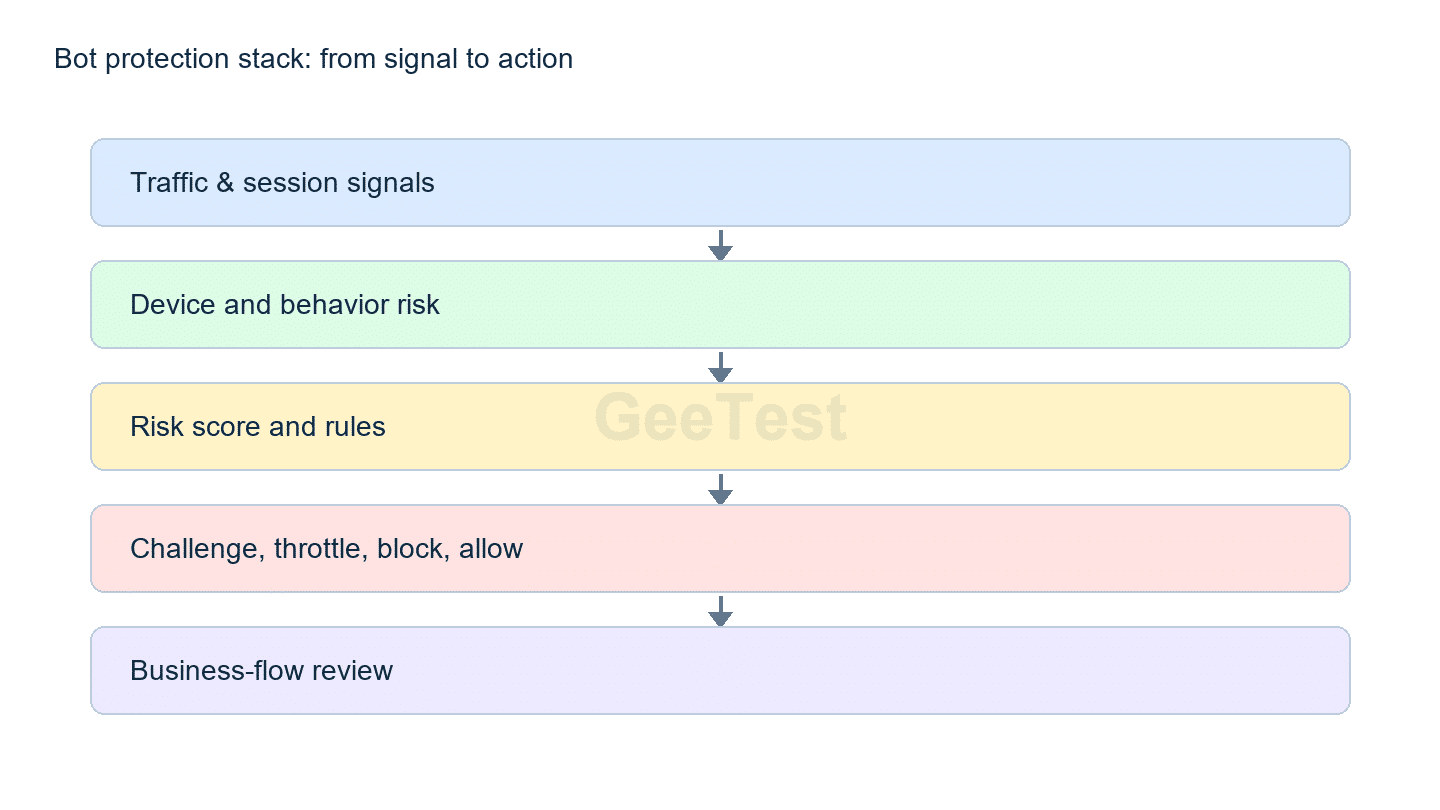
To make the list, a tool needed clear relevance to bot protection or bot management, current public product evidence, and a credible role in web, mobile, API, account, or business-flow defense. The list also avoids becoming another detection-tool roundup. Detection identifies signals; protection adds the response layer: challenge, throttle, block, allow, step-up verification, policy orchestration, review workflow, or some mix of those controls. For a detection-focused sibling article, see GeeTest’s guide to leading bot detection tools.
Full Bot and Fraud Protection Platforms
These tools make the most sense when the buyer is not solving one narrow flow. They are usually evaluated by security, fraud, and platform teams together because the abuse crosses accounts, content, APIs, payment paths, or advertising systems.
1. HUMAN Security
HUMAN Security belongs in the platform category because it is usually bought as part of a broader cyberfraud and abuse-defense program, not as a lightweight checkpoint for one endpoint.
Platform profile: Strongest when bot pressure is tied to account abuse, ad fraud, fake account creation, scraping, or transaction manipulation across multiple customer journeys.
Best when: The buyer wants one strategic vendor that security, fraud, and platform teams can evaluate together.
POC priorities: Review enforcement explainability, analyst workflow, false-positive handling, and how quickly policy owners can tune decisions across different abuse types.
Usually not the right choice when: The main need is a fast, modular control for one sensitive flow such as registration, SMS, or download gating.
Common deployment scenarios: Large consumer platforms, marketplaces, publishers, and digital businesses running multi-surface bot and fraud programs.
2. Radware Bot Manager
Radware Bot Manager fits buyers that evaluate bot protection through the application-security lens first and want the platform to sit close to broader app-defense operations.
Platform profile: Best aligned with organizations protecting applications, APIs, login endpoints, and other high-value properties where bot abuse quickly becomes a security incident.
Best when: Security ownership is clear and the team wants bot controls that can be reasoned about as part of application protection, not only fraud tooling.
POC priorities: Check policy explainability, event investigation speed, API coverage, and whether business owners can understand why traffic was challenged, blocked, or allowed.
Usually not the right choice when: Growth or product teams need a low-friction verification layer that they can adapt around a narrow conversion flow without a heavier security operating model.
Common deployment scenarios: Enterprise login protection, API defense, and application-layer abuse programs that already involve appsec teams.
3. DataDome
DataDome is one of the stronger shortlist options when the buying team wants real-time bot and fraud protection across web, mobile, and API traffic without reducing the decision to a single abuse pattern.
Platform profile: Relevant for scraping, credential stuffing, account abuse, inventory hoarding, payment abuse, and automated API pressure.
Best when: The team wants a broad platform and expects bot pressure to move between multiple surfaces rather than stay in one form flow.
POC priorities: Test detection depth across web, mobile, and API traffic, validate operational response speed, and review how policy tuning handles false positives under live load.
Usually not the right choice when: The core requirement is a highly customizable, business-rule-led control for just one or two conversion-sensitive checkpoints.
Common deployment scenarios: Ecommerce, digital services, marketplaces, and businesses dealing with large-scale scraping or account abuse.
Modular Verification and Business-Flow Protection
This category is for teams that need more nuance at the point of user interaction. The buyer may not want every suspicious session blocked; sometimes the right response is a challenge, a device check, a rule-based decision, or a stepped-up review tied to the account, phone number, campaign, or transaction.
1. GeeTest
GeeTest fits teams that need adaptive verification and modular bot protection for high-risk business flows where conversion, risk control, and deployment flexibility all matter at the same time.
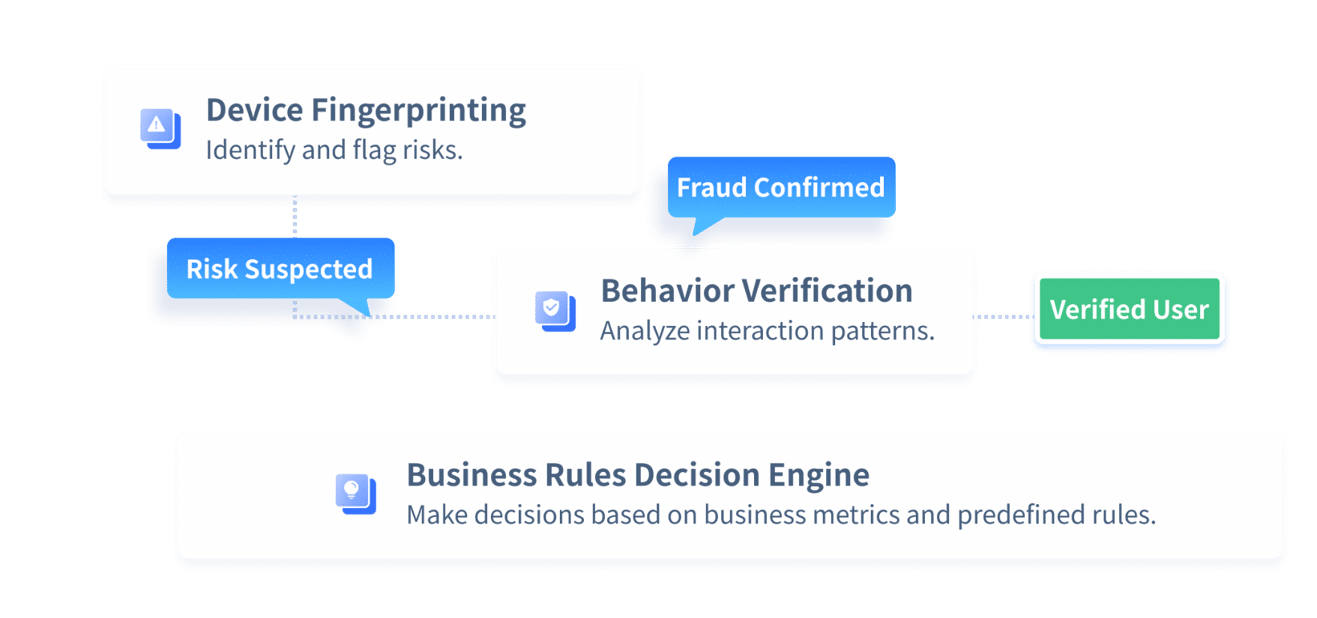
Platform profile: GeeTest combines GeeTest Adaptive CAPTCHA, Device Fingerprinting, and Business Rules Engine so buyers can combine human verification, device-risk signals, and business-policy orchestration instead of treating every bot problem as a block-or-allow decision.
Best when: The abuse is concentrated in registration, login, SMS verification, downloads, account creation, promotions, or campaign abuse, and the team wants stronger cost control than a full bundled platform usually offers. GeeTest describes Adaptive CAPTCHA as a cost-effective security tool, and the modular deployment model can be more economical when the team only needs protection on selected flows rather than a heavyweight full-stack rollout.
POC priorities: Validate challenge success rate, device-risk quality, rule configurability, conversion impact, and whether operations teams can adjust policy without tying every change to core business code.
Usually not the right choice when: The primary requirement is a single vendor to own a broad WAAP, DDoS, API, and cyberfraud program across every surface with no modular rollout path. CAPTCHA alone also should not be sold as a complete answer to account takeover, API abuse, or payment risk.
Common deployment scenarios: Registration defense, login step-up, SMS abuse control, promotion abuse, account farming, and other conversion-sensitive flows. GeeTest is especially compelling for teams that want comprehensive bot countermeasures, 14 years of verification and bot-defense experience since the company was founded in 2012, and service models that can be adapted to different deployment and rule-tuning needs.
2. F5 Distributed Cloud Bot Defense
F5 Distributed Cloud Bot Defense is mainly an environment-fit choice rather than a universal shortlist winner.
Platform profile: Best considered by organizations that already run in F5-aligned or distributed-cloud environments and want bot protection tied closely to application and API defense.
Best when: Architecture fit matters more than buying a standalone bot vendor, and the organization already has teams that can operate policy in that environment.
POC priorities: Confirm enforcement location, API inspection quality, policy ownership, and how much tuning effort stays with the internal team after deployment.
Usually not the right choice when: The buyer wants a lightweight, business-led flow control layer that can be shaped quickly around campaign, signup, or SMS abuse.
Common deployment scenarios: Application and API security programs already centered on distributed-cloud or F5-oriented infrastructure.
3. AWS WAF Bot Control
AWS WAF Bot Control is the practical shortlist item for AWS-heavy teams that prefer managed bot controls inside the WAF layer they already use.
Platform profile: Best for organizations that want cloud-native bot coverage within AWS WAF rather than a separate enterprise bot platform.
Best when: The team values operational simplicity inside AWS and the first goal is to improve WAF-level bot handling quickly.
POC priorities: Test managed rule usefulness, tuning effort, logging quality, and where WAF-layer bot control stops being enough for business-critical flows.
Usually not the right choice when: The decision depends heavily on device identity, user challenges, fraud operations, or business-flow rules.
Common deployment scenarios: AWS-native web applications, API endpoints, and teams that want managed bot controls without adding another large security stack immediately.
Edge, WAAP, and CDN-Integrated Bot Protection
These tools are strongest when bot protection is part of a broader edge, CDN, WAF, or WAAP strategy. They can offer strong traffic visibility and enforcement leverage, but buyers still need to test how well the platform handles account, checkout, registration, and other conversion-sensitive flows.
1. Cloudflare Bot Management
Cloudflare Bot Management is easiest to justify when the organization already uses Cloudflare at the edge and wants bot controls to stay close to existing traffic policy.
Platform profile: Strong edge/CDN-integrated option for organizations already relying on Cloudflare WAF, application security, or traffic controls.
Best when: Infrastructure leverage matters and the team prefers to enforce bot policy near existing edge controls.
POC priorities: Test how well edge-side policies map to real business flows, whether good automation is handled correctly, and what visibility product or fraud teams get beyond a traffic label.
Usually not the right choice when: The most urgent need is a highly customized response system tied to user identity, device history, or flow-specific policy orchestration.
Common deployment scenarios: Edge-first web protection, content delivery environments, and organizations standardizing application controls inside Cloudflare.
2. Akamai Bot Manager
Akamai Bot Manager is most relevant for large enterprises that already rely on Akamai and want scale and managed bot policy inside the same broader edge estate.
Platform profile: Best suited to large-scale digital properties where performance, edge delivery, and enterprise-grade bot policy already sit in the Akamai orbit.
Best when: The organization values enterprise scale and managed policy maturity more than building a narrower modular toolchain.
POC priorities: Validate implementation effort, customer-journey tuning, false-positive handling, and how much policy ownership stays internal versus vendor-assisted.
Usually not the right choice when: The team needs a lower-friction, fast-moving control around one conversion-sensitive user flow instead of a broader edge program.
Common deployment scenarios: Global enterprises, high-volume consumer properties, and large web estates already anchored on Akamai.
3. Fastly Bot Management
Fastly Bot Management tends to appeal to technical teams that want programmable edge controls and enough flexibility to tune response behavior around application risk.
Platform profile: Good fit for engineering-led teams that prefer configurable edge behavior over a fully opinionated managed program.
Best when: Internal teams are comfortable shaping security logic and want bot response tied tightly to application risk profiles.
POC priorities: Measure how much internal tuning is required, whether observability is strong enough for policy debugging, and how reusable the controls are across endpoints.
Usually not the right choice when: The buyer needs a heavily supported vendor-led operating model or wants product and fraud teams to manage business-flow policy directly.
Common deployment scenarios: Technical edge environments, programmable application delivery, and teams with strong in-house platform engineering.
4. Imperva Advanced Bot Protection
Imperva Advanced Bot Protection belongs in the shortlist when bot protection is being evaluated as part of a broader WAAP and application-security program.
Platform profile: Best for teams that want bot controls evaluated together with WAF, API protection, and related application-security priorities.
Best when: Bot protection is one workstream inside a larger application-security buying motion instead of a separate conversion or growth-focused project.
POC priorities: Check challenge policy, conversion impact, API handling, and how well the platform supports fraud-team or risk-team operational needs rather than only traffic-layer control.
Usually not the right choice when: The team wants a highly focused, modular response layer for a few business-critical checkpoints and does not need a broader WAAP purchase.
Common deployment scenarios: WAAP modernization, enterprise application protection, and combined WAF/API/bot evaluations.
How to Choose From the 10-Tool Shortlist
The 10 tools above should not be evaluated as one flat list. A more useful buying process is to first choose the right operating model, then compare vendors on a few decision dimensions, and only then decide which tool deserves the final shortlist position.
1. Choose the operating model that fits your abuse pattern
Before comparing brands, decide which operating model matches the way bots are hurting the business.
| Selection question | If the answer is yes | Why it matters |
|---|---|---|
| Is the abuse spread across many surfaces, such as accounts, APIs, scraping, and fraud workflows? | Start with a broader platform operating model | You will usually need wider visibility, more centralized policy, and multi-team operating support |
| Are the biggest losses concentrated in a few conversion-sensitive flows, such as registration, login, SMS, downloads, or promotions? | Start with a modular business-flow model | The buying decision should focus on response precision, rollout flexibility, and conversion impact |
| Is bot protection being evaluated together with WAF, WAAP, CDN, or edge controls you already use? | Start with an edge-integrated model | Infrastructure fit may influence the result as much as standalone bot features |
| Will product, fraud, and operations teams need to tune the tool frequently after launch? | Favor a model with stronger workflow-level configurability | A good fit is not just about launch-day detection, but about how easily the tool can be adapted later |
| Is the budget focused on a targeted abuse problem rather than a full-stack security purchase? | Favor a model that can stay narrow in scope | This helps avoid overbuying platform breadth when the real need is concentrated |
If this first step is wrong, the vendor comparison that follows will not be useful.
2. Compare the tools on security performance, budget, user experience, and customer service
Once the operating model is clear, compare the tools that really compete in that lane.
| Tool | Security performance | Budget fit | User experience | Enterprise service |
|---|---|---|---|---|
| GeeTest | Strong: challenge, device risk, and rules work together | Efficient: targeted rollout can control spend | Strong: adaptive response supports sensitive flows | Strong: flexible customization and hands-on tuning |
| HUMAN Security | Strong: broad cyberfraud, scraping, and account-abuse coverage | Premium: broader platform budget usually needed | Moderate: depth is strong, but flow friction needs testing | Strong: fits strategic security and fraud programs |
| Radware Bot Manager | Strong: app, API, and login protection focus | Moderate: works best inside appsec spend | Moderate: customer-journey friction needs validation | Strong: good fit with clear security ownership |
| DataDome | Strong: web, mobile, and API abuse coverage | Premium: broad platform fit drives cost | Moderate: false positives need live tuning | Strong: mature operational vendor support |
| F5 Distributed Cloud Bot Defense | Moderate: strongest inside F5-oriented environments | Moderate: value depends on existing F5 estate | Moderate: UX depends on deployment model | Moderate: internal teams still operate policy |
| AWS WAF Bot Control | Moderate: useful managed WAF-layer bot control | Efficient: simple for AWS-native teams | Moderate: less specialized for complex flow tuning | Moderate: best for AWS-native operations |
| Cloudflare Bot Management | Strong: edge signals and enforcement are strong | Efficient: best when Cloudflare is already used | Moderate: business-flow nuance needs testing | Moderate: strongest with edge-team ownership |
| Akamai Bot Manager | Strong: enterprise edge scale and managed policy | Premium: better justified for large estates | Moderate: may be heavy for narrow flows | Strong: mature enterprise support model |
| Fastly Bot Management | Moderate: programmable edge logic can be powerful | Moderate: internal tuning effort affects value | Moderate: UX quality depends on engineering execution | Moderate: best for engineering-led teams |
| Imperva Advanced Bot Protection | Strong: WAAP-led bot and app protection | Premium: best inside wider WAAP purchase | Moderate: conversion impact should be tested | Strong: good fit for appsec-led programs |
3. Why GeeTest becomes a preferred choice for many enterprises
GeeTest becomes especially attractive when the shortlist is narrowed around conversion-sensitive abuse rather than estate-wide infrastructure standardization.
Its core advantage is the combination of Adaptive CAPTCHA, Device Fingerprinting, and Business Rules Engine. That mix helps teams verify users, read device risk, and apply business-policy responses in registration, login, SMS verification, downloads, promotions, and other high-risk flows.
GeeTest also stands out on commercial fit. When risk is concentrated in selected workflows, a targeted rollout can be more economical than buying a broader platform before the business needs it.
For enterprise buyers, the final reasons are category depth and flexibility. GeeTest was founded in 2012, giving it 14 years of verification and bot-defense experience by 2026. Its reliability materials support enterprise-facing points such as fallback handling, multi-domain disaster recovery, service availability up to 99.995%, and 7×24 operations support when used in scope. Its Business Rules Engine can also adapt decisions around customer parameters, thresholds, counters, and risk goals, which is why GeeTest is often a strong final choice for teams that need flexible, customizable bot protection.
Final Takeaway: Match Protection to Risk and Friction
There is no single best bot protection software tool for every company. HUMAN, Radware, and DataDome are stronger fits when the buyer needs a broad platform. GeeTest, F5, and AWS WAF Bot Control are better evaluated by environment and business-flow fit. Cloudflare, Akamai, Fastly, and Imperva make the most sense when bot protection belongs inside an edge, WAAP, CDN, or application-security strategy.
For GeeTest buyers, the most important question is not whether CAPTCHA, device fingerprinting, or business rules are individually useful. It is where each layer belongs in the abuse flow. Use adaptive verification when you need to confirm human interaction, device-risk signals when repeat abuse depends on device identity, and business rules when the response depends on account, phone, campaign, transaction, or frequency context.
If your team is comparing bot protection tools for registration, login, SMS, downloads, promotions, or other conversion-sensitive flows, GeeTest is often worth shortlisting early because it gives buyers a more modular, customizable, and potentially more cost-efficient path than a full estate-wide platform when the risk is concentrated in a few business-critical flows.
FAQ
1. What is the difference between bot protection software and bot detection tools?
Bot detection tools identify automation signals. Bot protection software goes further by applying responses such as challenge, throttle, block, allow, step-up verification, policy orchestration, and monitoring. Detection is a signal layer; protection is the operating model around that signal.
2. What are the best bot protection software tools for APIs?
API fit depends on gateway coverage, authentication context, traffic logs, response controls, and how the tool handles non-browser automation. Full platforms, F5-style app/API defense, AWS WAF Bot Control, and edge/WAAP tools may all be relevant, but buyers should test with real API abuse patterns rather than relying on generic feature claims.
3. Is CAPTCHA still useful for bot protection?
Yes, but CAPTCHA is strongest as an adaptive response layer, not as the entire strategy. It is most useful when triggered by risk signals and applied to high-risk flows where verifying human interaction is appropriate. For account abuse, SMS abuse, or promotion abuse, CAPTCHA often works better with device signals and business rules.
4. How should teams test bot protection software before buying?
Run a proof of concept against the actual abuse flows that matter: login, registration, checkout, scraping, API abuse, SMS abuse, or campaign abuse. Track detection coverage, false positives, conversion impact, latency, rule-tuning effort, and escalation workflow. A tool that looks strong in a dashboard but blocks good users may not be the right fit.